Sunnyvale updates Vision Zero work: projects underway but commissioners call for deeper data analysis
Get AI-powered insights, summaries, and transcripts
Subscribe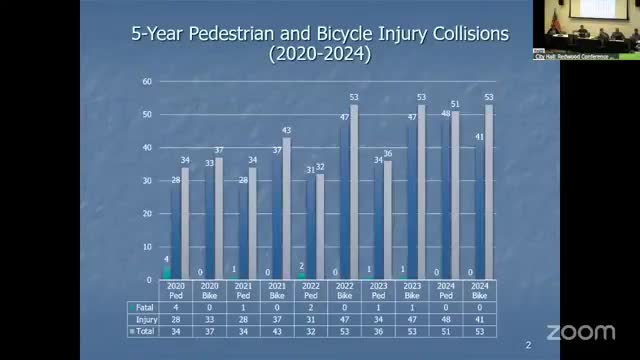
Summary
Transportation engineer Angela Zlong briefed the Bicycle & Pedestrian Advisory Commission on Vision Zero progress, listing completed quick‑builds and projects in design; commissioners urged an updated collision analysis, better exportable data and more funding for analytics and rapid implementation.
Angela Zlong, a transportation engineer with the City of Sunnyvale, presented an update on the city’s Vision Zero plan and related active‑transportation projects during the commission’s July 17 meeting.
Zlong said the city continues to implement engineering countermeasures identified in the Vision Zero plan adopted in July 2019 and listed recent completed and in‑progress projects. Completed items included Safe Routes to School improvements near Bishop Elementary, curb extensions at Maude & Matilda and other quick‑build pedestrian/bicycle safety improvements. In progress or planned items she named: Lakewood Safe Routes to School, Petersen Middle School sidewalk gaps, Peoria Park crossing upgrades, and Homestead Avenue buffered bike lanes timed to the 2026 annual slurry seal. She also flagged AB 413 daylighting requirements (painted approach zones) and an outreach campaign to promote Vision Zero goals.
Why it matters: the presentation broke down the city’s collision totals and the cumulative count of fatalities and serious injuries used to measure progress toward the plan’s goal of a 50% reduction in fatalities and serious injuries (cumulative) by 2029.
Zlong presented data showing a cumulative total of 273 fatalities and serious injuries from 2012 through 2024, with an average of about 21 per year; serious injuries average about 17 per year and fatalities roughly 4 per year. She emphasized pandemic effects — 2020 figures dropped with lower vehicle volumes — and noted the data shows an overall upward trend in aggregate collisions but that the severity trend is nuanced.
Commissioners pressed staff on whether the city is on track to meet the 2029 target. Zlong said the city is still implementing projects identified in the Vision Zero plan but that a comprehensive update — including a new collision deep‑dive and statistical analysis — would require additional funding and staff time. Several commissioners recommended an immediate data‑export capability (CSV/Excel) and map‑based collision visualizations to allow the commission and public to analyze patterns by time of day, intersection and injury severity. Commissioners discussed whether more rapid “quick‑build” implementation and reallocation of staffing or budget could accelerate progress.
Zlong described engineering measures already in use at signalized intersections — leading pedestrian intervals and advanced dilemma‑zone detection — and explained the city’s plan to implement the AB 413 daylighting rule at high‑priority crossings (about one‑half of roughly 300 identified locations have been painted so far). She also outlined planned outreach and education components, including school safety presentations and social‑media campaigns.
Several commissioners recommended the city seek consultant support or a funded study issue to update the Vision Zero plan with a new, statistically rigorous collision analysis that incorporates exposure metrics (vehicle miles travelled) and maps of high‑injury corridors. Commissioners also called for stronger coordination between Public Safety and Public Works to prioritize prevention over response when tradeoffs arise.
Ending: Staff said they will explore options to (a) provide exportable, mapped collision data; (b) accelerate select quick‑builds where feasible; and (c) seek funding options for a formal Vision Zero plan update or consultant study to evaluate progress toward the 2029 target.