Museum trustee documents 'orphan' natural-history collections at UVA, urges updated agreements
Get AI-powered insights, summaries, and transcripts
Subscribe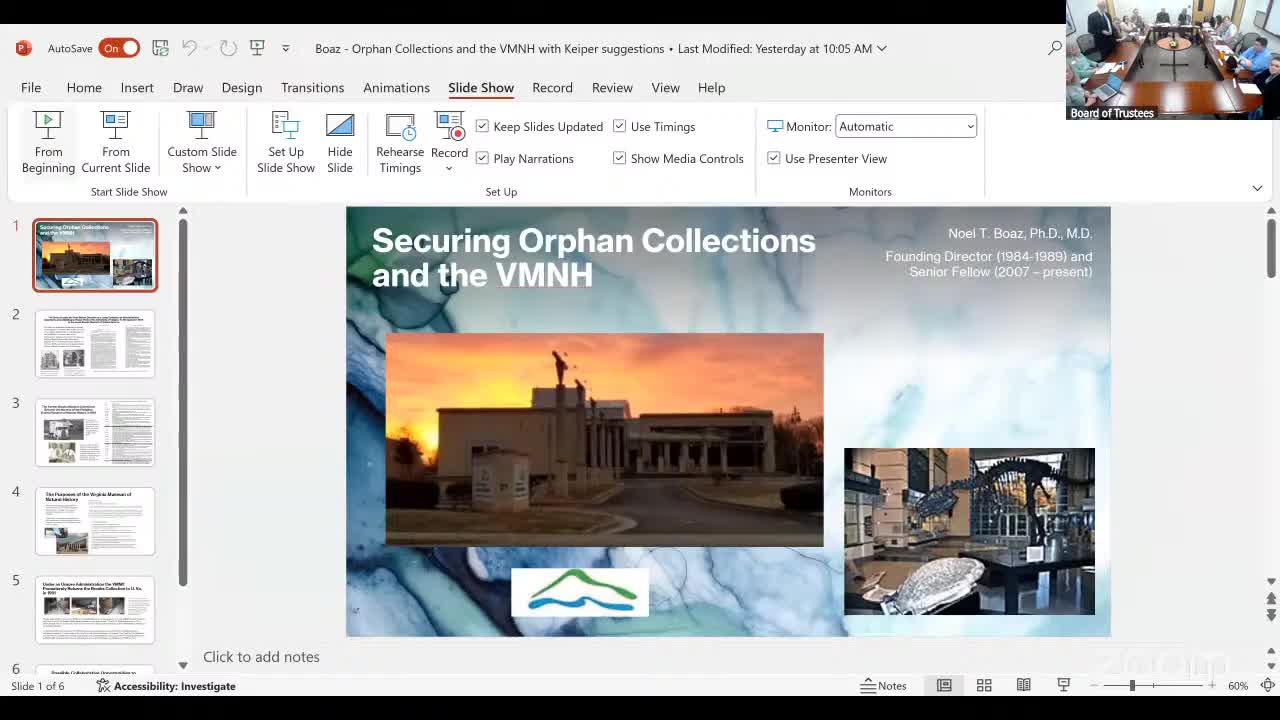
Summary
The Virginia Museum of Natural History board heard a 20‑minute presentation May 17 from former museum director Noel Boas documenting extensive historical natural‑history collections that originated in the Brooks Museum and are now dispersed across University of Virginia buildings and state agencies.
The Virginia Museum of Natural History board heard a 20‑minute presentation May 17 from former museum director Noel Boas documenting extensive historical natural‑history collections that originated in the Brooks Museum and are now dispersed across University of Virginia (UVA) buildings and state agencies. Boas told trustees the collections were accepted for the Commonwealth by a joint resolution in 1877 and that VMNH’s 1989 enabling statute charged the museum with serving as the permanent repository of Virginia’s natural heritage.
Boas said the collections include mammal and invertebrate fossils, a large rock and mineral assemblage and historically significant photo‑micrographs of Mesozoic paleo‑flora. He told the board the material is currently split among UVA locations, the Virginia Division of Geology and Mineral Resources (part of the Department of Energy), the Department of Forestry and loans to external institutions, and that some items are stored without curatorial oversight. “The fossils should not be handled by the library of UVA. They are really part of the Virginia natural heritage that should be covered by the museum,” Boas said.
The presentation traced the collections’ provenance to an 1877 joint resolution accepting a donation to the Commonwealth that later resided at UVA’s Brooks Museum. Boas described several transfers, periods of administrative turnover, and storage moves that left material dispersed and, in some cases, in poor condition. He said the Division of Geology and Mineral Resources accepted many of the rock and mineral holdings and stores them in Charlottesville, but its statutory mandate covers only Virginia material and does not solve curatorial custody for internationally sourced specimens.
Boas proposed three near‑term actions for the trustees to consider: (1) assert the museum’s custodial role over Commonwealth collections and update the memorandum of agreement that currently names UVA as custodian; (2) negotiate a memorandum of agreement with UVA’s Department of Environmental Sciences to clarify care and access for specimens on UVA property; and (3) open discussions with the Thomas Jefferson Foundation (Monticello) about long‑term loans and provenance research for items on loan there, including material linked to early Lewis and Clark and Jefferson collections.
Trustees asked whether Boas’s history of the collections had been published; Boas said the board’s staff has been working on both a 40th‑anniversary, photo‑forward volume and a longer scholarly history. Several trustees said putting the history in print could strengthen the museum’s case for capital space and conservation funding.
Boas asked the board for direction on pursuing updated agreements and on prioritizing at‑risk material for rescue or transfer. No formal motion or vote on custody or transfer was recorded during the meeting. The board’s collections and facilities committees have been meeting jointly on related matters including space planning for the Douglas Avenue facility and prioritization of collection moves.
The board packet includes a collections assessment that identifies paleontology and archaeology as out of space and recommends moving portions of those collections to Douglas Avenue when the site is ready. The trustees discussed the need to coordinate decisions about collections with the state agencies that currently store material and with external museums that hold loans.
Trustees and staff said they will follow up with more documentation and proposed next steps; Boas said he would prioritize publication of the history and continue provenance work with external museums and scholars.
Ending: The presentation left the board with a specific set of next steps to consider—updating memoranda of agreement, cataloguing priority items for transfer or conservation, and further provenance research with external partners—but no formal action was taken at the May 17 meeting.