
Senate committee approves amended bill restricting minors' accounts and limiting algorithmic features on digital platforms
Get AI-powered insights, summaries, and transcripts
Subscribe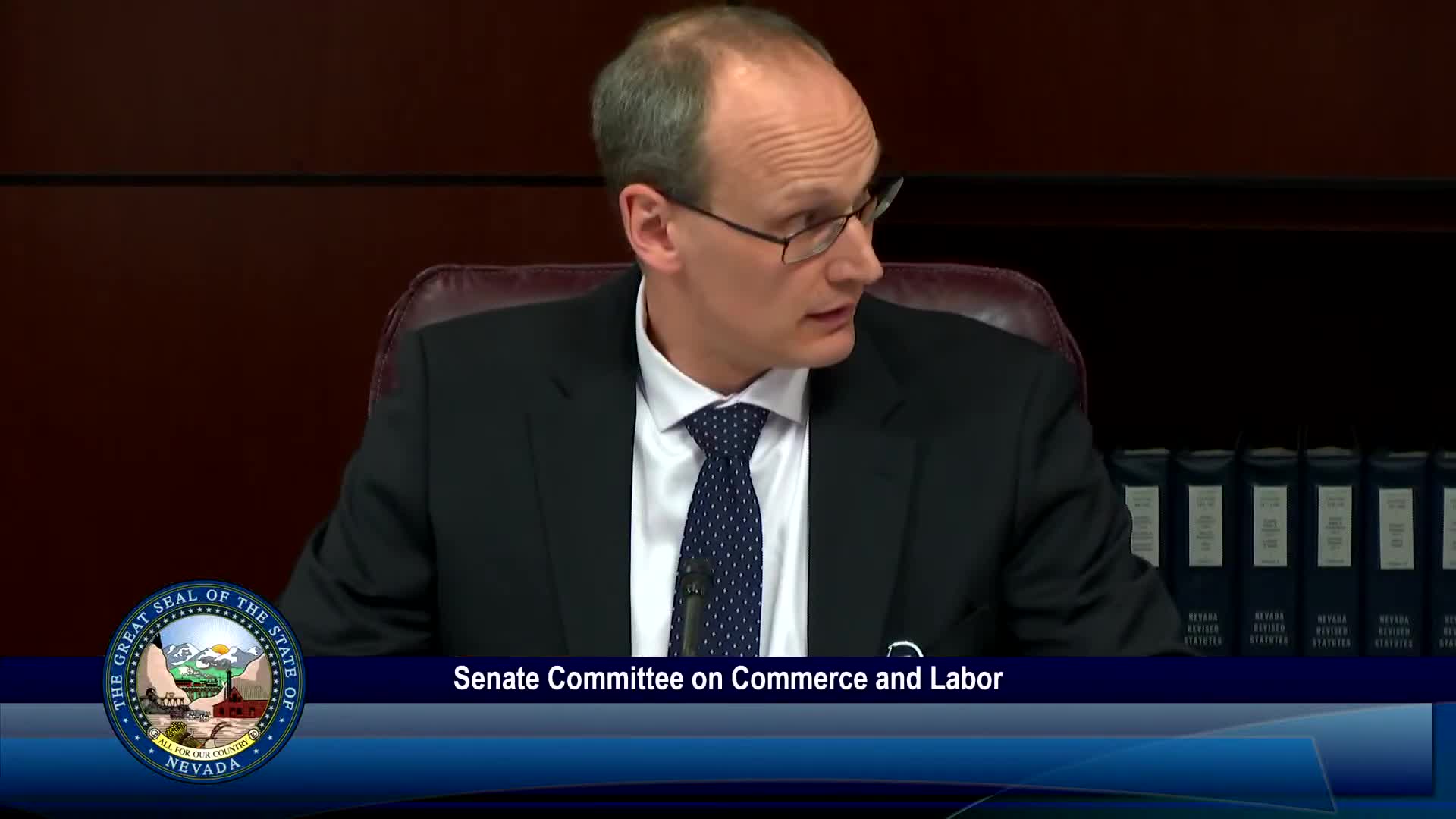
Summary
The Nevada Senate Commerce and Labor Committee voted to amend and advance SB63, a bill that restricts minors' accounts on covered digital platforms, limits algorithmic recommendations for minors and adds parental control mechanisms.
The Nevada Senate Committee on Commerce and Labor on a work session voted to amend and advance Senate Bill 63, a measure that restricts minors' access to certain digital platforms, limits algorithmic recommendation use for minors and requires parental consent and control mechanisms.
SB63 originally prohibited social media platforms from allowing minors under 13 to use the platforms and required platforms to obtain affirmative, verified parental consent for minors 13 and older. The committee approved an Attorney General‑sponsored conceptual amendment that redefined the covered services to a broader category called “digital platforms,” enumerated categories excluded from the definition (including most email, teleconferencing, cloud storage, interactive gaming and certain educational or employment services), and removed several sections requiring a specific age‑verification system.
The amendment also added operational protections and parental control mechanisms. Among the changes adopted by the committee:
- Platforms must, upon request by a verified parent or legal guardian, disable one or more specified features for a minor user; - “Infinite scrolling” for a minor must be limited to the lesser of six discrete items of content or seven minutes of continuous content; interactive video games are excluded from that content definition; - If a platform does not implement reasonable safeguards or a parent requests restrictions, the platform is prohibited from sending notifications to a minor between 12 a.m. and 6 a.m., or between 8 a.m. and 3 p.m., Monday through Friday during the months of August through May, measured in the minor's time zone; - The Department of Health and Human Services must adopt recommended practices for age verification and consent; adherence to those recommended practices creates a compliance safe harbor.
Attorney General Aaron Ford told the committee that many stakeholders who initially opposed the bill “moved to neutral” after negotiations over the amendment, but he said two businesses and two industry groups remained opposed. He also said advocacy groups including the Trevor Project and Silver State Equality were recorded as neutral on the amendment.
Committee members recorded mixed reactions in their votes. Senator Rogich told the committee he would "vote yes out of the committee and reserve my right to change the vote on the floor." Senator Steinbeck likewise voted yes while reserving his right to change, and Senator Ellison recorded a no while reserving his right. The motion to amend and do pass carried; the committee assigned the floor statement to Senator Lang.
Why it matters: SB63 would constrain how platforms treat minors in Nevada by creating parental control mechanisms, restricting certain algorithmic practices for minors and establishing a regulatory standard through DHHS recommended practices. The measure also treats violations as a deceptive trade practice under state law as amended in committee.
What the amendment changed from the hearing: The Attorney General's conceptual amendment narrowed the bill's reach by changing the statutory term from “social media platform” to “digital platform” and enumerating exclusions (examples include email, teleconferencing, cloud storage, and many gaming services), removed the bill’s age‑verification system provisions, and added targeted technical limits and parental control options.
Stakeholder positions: According to the Attorney General in committee, the negotiated amendment reduced opposition among many previously opposing parties; a small number of businesses and industry groups remained opposed and certain advocacy organizations registered as neutral.
Next steps: SB63 now goes to the Senate floor for further debate and possible amendment. Several senators who supported the committee motion reserved the right to change their votes on the floor.