
Senate finance committee hears AB499 to implement voter ID, add weekend drop boxes; opponents warn of disenfranchisement
Get AI-powered insights, summaries, and transcripts
Subscribe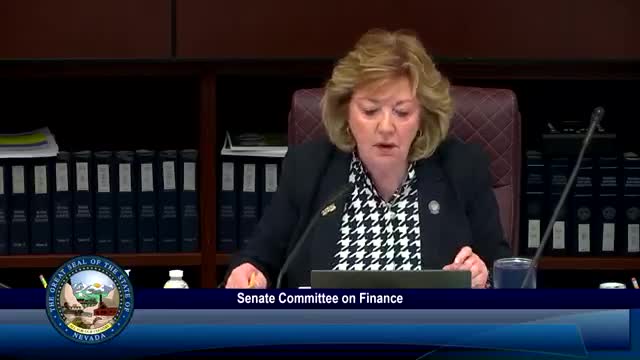
Summary
CARSON CITY ' The Nevada Senate Finance Committee heard Assembly Bill 499 on Saturday, a measure to implement voter ID requirements laid out in 2024's Question 7, require monitored weekend drop boxes in Clark and Washoe counties, and appropriate funds for DMV IDs and a statewide voter-education campaign.
CARSON CITY — The Nevada Senate Finance Committee on Saturday heard Assembly Bill 499, a bill to implement voter identification requirements reflected in 2024's Question 7, to require short-term, monitored ballot drop boxes in Clark and Washoe counties during the days between the end of early voting and election day, and to fund outreach and free state IDs.
Assemblyman Steve Yeager, D-Las Vegas, presented the bill amendment and told the committee the measure reflects ongoing discussions with the governor and local election officials. "This would provide additional options for that voter to fill out their mail in ballot and place it in a drop box over the weekend," Yeager said, arguing the change would help clerks process ballots earlier and reduce election‑day backlogs.
The mock-up amendment tracked Question 7's language on identification and the order of verification numbers for mail ballots: last four digits of a driver's license, last four of Social Security number, then the voter registration number. Yeager said the bill requires in-person voters to present photo identification (driver's license, passport, military ID or a digital ID issued by the secretary of state), allows provisional ballots that must be cured by 5 p.m. the Friday after the election, and directs the DMV to provide free state IDs to registered voters experiencing financial hardship. The measure also includes a $548,528 appropriation to the Department of Motor Vehicles and $3,200,000 to the secretary of state's office for voter education and outreach.
The bill adds requirements for Clark and Washoe counties to provide a minimum number of secure, monitored drop-box locations on the Saturday, Sunday and Monday immediately before election day; each such location must be at a site that previously served as an early-vote or election-day polling place, be monitored during use, secured outside hours, and be available at least seven hours but no more than 12 hours on each of those days. It also establishes a statewide voter services portal hosted by the secretary of state, with QR codes required on county mailings linking voters to the portal.
Several state officials and fiscal staff described how the amendment is intended as implementing legislation for Question 7 should voters approve it again in 2026. Bradley Schrager (recorded in the hearing as Bradley Traeger in a few places), counsel on the bill, said the amendment "tracks and complies, exactly" with the constitutional language. Wayne Thorley of the Legislative Counsel Bureau's fiscal analysis division gave the committee data on signature cures from the 2024 general election: 32,818 mail ballots needed a cure (about 4.6% of mail ballots returned), 23,644 were successfully cured (72% of those), and 9,174 were not cured (about 1.3% of all mail ballots returned).
Secretary of State staff said the office will not register voters (county clerks do that), but would host the portal and run digital-ID services; Gabriel De Cara, chief deputy secretary of state, said county clerks remain responsible for voter verification and poll operations even if some tools or portals are centralized. Legal and regulatory details, including specifics of drop-box monitoring and digital-ID implementation, were left to the regulatory process and the secretary of state's rulemaking authority in the bill.
Committee members pressed authors and staff on multiple topics: whether the proposed language would conflict with Question 7 (Yeager and counsel said the bill was drafted to avoid conflict), how the signature-verification process would interact with the new numeric identifiers on mail ballots (Schrager said signature verification remains the primary check; the numbers act as secondary verification when signatures mismatch), timelines for DMV and county readiness, special needs of voters with disabilities or cognitive conditions (including dyscalculia), how the change could affect young, elderly, minority, tribal and immigrant voters, and whether the additional weekend drop-box period might enable last‑minute collection practices.
Public testimony was dominated by opposition. Speakers representing the NAACP, the ACLU of Nevada, Silver State Voices, Make the Road Nevada, Campion Legal Center, AFSCME, Planned Parenthood Advocates, tribal and Native organizations, environmental groups and others urged rejection. Common themes in opposition testimony: the amendment was filed late in the session, it will create new barriers and intimidation at the polls, it risks disenfranchising seniors, people of color, Native voters, immigrants, disabled voters and young voters, and it duplicates or replaces safeguards that election officials already use. Ayesha Goins, first vice president of the Las Vegas NAACP, said the proposal would "deprive" people of access and was "appalling"; the ACLU's representative said a last‑minute move to adopt voter ID rather than letting voters decide at the ballot box is a "betrayal" of the communities that advocated for voting access.
Supporters and some neutral witnesses said they supported implementing language that reflects voters' approval of Question 7 in 2024 and that early action would give clerks and the secretary of state's office time to test systems before higher‑turnout elections in 2028. Anna Hit Bageshyn of Nevada Policy said the amendment would "be a net positive" and reflected the majority vote on Question 7. Some callers and witnesses who said they supported voter ID nonetheless criticized aspects of the amendment (for example, extended drop‑box days).
No formal committee vote was taken at the conclusion of the hearing. Chair Dondero Loop closed the hearing and recessed the committee for floor activity; proponents and opponents said they planned to continue engagement on the bill and on implementation questions.