
Senate backs emergency bill letting Green Mountain Care Board trim hospital payments, appoint observers amid Blue Cross solvency concerns
Get AI-powered insights, summaries, and transcripts
Subscribe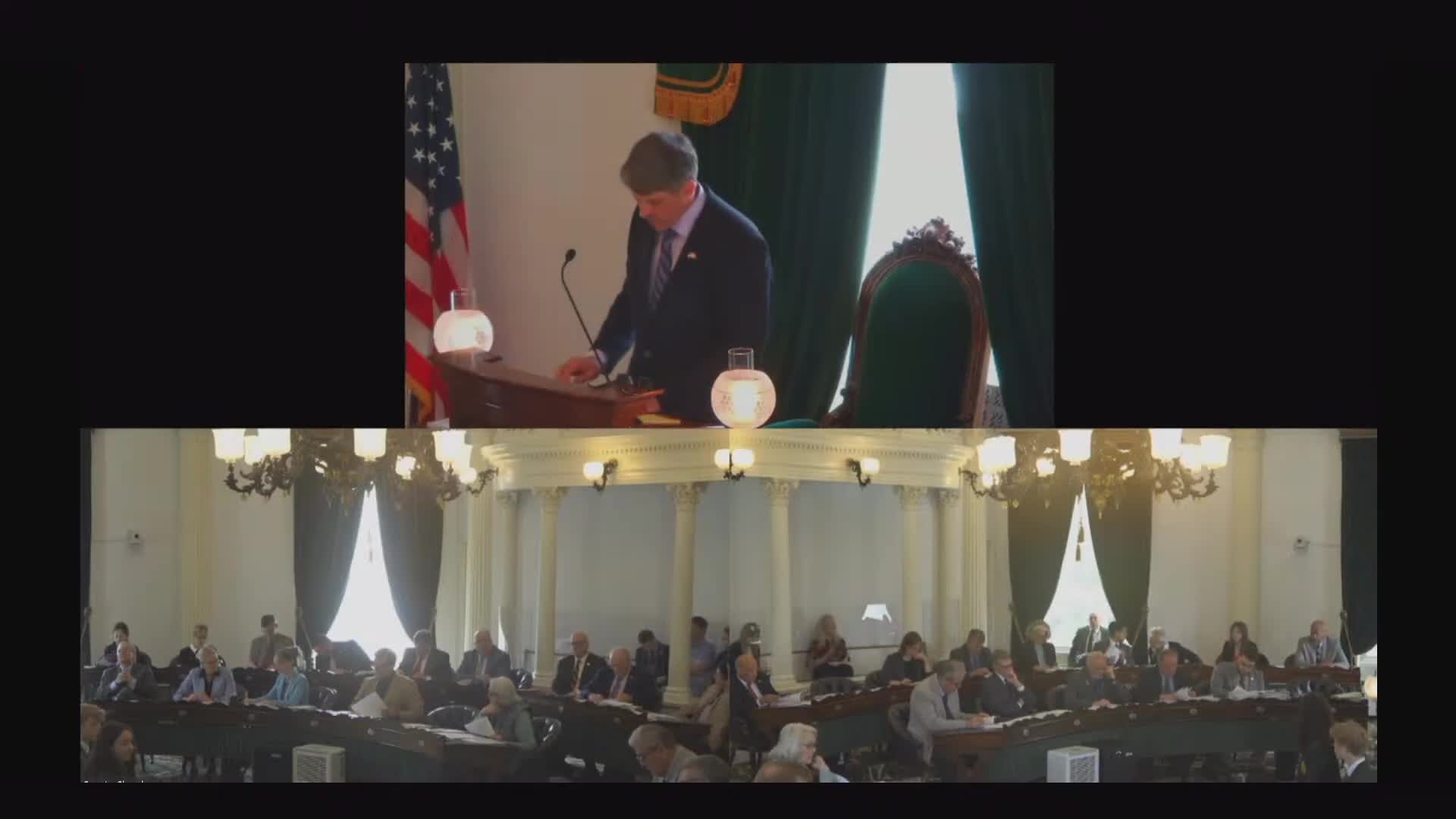
Summary
The Vermont Senate advanced H.482, an emergency response bill that would let the Green Mountain Care Board reduce commercial reimbursement rates to certain hospitals to protect the state's only domestic insurer and authorize appointment of independent observers when hospitals materially misstate budget information.
The Vermont Senate on Monday moved to send H.482 to the House with the Senate's proposed amendments, approving a committee recommendation to allow the Green Mountain Care Board to reduce certain hospitals' commercial reimbursement rates and to appoint independent observers when hospitals materially misrepresent budget information.
The bill was presented to the Senate as an emergency measure to address two urgent problems: the near-insolvency of Blue Cross and Blue Shield of Vermont, the state's only domestic health insurer, and recent instances in which the Green Mountain Care Board found material misinformation in a hospital budget submission.
Committee chair (Senator from Southeast District) told the chamber that Blue Cross "requires about $35,000,000 a week to pay claims" and that the insurer's reserves were rapidly declining. The senator said the bill's first section would allow the Green Mountain Care Board, after consulting the Department of Financial Regulation commissioner, to reduce a commercial insurer's reimbursement rates to one or more hospitals when necessary to remediate an immediate threat to the insurer's solvency.
The bill sets financial guardrails. A hospital would be eligible for a rate reduction only if it met one or more financial criteria (for example, having at least 135 days cash on hand and a positive operating margin in the prior fiscal year), and any ordered reduction could not reduce a hospital's projected days of cash on hand to below 125 days. The board must consider competing financial obligations of both the insurer and the hospital before ordering reductions.
A second major component addresses hospital budget review. Upon finding that a hospital made a material misrepresentation in documents it submitted or is materially noncompliant with its approved budget, the board could adjust commercial reimbursement rates and appoint an independent observer for the hospital. According to the report, an observer may monitor operations, obtain hospital information, report findings and recommendations to the Green Mountain Care Board, and share information with the Office of the Health Care Advocate while limiting further disclosure of confidential materials. The board may order the hospital to pay all or part of the observer's costs. The bill also includes a repeal date for the independent-observer authority of January 1, 2030.
Sponsors and committee members told the Senate they had heard testimony from dozens of stakeholders, including Blue Cross and Blue Shield leadership, hospital executives, the Green Mountain Care Board chair, the Department of Financial Regulation, the Office of the Health Care Advocate, and health policy academics. The committee reported a 3-2-0 vote in favor of the bill.
Senators asked whether the solvency portion of the bill includes a sunset; the committee reporter said the independent-observer authority in section 2 sunsets in 2030 but that there is no sunset on the solvency authority in section 1. Questions about whether the Green Mountain Care Board has referred any potential criminal misrepresentation to law enforcement were described as "beyond the scope" of the committee's legislative review and were referred to the board.
Committee advocates framed the bill as an extraordinary, targeted remedy designed to preserve both the insurer and hospital financial stability, noting the state's limited ability to absorb rapidly escalating commercial reimbursement costs. The senator reporting the bill also cited an example in testimony of a hospital billing at 528% of Medicare rates for certain high-utilization services and contrasted that with prior policy discussions that viewed 250% to 300% of Medicare as more defensible.
The Senate voted by voice to propose to the House that H.482 be amended as recommended by the committee and ordered third reading. The voice vote recorded "ayes have it"; no roll-call tally was given on the floor.
If enacted, the bill would give the Green Mountain Care Board new emergency tools to address insurer solvency and to investigate and remedy material misstatements in hospital budget submissions. Supporters said the measures are narrow and include explicit financial limits to reduce the risk the board's action would imperil fragile hospitals; opponents in committee raised concerns about regulatory reach and the circumstances under which the observer power would be used.
The committee listed witnesses including: Alyssa Black (house reporter of the bill), Susan Barrett (executive director, Green Mountain Care Board), Emily Brown (deputy commissioner, Department of Financial Regulation), Michael Del Treco (president and CEO, Vermont Association of Hospitals and Health Systems), Mike Fisher (chief health care advocate), Owen Foster (chair, Green Mountain Care Board), Judy Fox (CEO, Rutland Regional Medical Center), Don George (president and CEO, Blue Cross and Blue Shield of Vermont), Devin Green (VP, government operations, Vermont Association of Hospitals and Health Systems), Nancy Kane (professor, Harvard T.H. Chan School of Public Health), Steven Leffler (president and COO, UVM Medical Center), Sam Peisch (health policy analyst, Vermont Legal Aid), Sarah Teachout (public media relations, Blue Cross and Blue Shield), and Kai Sampson (commissioner, Department of Financial Regulation).
The Senate report emphasized the bill is an emergency response meant to be used only when necessary to prevent insurer insolvency or to remedy materially misleading budget submissions, and it includes procedural safeguards the committee said were intended to protect hospital financial viability.
The bill will return to the House for consideration of the Senate's proposed amendment.