Bill to increase state grants and create ‘State Grant Plus’ advances after Minnesota Education Equity Partnership testimony
Loading...
Summary
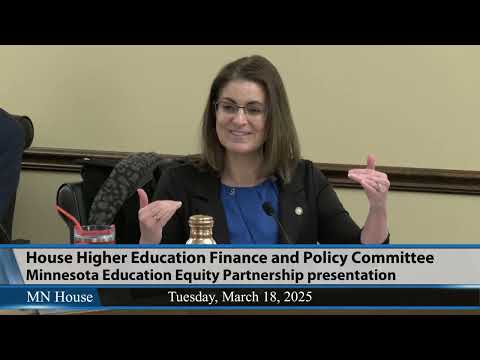
Representative Richard Frasier introduced House File 2,090 to the House Higher Education Finance and Policy Committee as a package of measures aimed at making college more affordable and improving completion rates for underrepresented students.
Representative Richard Frasier introduced House File 2,090 to the House Higher Education Finance and Policy Committee as a package of measures aimed at making college more affordable and improving completion rates for underrepresented students.
The bill would increase the state grant living and miscellaneous expense (LME) allowance from 115% to 121% of the federal poverty guideline; create a State Grant Plus scholarship equal to 25% of a student’s existing state grant award; provide one-time grants to nonprofits for FAFSA completion efforts; fund competitive grants supporting retention of low-income students; require multilingual, culturally relevant materials; and create working groups on higher education financial stability and attainment goals. Representative Frasier moved to lay the bill over for possible inclusion in the higher education finance omnibus bill; the motion was laid over by voice vote.
Why it matters: supporters said the bill responds to rising costs, persistent completion gaps by race and income, and the statewide workforce need for better postsecondary attainment. Carlos Mariani, executive director of the Minnesota Education Equity Partnership (MNEP), reviewed MNEP’s history and said the organization will continue to advise on policy and data-disaggregation to support equity in higher education.
Committee questioning focused on cost and implementation details. Representative Novotny noted the bill’s appropriations were left blank; Dr. John Peterson, senior policy fellow with MNEP, described those blanks as intentional to open policy discussion amid constrained state finances and said modest one-time appropriations (he suggested $50,000) would help produce multilingual FAFSA outreach materials. Dr. Peterson also provided illustrative calculations for the State Grant Plus award using 2024 average state grant amounts: roughly $1,500 at University of Minnesota campuses, $1,450 at nonprofit private institutions, $800 at Minnesota State universities and $350 at Minnesota State colleges, with the Commissioner authorized under the bill to adjust the 25% match level based on appropriation availability.
Several members raised budget concerns. Representative Rarick noted the governor’s proposal would have reduced the LME to 110% and said increasing it to 121% could add roughly $36 million to the state grant shortfall; he and others stressed the state grant program already faces a significant deficit. Supporters responded that the bill’s purpose is to surface proposals and design targeted supports even if funding must be negotiated later.
Student testimony framed the provisions in personal terms. Jamaa Jigo, an Augsburg University student and financial aid recipient, told the committee that increases to LME and the State Grant Plus scholarship would help cover commuting and living costs that otherwise threaten students’ ability to finish degrees.
The committee laid HF 2090 over for possible inclusion in the higher education omnibus bill so fiscal and program details can be developed in subsequent work. The Office of Higher Education would be directed in the bill to convene the working groups and administer competitive grants and reporting required by the proposal.
Votes at a glance: the committee adopted a motion to lay HF 2090 over for possible inclusion in the higher education finance omnibus bill by voice vote; no roll-call tally was recorded in the hearing transcript.
Provenance: the committee first heard MNEP testimony introducing the topic at 48.825 seconds into the transcript and the bill was laid over at 2466.715 seconds, where the committee chair renewed the motion to lay HF 2090 over.
What’s next: the bill has been laid over for potential inclusion in the higher education finance omnibus; appropriations and statutory language details will be subject to further committee and caucus negotiation.