
Austin Energy study: systemwide burial of distribution lines would cost about $50 billion; recommends targeted undergrounding
Get AI-powered insights, summaries, and transcripts
Sign Up Free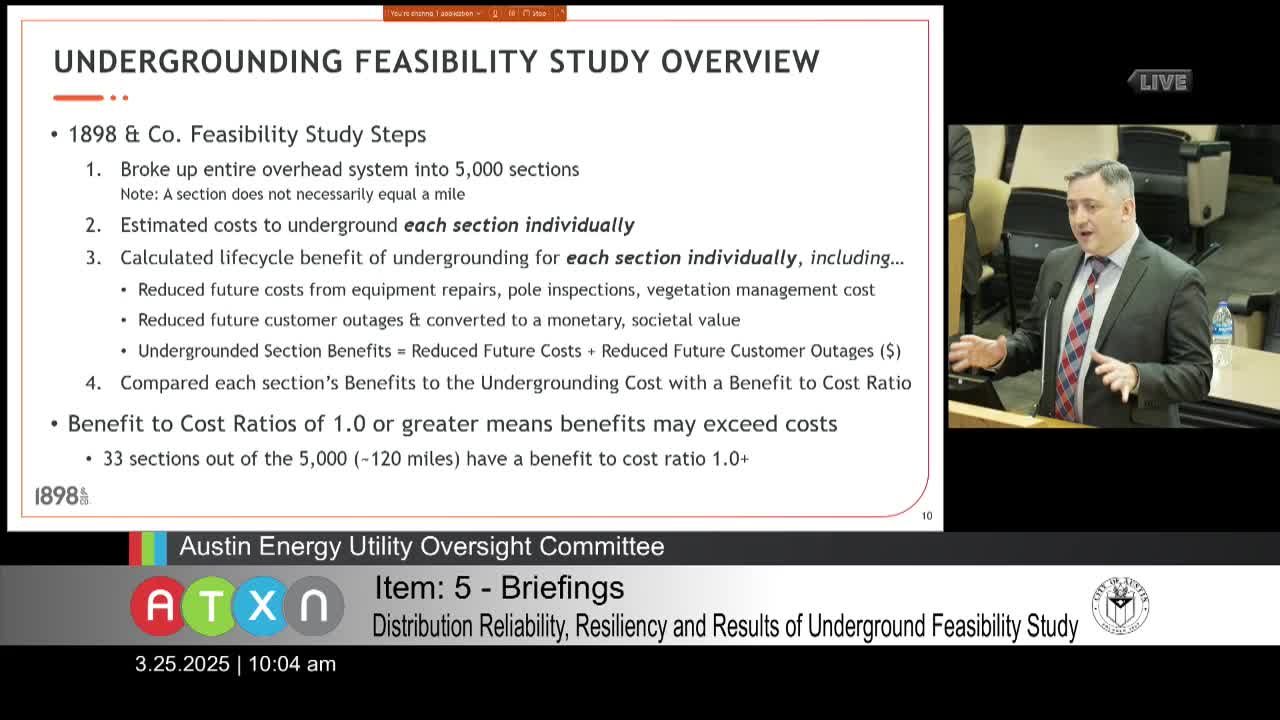
Summary
Austin Energy and consultant 1898 & Co. presented findings of an underground‑feasibility study showing a full systemwide conversion would cost roughly $50 billion, and recommended strategic, prioritized conversions combined with overhead hardening measures rather than citywide burial.
Austin Energy staff and a consultant on March 25 presented the results of an underground-feasibility study that concluded burying all remaining overhead distribution lines in Austin would be technically feasible in many places but extremely costly, and recommended targeted conversions rather than a systemwide program.
The study, conducted by 1898 & Co. (part of Burns & McDonnell) and reviewed by Austin Energy, estimated Austin’s distribution system at about 12,000 miles, of which roughly 7,000 miles are underground and 5,000 miles remain overhead. The consultant estimated a citywide undergrounding price tag in the ballpark of $50,000,000,000 and found about 33 discrete sections (roughly 120 miles) where a benefit‑cost ratio exceeded 1 on a lifecycle basis.
Why this matters: Undergrounding reduces outages caused by vegetation and weather and can improve resilience in wildfire and storm‑prone areas, but it also raises large upfront costs, environmental permitting issues, utility telecommunications coordination, and localized engineering challenges such as shallow bedrock and tight easements. Committee members pressed staff on where undergrounding could be coordinated with other public projects and on options short of full burial, such as overhead hardening and sectional investments.
The study’s scope and main findings
“We broke up the entire system into about 5,000 sections,” said Arlen Muir of 1898 & Co., describing the analytic approach used to estimate section‑level costs and benefits. The consultant converted avoided future outage costs, operations and maintenance savings, and reduced customer interruption costs into a present‑value benefit and compared that to the estimated cost of each section’s underground conversion.
The system overview presented by Austin Energy staff put the totals in context: roughly 12,000 miles of distribution lines, about 75,000 poles and roughly 90,000 transformers. David Tomcheson, Austin Energy vice president for electric system engineering, said that today “approximately 58% of our distribution lines … are already underground.”
Cost drivers and constraints
Consultants and staff flagged several drivers of high costs and uncertainty: rocky soils that require deeper excavation or specialized equipment; numerous telecommunications attachers that must relocate and comply with attachment sequencing; dense customer lots that raise traffic control and restoration complexity; environmental sensitivities (including karst zones and habitat protections); and potential archaeological or cemetery impacts. Arlen Muir said many of those site‑specific uncertainties “require site specific evaluation to estimate the cost of a section — you don't always know until you get out there.”
The consultant recommended against a blanket systemwide burying program given the aggregate cost and uncertain return, but identified a number of strategic conversions where benefits were compelling. “We are not currently recommending that Austin Energy undertake a system wide undergrounding of the overhead distribution system,” Muir told the committee, while noting the utility could pursue targeted areas where conversions align with other public works or provide outsized resilience gains.
Tradeoffs and alternatives
Staff emphasized that undergrounding is one tool in a broader distribution‑resiliency portfolio. Austin Energy will present a complementary overhead hardening study in May; that analysis is expected to identify lower‑cost measures (for example covered conductor, targeted pole and equipment upgrades, and sectionalization/automation) that can deliver resilience benefits in many locations without full burial.
“We will continue to examine where strategic underground conversions make sense,” said Lisa Martin, Austin Energy chief operating officer, and she added the utility will combine the consultant results, the overhead hardening study and stakeholder input to form a comprehensive distribution resiliency plan later this year.
Coordination and next steps
Council members pressed staff to overlay the consultant’s 33 high‑benefit sections with planned City projects — including Project Connect, mobility corridors and water‑oriented construction — to seize “dig once” opportunities and reduce incremental costs. Staff said such coordination is already underway through city permitting and utility coordination channels and that they will share the candidate sections with councilmembers for review.
The utility also signaled it may propose pilot underground conversions in a small number of strategic locations and continue its standard that requires or incentivizes underground service design in many new developments.
What committee members asked and what staff said
Committee members raised wildfire risk, telecommunications relocation costs, and the potential to prioritize corridors that support mobility and redevelopment. Staff said telecom attachers are legally required to pay relocation costs under the city’s design criteria and that telecom coordination frequently contributes to schedule and cost uncertainty. On wildfire, staff said conversions and alternative hardening measures will both be examined to reduce ignition risk and improve post‑event restoration.
Where this goes from here
Austin Energy will combine these underground feasibility findings with an overhead hardening study due in May, refine candidate sections for targeted underground conversions, seek stakeholder input, and return later this year with a multi‑year distribution resiliency plan that includes near‑term priorities and possible pilot projects.
Ending: The study frames undergrounding as an important but expensive resilience tool. Staff and the consultant recommended a measured approach — prioritize conversions where technical conditions, environmental permitting risks and coordination opportunities with other city projects make burial practical and cost‑effective, and consider shorter‑term hardening or automation steps where undergrounding is not the best near‑term option.