House adopts FY26 budget; restores mental‑health school funding, boosts corrections spending
Loading...
Summary
The Georgia House on Day 40 adopted the conference committee report on House Bill 68, approving a budget that funds the Promise scholarship, restores Apex mental‑health funding to DBHDD, boosts Department of Corrections funding and adds several education and rural health items.
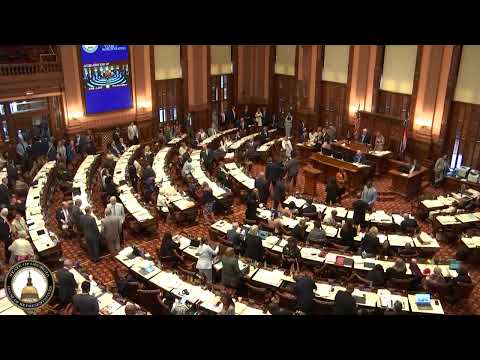
The Georgia House on Day 40 adopted the conference committee report for House Bill 68, the fiscal 2026 state budget, approving the conference committee substitute after floor remarks from the budget chair and a brief round of questions from representatives.
"Y'all, it's been a journey to get to this point on the FY26 budget, but we have arrived," Representative Matt Hatchett, chairman of the House budget committee, said as he presented the report and asked for the body's favorable consideration. The House adopted the committee's recommendation by recorded vote: yeas 170, nays 5.
The conference report, Hatchett said, preserves the chamber's priorities on public safety and education and aligns House, Senate and governor positions on several items. Among the line items Hatchett highlighted: full funding for the Georgia Hope/Promise scholarship at $141,000,000 (described in the report as 1% of QBE earnings); restoration of $9,200,000 in Apex funding to the Department of Behavioral Health and Developmental Disabilities (DBHDD); nearly $20,000,000 for mental‑health support grants for middle and high schools; $2,300,000 to assist small school systems that do not earn full funding for a school social worker; and a poverty weight funded at $15,200,000 that the chair said would affect more than 94,000 students in 59 school systems.
Hatchett also said the conference committee returned to the governor's approach of funding capital projects with cash for one more year rather than issuing bonds, and that the Department of Corrections receives an infusion of $200,000,000 in the final version — an amount Hatchett described as $75,000,000 more than the governor's original recommendation. He said the budget preserves several Medicaid payment adjustments and steps to help rural health care, including $3,900,000 to expand a newborn add‑on payment so eligible rural deliveries receive a $2,000 add‑on for a total of $3,000 per delivery in qualifying counties.
Representative Jasmine Clark and several other members asked questions about specific line items. Clark asked whether voucher/charter startup grants referenced in the tracking sheet matched the enacted appropriation; Hatchett responded that the enacted appropriation was $500,000 and explained the appropriation is structured as a grant program. Representative Lupton asked about victims' services funding; Hatchett confirmed the budget provides $3,100,000 for victims' services (below an earlier request of $8,100,000) and noted the state cannot fully replace all federal funding if it disappears.
The chair said items not listed on the differences sheet reflected agreement between the chambers and the governor's office. He thanked subcommittee chairs, Senate colleagues and budget staff for their work assembling the document and took questions before the vote.
Action on the conference committee report closed floor consideration of the FY26 budget in the House; Hatchett yielded the well after the vote and the House moved to other business.
Ending: The adopted conference committee report becomes the House’s formal approval of the conference substitute; the bill will move to the governor for signature or veto according to the statutory process. The House debate focused on funding priorities and technical clarifications rather than new policy language.