
Hays County authorizes DWI and drug courts to expand specialty-court programs
Get AI-powered insights, summaries, and transcripts
Subscribe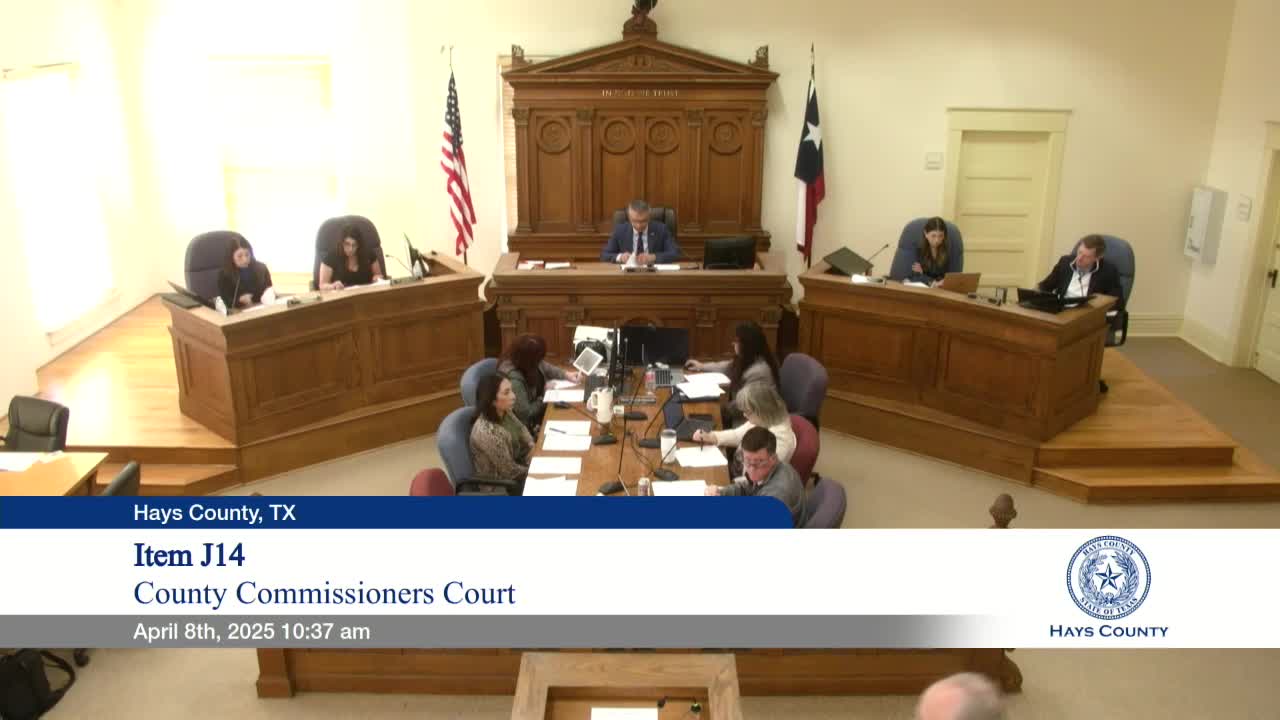
Summary
The Commissioners Court adopted a resolution authorizing the establishment of DWI and drug court programs to expand treatment-focused alternatives to incarceration and to qualify the county for state and federal grant funding.
Hays County commissioners on April 8 adopted a resolution authorizing the creation of DWI and drug courts as specialty courts, with the programs expected to be operational by Dec. 1, 2025.
County Court at Law judge Jimmie El Hall presented the resolution and said specialty courts reduce recidivism, provide rehabilitation and save county money compared with incarceration. Matthew Hammonds, the county’s newly hired DWI and Drug Court facilitator, told the court the county’s estimated population of roughly 290,000 creates a statutory expectation for such programs and that the courts will position Hays County to receive state and federal grant funding once approved by the Office of Court Administration (OCA).
Hammonds said the county currently has about 260 active cases eligible for the program and more than 530 potentially eligible cases over the last three years. He described a pilot start date of Dec. 1 and said grant sources would include the Department of Justice, Texas Health and Human Services grants and the Criminal Justice Division at the Office of the Governor.
District Judge Alicia Keyes, who volunteered to oversee the felony-level portion of the program, said she has observed many defendants whose court involvement is driven by substance-use disorders rather than violent behavior. “They deserve therapeutic measures,” Keyes said.
District Attorney Kelly Higgins said the DA’s office supports the dockets and will review cases for suitability and provide office resources to the program. “Rather than treat every drug possession as a violent crime, these programs will be more humane and make better use of resources,” Higgins told the court.
Commissioner Inglesby and Judge Becerra were listed as sponsors of the agenda item. The court read the specialty-court resolution aloud and recorded a unanimous vote in favor.
The resolution authorizes the courts to apply for necessary approvals from the Office of Court Administration; staff and judges will finalize policies, procedures and the strategic plan required by OCA before grant applications and program launch.