
Pulaski County advisory committee names chair and vice chair, sets schedule to review county offices
Get AI-powered insights, summaries, and transcripts
Subscribe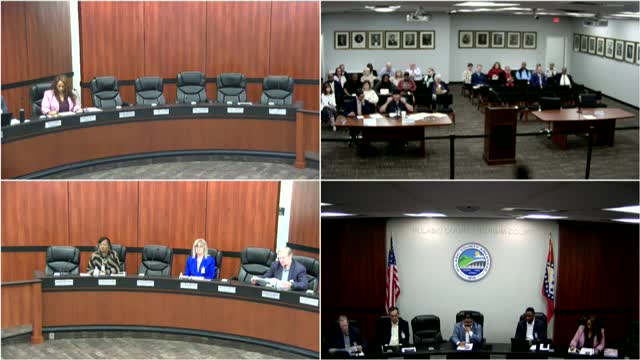
Summary
An advisory committee convened by the Pulaski County Quorum Court selected Mark Stodola as chair and Luis Calderon as vice chair, set a timeline to deliver reorganization recommendations by Jan. 30, and asked staff to gather organizational charts, statutory background and office narratives for the next meeting on April 22 at 2 p.m.
An advisory committee convened by the Pulaski County Quorum Court selected Mark Stodola as chair and Luis Calderon as vice chair and set a schedule for work that could lead to recommendations on reorganizing county offices.
The committee — formed to review the duties and possible consolidation or reassignment of the nine county offices — was tasked with producing recommendations to the quorum court by Jan. 30 of next year. County Attorney Adam Fogelman told members the group may recommend changes that could be referred to Pulaski County voters.
Members opened the meeting with introductions and nominations. After a nomination and second, Stodola accepted the chair role “until I resign,” and the committee confirmed Calderon as vice chair by acclamation. The committee also voted to meet again on April 22 at 2 p.m. and established an initial meeting cadence of committee meetings and full-group meetings on a roughly twice-monthly basis, with an emphasis on daytime meetings.
The committee’s stated charge is to examine offices as they are organized today — including the treasurer, assessor, circuit clerk, county clerk, county judge, sheriff, coroner and surveyor — and to determine whether duties should be retained, revised, consolidated, abolished or made appointive. Fogelman repeatedly referenced Amendment 55 to the Arkansas Constitution and the authority found in Arkansas law (cited in the meeting as “Title 14” and “14 14 6 0 1 and the following statutes”) as the legal framework for options the committee may recommend.
Members asked county staff to assemble background materials before the next meeting. Justin Blagman, the Quorum Court coordinator, said the committee would be provided the statutory definitions and responsibilities for each office, organizational charts where available, and a plain-language memo about the current Pulaski County structure. Blagman also said the county would request narrative descriptions from officeholders explaining how their offices operate, and would work with the University of Arkansas at Little Rock (identified in the meeting as an academic partner working under an MOA) to develop benchmarking and draft survey questions.
Committee members discussed using surveys, follow-up interviews and stakeholder outreach to gather information. Several members emphasized concise deliverables: Joe Thomas, chief administrator for the assessor’s office, asked whether the committee preferred a short executive synopsis; the committee requested succinct (roughly three- to five-page) summaries or bullet-pointed outlines describing each office’s basic functions, workflows, and any technology updates since the prior 1990s study.
Public comment at the meeting urged transparency. Cathy Wells, president of the Coalition of Little Rock Neighborhoods, asked that the committee’s documents — including the 1992 report referenced as background — be posted online. Justin Blagman said the county’s FOIA portal and website would be used to make materials available and that meetings would be streamed and archived where possible.
The committee discussed logistics, including room availability and the likelihood of splitting into two subcommittees to divide the five offices not previously consolidated. Fogelman noted that the 1992 review had used subcommittees and suggested members could adopt a similar process; members agreed to consider committees that would meet at least monthly and report back to the full group.
The group set its next meeting for April 22 at 2 p.m., with a goal to return with recommended survey questions, organizational charts, and narrative materials. Members were asked to consider committee assignments and bring questions and initial ideas to that meeting.
The committee’s final recommendations to the quorum court may include options to consolidate offices, alter duties, or change whether positions are elected or appointed; any proposal that requires voter approval would be subject to referral by the quorum court and then placed before county voters.