
Assembly hearing outlines $2.8 billion general‑fund Medi‑Cal augmentation and wildfire recovery backfill in SB 100/AB 100
Get AI-powered insights, summaries, and transcripts
Subscribe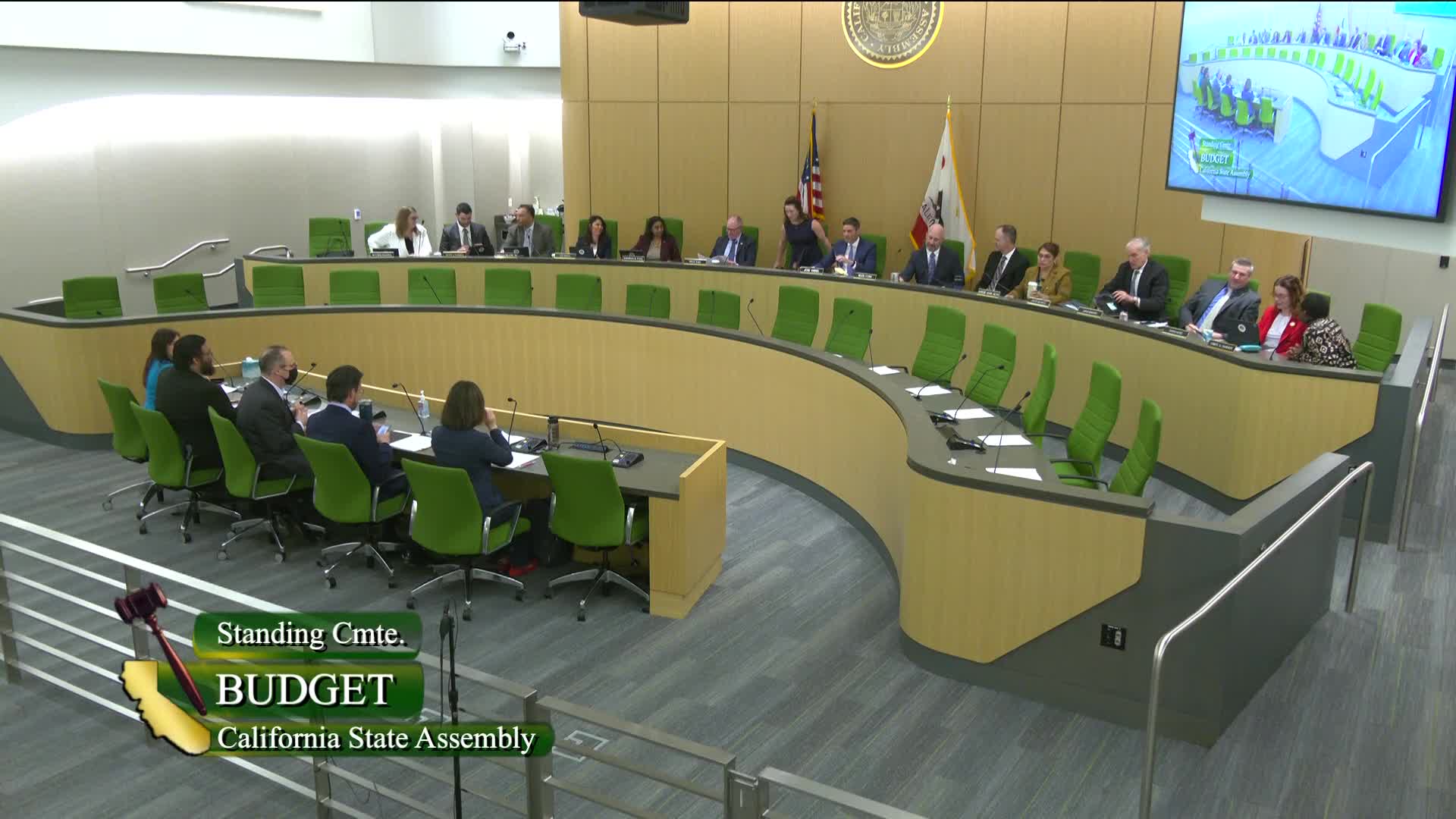
Summary
The California State Assembly Budget Committee on an informational hearing reviewed SB 100 and its identical counterpart AB 100, early‑action budget bills that would add $2.8 billion in General Fund support and $8.3 billion in matching federal funds for the Medi‑Cal program and authorize multiple wildfire recovery and program‑specific appropriations.
The California State Assembly Budget Committee on an informational hearing reviewed SB 100 and its identical counterpart AB 100, early‑action budget bills that would add $2.8 billion in General Fund support and $8.3 billion in matching federal funds for the Medi‑Cal program and authorize multiple wildfire recovery and program‑specific appropriations.
The measures, presented by Erica Lee of the Department of Finance, also would authorize augmentations to reimburse Los Angeles County and cities for unmet response and recovery costs from the Eaton and Palisades fires; provide property‑tax backfills for taxing agencies affected by the fires; increase California Office of Emergency Services reimbursement authority; restore unencumbered 2023–24 funds for the California Nonprofit Security Grant Program; and make a series of smaller, targeted appropriations and control‑section changes.
"This bill includes an increase in expenditure authority of 2,800,000,000.0 general fund and 8,300,000,000.0 matching federal funds for the Medi Cal program," Erica Lee said. Lee said the bill would also require recipients of wildfire funding to seek the maximum federal reimbursements and to deposit any federal reimbursements back into the General Fund.
Legislative Analyst's Office staff and Department of Finance witnesses told the committee that the requested $2.8 billion is intended to supplement a $3.4 billion short‑term loan the state took earlier in the fiscal year and, together with federal funds, is meant to carry Medi‑Cal provider payments through June. "That $3,400,000,000 loan... was necessary to meet cash flow needs," a Department of Finance official said. Laura Ayala of the Department of Finance said the state now pays roughly "$11 and 15,000,000,000 per month for Medi Cal." (Transcript phrasing preserved.)
Committee members and witnesses attributed higher‑than‑expected Medi‑Cal costs to multiple factors, including higher pharmacy costs, increased enrollment among seniors, higher take‑up in newly eligible groups (including undocumented immigrants), pandemic‑era federal flexibilities that increased caseloads, and a shift in the state's pharmaceutical payment approach that increases budget volatility for some high‑cost drugs. Jason Constanturos of the Legislative Analyst's Office summarized that eligibility expansions and other policy changes have increased caseload and spending.
Erica Lee also described wildfire‑related provisions in the bills: an augmentation to backfill property tax revenue lost in 2024–25 and 2025–26 for cities, counties and independent special districts affected by the Eaton and Palisades fires; an increase to Cal OES reimbursement authority (described in the presentation as 7,650,000.00) through June 30, 2026 to continue an operational observer contract monitoring covered utilities; and restoration of a $20,000,000 General Fund augmentation for the California Nonprofit Security Grant Program that had not been encumbered in 2023–24 before appropriations expired.
The bills also would: allow the State Controller to use existing funds in the Property Tax Postponement Fund for approved manufactured/mobile home applications in 2024–25; add a $2,000,000 Administrative Procedures Act exemption for a farmer program administered by the California Air Resources Board (described as necessary to allow allocation of the funds); provide an additional $17,000,000 from the Enhanced Fleet Modernization subaccount to local air districts for the Clean Cars for All program; authorize up to $2,000,000 from the Foster Family Home and Small Family Home Insurance Fund to address certain claims; reappropriate an amount described in the presentation as "1,000,001 time Proposition 98 General Fund" to the Fiscal Crisis and Management Assistance Team for technical assistance to local educational agencies impacted by the LA wildfires; increase Commission on Teacher Credentialing authority by $250,000; and add a control section to appropriate certain Proposition 4 climate bond dollars to six state conservancies and $10,000,000 to the Department of Forestry and Fire Protection for a fire‑resiliency training center (name given in the presentation).
Members of the committee pressed the Department of Finance and the Legislative Analyst's Office on forecasting and on whether additional loans or emergency funds would be necessary. In response to a question about the state's authority to take another loan, a Finance official said the state has already exercised the loan authority and that the $2.8 billion request "is what we believe will take us through this year." The same witness confirmed that the $2.8 billion augmentation is not intended to pay back the $3.4 billion loan taken earlier; that loan is expected to be repaid by the state over time.
Public commenters largely urged full funding for Medi‑Cal and supported the wildfire and property‑tax provisions. Linda Wei of Western Center on Law and Poverty said, "the increase in caseload is a sign that the program is acting as intended and that people are getting needed care." Christine Smith of Health Access California and labor and provider representatives also urged protecting recent coverage gains and opposing eligibility cuts. Marcus Detwiler of the California Special Districts Association and Jean Hurst of the Altadena Library District spoke in support of the property‑tax backfill language for special districts and local taxing agencies affected by the Eaton Fire.
No formal committee vote on SB 100 or AB 100 was recorded at the hearing; committee staff said a floor vote on one of the bills was expected later in the morning on the Assembly floor. The hearing was adjourned to allow members to attend floor session.
Questions and clarifications recorded at the hearing reflect the information provided in the presentation and by LAO and Finance staff and are summarized above. The committee did not adopt amendments or take a formal action during the informational hearing.