
Planning commission approves 152-foot monopole for Belmont Interchange; forwards special-exception to supervisors
Get AI-powered insights, summaries, and transcripts
Sign Up Free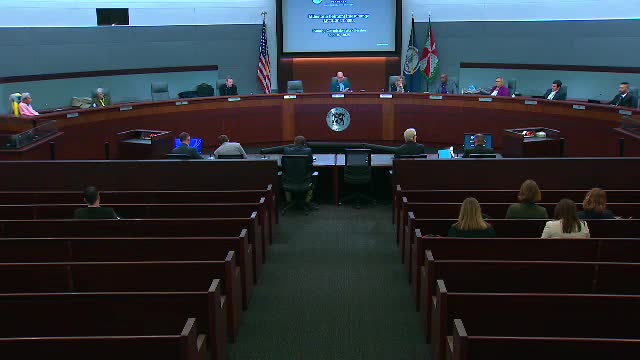
Summary
The Loudoun County Planning Commission on April 10 approved a commission permit for a 152-foot telecommunications monopole at the Belmont Interchange and forwarded a related special exception to the Board of Supervisors with staff-recommended conditions.
The Loudoun County Planning Commission on April 10 approved a commission permit to build a 152-foot telecommunications monopole at the Belmont Interchange and voted to forward a special exception (SPEX) to the Board of Supervisors with recommended conditions.
Christian Maldonado, a planner with the Department of Planning and Zoning, told the commission staff supported approval and said the proposal “was found to be consistent with county policy.” The applicant, represented by Aaron Swisshelm and the Milestone team, described the siting as a response to a local coverage gap along Route 7 and said the monopole would be built to support up to four carriers.
Why it matters: the proposal sits within the VDOT right-of-way along Route 7 in a suburban policy area and is intended to improve wireless coverage for vehicular and nearby residential areas. Commissioners focused their review on visual screening, alternative rooftop options and how the proposal aligns with the county telecommunications plan.
Commission and applicant details: the application includes an antenna hub and ground-level equipment compound enclosed by a 10-foot chain-link fence with green privacy slats, a 20-foot landscaped buffer (up from 15 feet in the earlier submittal) and additional evergreen plantings. Maldonado noted the applicant shifted the monopole two feet south to accommodate a Dominion Energy easement and added 12 evergreens to increase screening.
Alternatives and co-location: the commission repeatedly pressed the applicant about rooftop co-location and small-cell alternatives. The applicant said a nearby seven-story office rooftop was evaluated but that structural, financial and coverage constraints made rooftop co-location infeasible for the broad coverage the carrier sought; Paul Dugan, an RF consultant, summarized his technical review by saying small cells provide “spot coverage” and are not a practical substitute here for the macrocell solution proposed.
Screening and fence treatment: several commissioners expressed concern that a 10-foot chain-link fence with slats offers limited ground‑level screening and maintenance challenges. Commissioners discussed requiring a more opaque wall (masonry or similar) like those used at some substations; staff said such an enhancement could be included as a recommended condition in the SPEX forwarded to the Board.
Coordination with other agencies: Milestone and county staff said the company coordinated with Dominion Energy, which shifted its easement two feet, and that Inova (the hospital) reviewed the site and had no operational concerns for helipad access. The applicant said there were no current plans for FirstNet or public-safety users to attach to the pole, but the monopole would be built for co-location.
Vote and outcome: the commission voted to approve the commission permit and to forward the SPEX to the Board of Supervisors with conditions. The motion passed 5–3–1 (one commissioner absent). Staff and the applicant will carry the commission’s recommended design and screening conditions forward to the Board.
Next steps and context: the Board of Supervisors will receive the SPEX and the planning commission’s conditions. If the Board approves the special exception, final design and building permits will still be subject to the county’s site-plan and permitting processes and any required VDOT or utility approvals.