
Lubbock County rejects $45,000 request to help fund Slaton downtown revitalization plan
Get AI-powered insights, summaries, and transcripts
Subscribe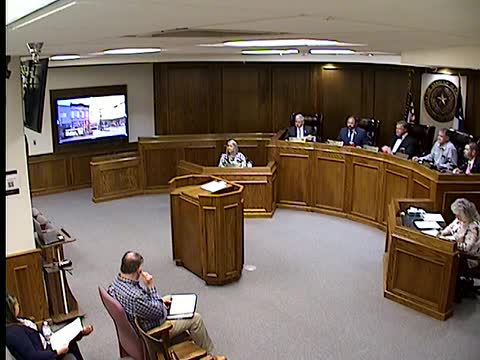
Summary
The Lubbock County Commissioners Court voted 2–2 with one abstention on April 14 to deny a request that would have provided $45,000 toward a three‑year downtown revitalization engagement for the city of Slaton; proponents said the plan would be phased over three years and include a $45,000 first‑year payment.
Lubbock County Commissioners Court on April 14 declined a request from the Slaton Economic Development Corporation (SEDCO) for an upfront $45,000 county contribution toward a downtown revitalization work‑action plan. The motion failed on a 2–2 vote with one commissioner present but not voting.
The proposal presented by Lacey Beasley, president of Retail Strategies, asked the court to allocate $45,000 in the first year, followed by $25,000 in each of years two and three, to support a consultant‑led, five‑year work plan that the presenter said is implemented by a local task force and supported by ongoing consultant office hours.
Beasley said the proposal is a tactical alternative to multi‑year master plans, describing it as a nine‑month development period that yields a five‑year work action plan. "The investment here is 45,000 for the first year, the second year, 25,000, and the third year, 25,000," Beasley told the court.
Slaton City Manager Wade Wilson and Leslie Harlan of SEDCO described local plans tied to expected growth around a future highway loop and the community’s goal to position Slaton as a destination outside Lubbock. Harlan said SEDCO would sign a contract and asserted that the organization had reserves to participate: "We sign a contract that states that it's a 3 year commitment," she said; she later told the court that SEDCO maintained roughly $500,000 in reserves.
Commissioners questioned financial sequencing, asking why the county would be first to provide funds while SEDCO’s own designated funds were currently committed to other projects. Court members also discussed contract terms, the ability to include claw‑back language in an interlocal or contract, and whether the city of Slaton or SEDCO would make the subsequent year payments if the county contributed the first installment.
A motion "to enter into an agreement to give SEDCO $45,000 to fund the first phase" was moved and seconded; the court recorded two ayes, two nays and one present not voting and the motion failed. The court clerk announced: "The vote being, 2 ayes and 2 nays and 1 present not voting, the motion for agenda item 9 fails." Several commissioners suggested the court could reconsider a partnership during the October budget process with a more detailed financial breakdown.
The proposal would have funded Retail Strategies consulting services contracted by SEDCO; the presenters said the contract structure would be a three‑year payment schedule embedded in a five‑year commitment and that SEDCO planned to contribute in years two and three if the county participated.
The court did not adopt any contract language or interlocal agreement and took no further action on the request.
Details recorded during the meeting indicate the request included a first‑year county contribution of $45,000 and proposed SEDCO commitments of $25,000 in years two and three; SEDCO representatives confirmed they would execute a multi‑year contract if county funds were approved.