
Supervisors discuss river maintenance, water-trail grants and who is responsible for clearing debris
Get AI-powered insights, summaries, and transcripts
Sign Up Free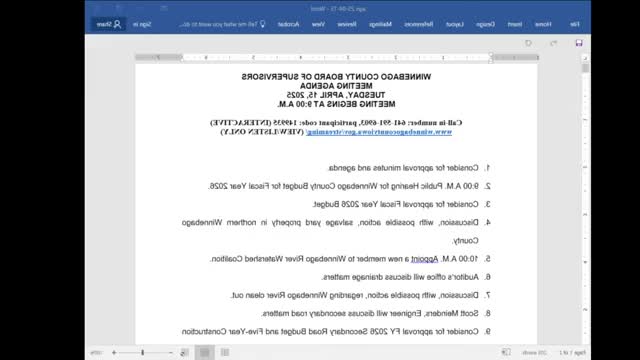
Summary
County supervisors discussed options for removing trees and debris from the Winnebago River, the role of the DNR and watershed coalition, Corps of Engineers limits on excavation and available grants for water-trail signage and improvements.
Winnebago County supervisors and staff held an extended discussion about maintenance needs on the Winnebago River, including when to remove downed trees and brush, who bears responsibility for water-trail upkeep and whether available DNR grants or watershed coalition planning could support larger work.
Staff and supervisors laid out three primary considerations: public safety where "strainers" (trees and branches) make navigation hazardous; ecological benefits of in-stream wood for habitat and bank stabilization; and erosion or property impacts where debris shifts flow toward roads or private property. County staff said the U.S. Army Corps of Engineers allows cutting and releasing trees from roots but generally restricts digging out root systems; any larger sediment work could require additional permits and oversight.
Board members asked staff to consult the DNR and the newly formed watershed coalition for engineering plans, grant eligibility and the anticipated responsibilities of any local sponsor. Staff noted the watershed coalition has recently obtained a grant for an engineering plan; supervisors suggested inviting coalition leadership or DNR representatives to brief the board on grant timelines, responsibilities and what the coalition's engineering work will cover.
Options discussed ranged from targeted chainsaw work in low flows to remove small obstructions to coordinated large-scale removal that would require excavation equipment, permits and potential hauling of sediment (which can increase costs if material must be removed rather than spread). One staff member suggested beginning with tree removal and monitoring whether subsequent flows clear smaller material.
Supervisors asked staff to determine the DNR's stance on clearing designated water trails and the watershed coalition's plans, including whether grants cover access improvements and who would manage long-term maintenance. Staff said they would check which local entity applied for any DNR water-trail grant and whether county conservation, a watershed group or another entity is the local sponsor.
Provenance (excerpted from meeting audio): river and watershed discussion across segments ~1771.4 to ~3046.14 seconds, including references to Corps of Engineers guidance and watershed coalition planning efforts.