
Houston officials say limited authority hampers shutdowns of unpermitted nightclubs
Get AI-powered insights, summaries, and transcripts
Subscribe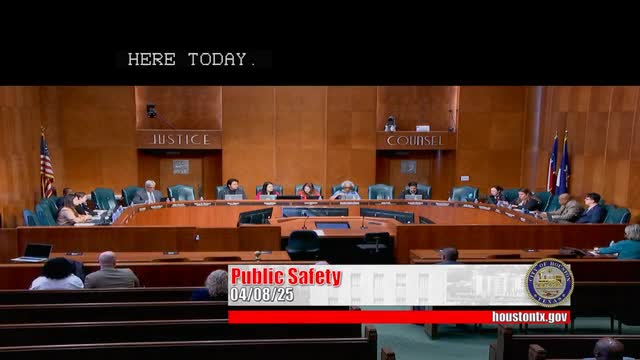
Summary
Houston Public Works and the Houston Fire Department told the City Council Public Safety Committee that state law and current codes limit their ability to close unpermitted after‑hours clubs. Staff agreed to review complaints about two Washington Avenue venues and to provide follow‑up reports.
At a Houston City Council Public Safety Committee meeting, Houston Public Works and the Houston Fire Department described constraints that limit their ability to shut down unpermitted after‑hours clubs and nightclubs, and staff agreed to investigate complaints about two Washington Avenue venues.
Rudy, a Houston Public Works presenter, outlined the certificate of occupancy (CO) and occupancy inspection process, saying applications differ for existing buildings and for new construction or a change of use. Rudy said inspectors evaluate buildings under the code that was in place when each building was constructed, that inspection reports are typically available to customers within two business days, and that correction permits must be obtained within 100 days or an occupancy permit will expire. He added that structural permits may be secured by an owner or agent, but electrical, mechanical and plumbing permits must be secured by a licensed contractor.
The department’s building code enforcement investigations begin with 311 complaints, which Rudy said are routed to their investigations team under a seven‑day service line agreement. If inspectors identify deficiencies they issue a red tag and follow up every two weeks; municipal citations may be issued for continuing violations, described in the presentation as a class C misdemeanor with fines “no less than a hundred and not more than 2,000” per day while a violation continues.
Brent, a Houston Fire Department presenter, said the department’s authority derives from the 2021 International Fire Code, the City of Houston Building Code and the department’s Life Safety Bureau standards. He said fire inspectors can abate immediate fire hazards, evacuate a venue and prohibit reopening until a life‑safety hazard is corrected, but that the department cannot issue certificates of occupancy and is limited to enforcing fire‑code violations. "Our enforcement of these facilities are limited by state law as we can only regulate fire code violations," Brent said.
Both presenters described how, in practice, enforcement can leave venues operating while citations are pursued. Brent said that when a venue lacks a CO it is generally treated as a business with an occupant limit of 49; venues with an occupant load of 50 or more are classified as public assembly and require additional permits. He said the fire department’s citations are also a class C misdemeanor, described in his remarks as carrying a fine of "not less than $500 but not more than $2,000" per day, and that the department works with Houston Police Department units (including a differential response team) on after‑hours incidents.
Council members and staff pressed for details about two frequently complained‑about local venues: 5306 Washington and Fuego (spelled variously in the record as Fuego/Fuegos). Council member Ramirez said his office had received complaints that 5306 Washington was operating without a certificate of occupancy. Brent said his office’s records going back to January 2022 showed five calls for service at 5306, including overcrowding and a tent without a permit; for Fuego he said the only record found was a 2023 recertification inspection.
A public commenter told the committee the enforcement system "seems really weak" and described the situation as "very frustrating," citing limited weekend staffing and repeated citations that are not effectively collected. Several council offices urged better coordination between Houston Public Works, the fire marshal and HPD’s loud noise/response units; a staff member for Councilmember Alcorn said that FD and HPD could better share information about noise and CO violations so officers know they may also cite for an invalid CO.
Committee members discussed possible ordinance changes, including whether the rule that limits a venue without a CO to 49 people could be amended. Brent and other staff said some changes would require City Council ordinance amendments because the city adopts and modifies the International Building Code and International Fire Code with local amendments.
Next steps recorded during the meeting included Houston Public Works and Houston Fire Department staff agreeing to provide additional information and to review specific complaints in District C and District D regarding the two Washington Avenue locations. Committee leadership said the conversation will continue at future meetings; the committee announced its next meeting for Thursday, May 18. No formal motions or votes were taken on the subject during the session.