
U.N. Secretary‑General Antonio Guterres urges immediate Gaza ceasefire, presses for climate justice and U.N. reform
Get AI-powered insights, summaries, and transcripts
Subscribe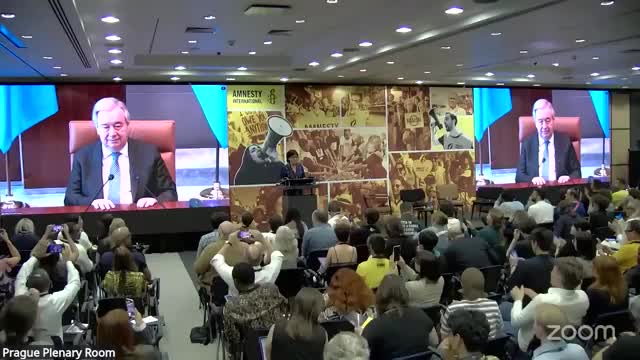
Summary
At Amnesty International's Global Assembly, Secretary‑General Antonio Guterres called for an immediate and permanent ceasefire in Gaza, unconditional release of hostages, expanded humanitarian access, stronger climate action anchored in human rights and reforms of international institutions.
Secretary‑General Antonio Guterres told Amnesty International's Global Assembly that the world needs "an immediate and permanent ceasefire, the immediate and unconditional release of our hostages, and the immediate and unimpeded humanitarian access," and that the United Nations stands ready to scale up aid if a pause in fighting allows it.
Guterres, the U.N. secretary‑general, framed his remarks to the global human rights organization around three themes: the erosion of civic space and rising authoritarianism, the humanitarian catastrophe unfolding in Gaza and other conflict zones, and the need for climate justice rooted in human rights. "The world needs you more than ever. We need your courage, your creativity, and your clarity," he said of Amnesty and civil society groups.
The speech warned of sustained attacks on international human rights institutions and enumerated current crises that, Guterres said, show the limits of the international order. He cited the "horrors in Sudan," Russia's invasion of Ukraine and the "relentless" Israeli offensive in Gaza. "Since May 27, United Nations has recorded over 1,000 Palestinians killed trying to access food," Guterres said, calling that figure evidence of a moral and humanitarian crisis.
Guterres urged concrete steps beyond statements: a ceasefire and unimpeded access for humanitarian aid to the Gaza Strip, a renewed push for a two‑state solution, and legal and political accountability for violations of international law. He said the United Nations has plans ready to expand operations during a ceasefire and that those plans were finalized, but emphasized that "words don't feed hungry children."
On institutional reform and global governance, Guterres called for stronger participation by developing countries, saying it is "a scandal that Africa still has no permanent seat at the table" on the U.N. Security Council and urging debt relief, more development finance and a transformed international financial system to address inequities.
On climate justice, Guterres pointed to a recent advisory opinion from the International Court of Justice and said states are obliged to protect the global climate system and that climate policy should be guided by limiting warming to 1.5 degrees Celsius. He urged richer countries and major emitters to deliver finance for mitigation, adaptation and loss and damage, to align national climate plans with the 1.5C goal, and to place human rights at the center of critical mineral supply chains.
Guterres also endorsed civil society'led accountability in digital spaces, referencing the U.N. General Assembly's adoption of the Global Digital Compact and urging action against social media manipulation that he said amplifies hate and disinformation. He praised Amnesty International's history and role in the global human rights movement and called on activists to continue "troublemaking" that exposes injustice.
A moderator for the assembly opened and closed the session by welcoming Guterres and thanking him for addressing the assembly. "It is an honor to welcome Antonio Guterres, secretary general of the United Nations," the moderator said at the start. At the conclusion the moderator thanked the secretary‑general for his remarks.
No formal votes or resolutions were recorded in this session.