
Wake County holds public hearing on HUD consolidated plan; staff seeks comment before final adoption
Get AI-powered insights, summaries, and transcripts
Subscribe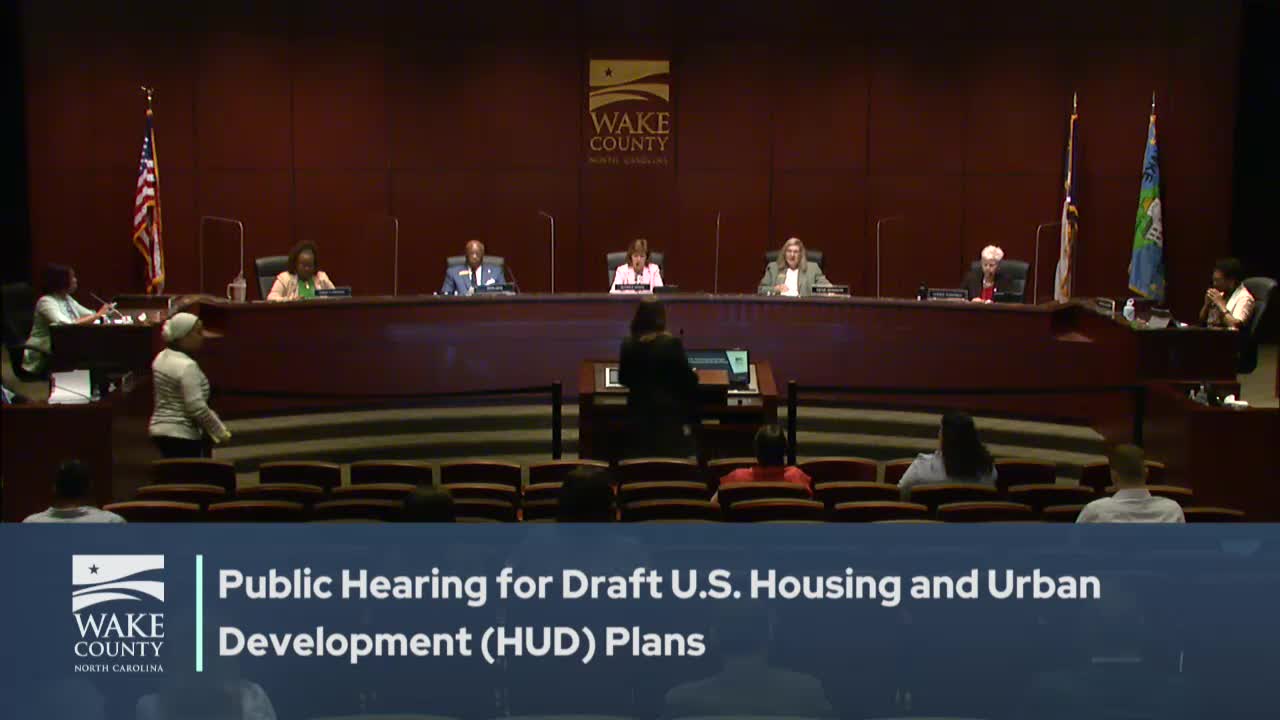
Summary
Deputy Housing Director Alicia Arnold presented Wake County's draft 2025–2030 consolidated plan and 2025 annual action plan, describing outreach and priority goals; the board voted to receive comments and keep the public comment period open ahead of final approval.
Wake County held a public hearing April 21 on draft housing plans the county will submit to the U.S. Department of Housing and Urban Development: a five‑year consolidated plan (2025–2030) and an annual action plan for 2025.
Alicia Arnold, deputy housing director in the county’s Housing Affordability and Community Revitalization Department, summarized the outreach that informed the draft: five public meetings, engagement with more than 51 stakeholder groups, and about 160 survey responses since October. Arnold said the draft keeps the county’s priorities largely unchanged: increase and preserve affordable housing, reduce obstacles to housing affordability, and support low‑ and moderate‑income communities.
Arnold summarized key data cited in the plan: rent costs rose about 37% over the past five years while incomes grew roughly 31%; 83% of renters earning less than 50% of area median income (AMI) are cost‑burdened (paying more than 30% of income for housing); and the county estimates roughly $24 million in federal HUD resources over five years (about $5 million annually) based on the current year allocation, pending HUD’s formal allocations.
Speakers at the public hearing included: - Yolanda Winstead, president and CEO of DHIC, which develops and preserves affordable housing; she expressed support for the consolidated plan and noted development projects (The Canopy in Cary and Fisher Grove in Raleigh) that would benefit from federal funds. - Patricia Burch, CEO of Habitat for Humanity of Wake County, supported the plan and cited past county accomplishments in preserving and producing affordable housing (the county exceeded a prior goal by producing 948 units during the last plan period versus a target of 255 units). - Everett McElveen, CEO of CASA, and Paul Allen Berry of Veterans Bridge Home described service needs for extremely low‑income renters, veterans and other vulnerable populations and urged continued federal investment and local partnerships. - Tim Orgen of Evergreen Construction described local developers’ experience leveraging county and federal funds to produce units; he said developments are quickly leased and demand is strong.
Arnold said the draft action plan would preserve core federally eligible programs (Community Development Block Grant, HOME Investment Partnerships, HOPWA and Emergency Solutions Grant) and continue programs such as rehabilitation and repair, homeownership support and rental assistance. She said some county funds will continue to supplement federal dollars because HUD funding alone does not meet local needs.
Commissioners thanked staff for robust engagement. Commissioner Stallings asked staff to confirm the planning estimate of about $5 million per year from HUD; Arnold said the estimate was based on the current year allocation and that HUD has not yet issued next‑year allocations. The county will continue accepting public comment on the draft; the board voted to receive comments on the draft plan and keep the public comment period open before final approval expected next month.
Motion: Commissioner Stallings moved and Commissioner Jackson seconded a motion that the board, having held a public hearing to receive comments on the draft 2025–2030 consolidated plan and 2025 annual action plan, receive the comments. The motion carried by voice vote.