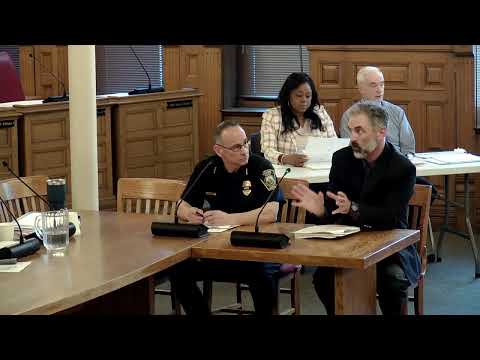
Syracuse police chief warns staffing shortfall, highlights crime drops and overtime pressures during budget hearing
Loading...
Summary
At a Syracuse City Common Council budget hearing, the police chief outlined a gap between authorized and on-road officers, credited crime-prevention work for falling crime rates, and described ongoing efforts to cut overtime costs while expanding alternative responses and special patrol officers.
Syracuse City police leaders told the City Common Council on Wednesday that the department remains below its authorized staffing level and is managing rising retirement and overtime costs even as several crime categories fell from last year.
The police chief said the department is budgeted for 419 total positions but has 388 current employees; 17 recruits are still in the academy and eight recent graduates are in field training, leaving roughly 363 officers actually on patrol — a shortfall of 56 from the funded strength. "We're playing with house money this year because I'm leaving at the end of the year," the police chief said, adding the department swore in its 11th academy under Mayor Walsh and is exploring a 12th academy before the end of 2025.
Council members pressed the chief and deputies on several budget lines, including overtime, contractual sick-time buybacks and retirement contributions. The department requested $6.5 million for overtime in the budget book; officials said last year’s overtime spending approached $9.7 million and that, after expected reimbursements for work on behalf of outside agencies, the city share could be closer to $4.9 million. Deputy chiefs and the chief said the department is actively managing overtime and cited the switch to 10-hour patrol days as a significant cost-reduction measure. "Prior to the 10-hour shift, we spent over a million dollars on [minimum staffing]; since the 10-hour shift...we spent $233,000," the chief said, citing the reduction in one major overtime category.
The chief attributed recruitment shortfalls to low applicant interest. Civil service exams now draw under 100 candidates, officials said, and candidates are pursued by multiple agencies across Onondaga County and Central New York. The department described a range of recruitment tools — a cadet internship program, targeted outreach showing officers who reflect the audiences they recruit, microsites and fitness and study supports — that officials said produced a larger recent academy class than in prior years, though some recruits have dropped out.
Officials credited specific crime-reduction and prevention efforts for measurable declines: Part I crime was down 21.7% year over year, violent crime down about 14.6%, property crime down nearly 30% and stolen vehicles down 55%. The chief attributed the stolen-vehicle decline to police-community collaboration, distribution of about 2,000 steering-wheel locks and dealership software upgrades on affected models.
Police leaders described an expanding alternative-response program for behavioral-health calls. Deputy chiefs said the city has offloaded about 4–5% of calls to nonpolice responders so far and expects that proportion to grow as 9-1-1 triage decisions improve. "We are over that [9-1-1] hurdle now...so we may see that increase, continue over the years," the chief said.
The council also questioned a near half-million-dollar increase in "police services — outside agencies" revenue (page 8 of the budget book). Staff explained the line captures reimbursable work for third parties — examples include officers assigned to Centro/central bus depot work, Syracuse University events at the Dome and other reimbursed deployments — and that the city evaluates requests for such assignments based on net benefit to city patrol workload.
The department outlined plans to expand special patrol officers (SPOs). Deputy Chief Trudell said SPOs are sworn peace officers, often retirees rehired, who serve as a force multiplier: "For every 2 SPOs that we have out there doing work would equal 1 police officer we would have to take off the street," he said. The budget shows 57 SPO positions rising to 67 in the proposed year; officials clarified 47 would serve department functions (camera monitoring, compliance, property, records and CPTED work) and 20 positions were earmarked for the City School District, which has not yet recruited or accepted slots.
Councilors and staff discussed parking enforcement and quality-of-life patrols in neighborhoods such as Thornton Park. The mayor and police leaders said they are looking to hire weekend and evening parking checkers and formed a working group to coordinate parking enforcement strategies, deploy new devices for officers and explore reassignment of personnel to chronic trouble spots.
On retirement costs, council members were shown that combined sworn, civilian and fire retirement obligations approach $98 million — about 28% of the city’s proposed spending in the coming year, city staff said — and that long-term financial pressures remain a concern. Officials noted tiered retirement rules and changes in what overtime counts toward pensionable earnings will affect future employer contribution rates.
No formal votes were taken at the hearing; councilors directed staff and the department to return with additional detail on specific lines (overtime PCs, contractual obligations and reimbursements), to continue work on recruitment and the academy calendar, and to pursue expanded alternative responses and parking-checker hires.
The department left the council with a mix of immediate operational changes and longer-term constraints: training and 10-hour shifts provided measurable savings, while recruitment, retirement and the scale of patrol supervision remain the principal challenges to reaching funded staffing levels.