
Richmond council, administration reach consensus on many FY26 budget amendments; debate remains over top‑tier raises, park ranger cut and fleet reductions
Get AI-powered insights, summaries, and transcripts
Subscribe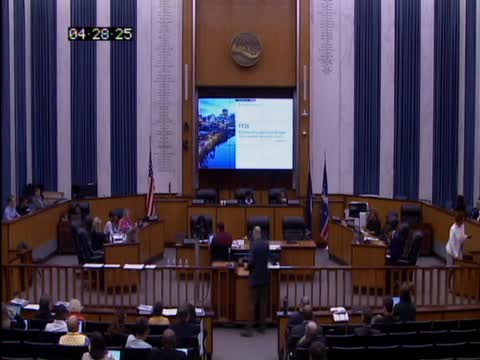
Summary
Council and administration agreed on a package of capital and operating adjustments and a set of nonprofit and housing‑related enhancements to the FY26 budget, but debate remained over limiting raises for employees earning above $175,000, cutting a vacant park ranger post, and fleet reductions.
The Richmond City Council and city administration spent a budget work session reviewing proposed FY26 ordinance changes, capital and operating reductions, and targeted enhancements. Members and staff reported consensus on many items but left several contested topics unresolved for later action.
Interim Chief of Staff Matthew Slats and interim Deputy Chief of Staff Daniel Wagner led the discussion of capital proposals. The council’s reduction package included the proposed removal of an active Laburnum widening (parking/improvements) project, repurposing about $959,617 in general‑obligation bond funding toward Pine Camp facilities in the Third District, and a cash‑funded reduction to the city vehicle replacement program. Wagner said the fleet cut would spare emergency response vehicles (police, fire and refuse trucks) but reduce the pool of other replacement vehicles; the draft reduction totaled about $2.2 million when combined with the Laburnum reallocation.
Council members pressed administration staff about which specific vehicles would be affected and whether animal care control, bulk‑pickup boom trucks, or Richmond Ambulance Authority ambulances would be impacted. Gail Johnson, director of general services, said sufficient remaining funds would allow the city to prioritize purchases for animal care control and solid waste but that not all planned purchases would be available if the reduction stood. Sabrina Joy Hogg, interim chief administrative officer, said the city would continue to fund ambulances through lease‑purchase arrangements with the Richmond Ambulance Authority.
On operating reductions, administration presented a slate of proposed cuts that rely largely on vacant positions across several departments (Office of Community Wealth Building, public works, registrar) and one‑time timing adjustments (a $500,000 timing issue for a resiliency cohort contracted with UpTogether). Bernadine Doggett of the Office of Community Wealth Building confirmed four positions identified for savings are vacant; the office said it has aligned staffing so more than 85% of current staff are in direct‑service roles.
Councilmembers expressed concern about the practical effects of cutting vacant positions that are being covered by temporary or contract staff. Council member Jones asked for a clearer inventory of which functions use temporary contractors and the dollar value of those contracts; council member Gibson requested documentation about temp/contract staffing and the administration agreed to provide follow‑up.
A notable council proposal from Council member Abu Bakr would have reduced the 3.25% across‑the‑board raise for employees earning more than $175,000, reallocating those dollars toward lower‑paid frontline workers. Abu Bakr framed the amendment as an equity measure and a modest way to preserve funds in light of large multi‑year revenue variances. The proposal drew support from several council members who urged an independent salary study; others on council and the administration indicated they did not have consensus to adopt the amendment in the current package.
Parks leadership and several council members pushed back on one personnel reduction that would remove a single vacant park ranger position. Chris Ferlke, director of Parks, Recreation and Community Facilities, said the department had three vacancies it aimed to fill and had used contracted security to cover needs; council members representing districts adjacent to the James River Park System argued that reducing rangers would harm public safety and visitor management during peak season.
Council and administration also agreed on a set of operating enhancements that would not require offsetting reductions in FY26, including boosts to a right‑to‑counsel grant fund, the family crisis fund, eviction‑diversion funding, and targeted nonprofit supports (Caritas, OAR, positive youth development programs and other non‑departmental partners). Wagner said the slate of enhancements, together with agreed reductions, left approximately $50,000 in unallocated funds; council members discussed banking that balance or applying it to fleet or other priorities and asked staff to track and translate the agreed items into the ordinance and contract language needed for execution.
Administration and the city attorney clarified process points: earmarked nonprofit funding that is explicitly named in the adopted budget can be converted directly into contracts without returning to council for re‑appropriation; general allocations described only by program area (for example, “after‑school programming”) would require a subsequent competitive or contracting step and, if necessary, a re‑appropriation paper.
The session produced multiple consensuses—captured by staff for inclusion in the budget ordinance—but several politically sensitive items (the pay‑cap amendment and some position reductions) remained unresolved and will be the subject of follow‑up work between council and administration ahead of formal adoption.