CPUC liaison briefs Carlsbad on energy affordability, broadband grants and rail crossing safety
Get AI-powered insights, summaries, and transcripts
Sign Up Free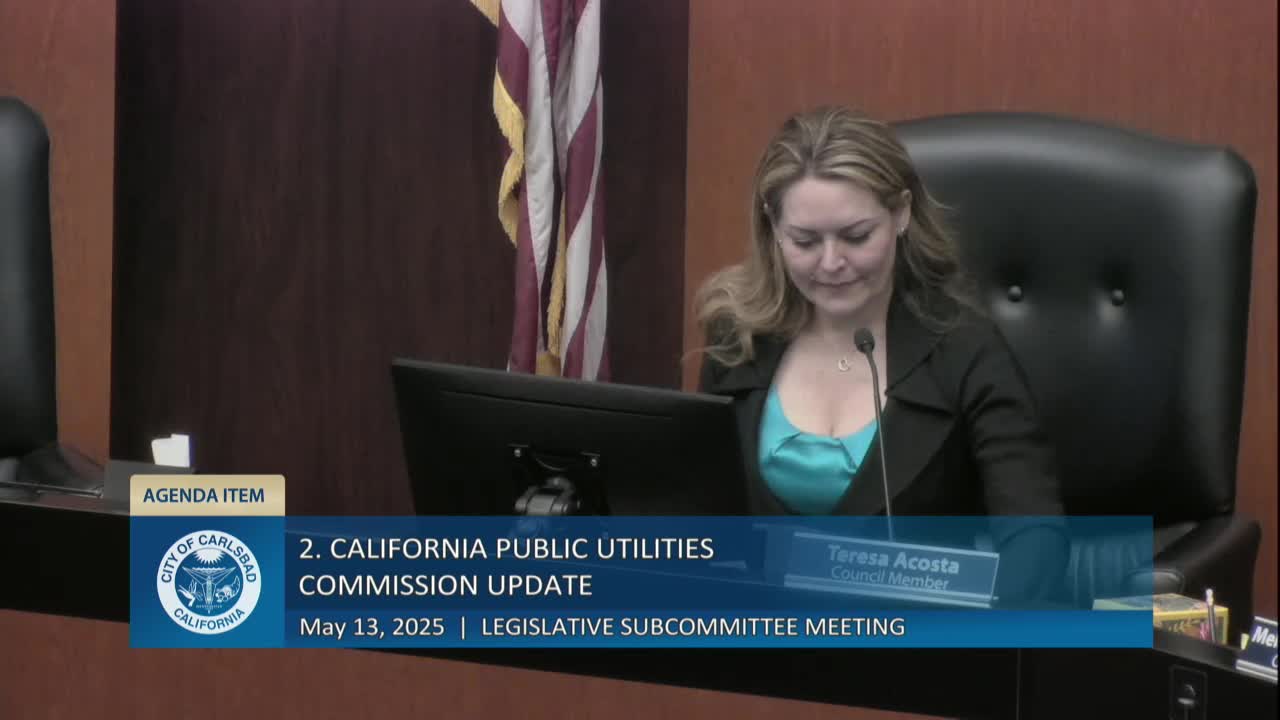
Summary
The California Public Utilities Commission updated the Carlsbad subcommittee on energy affordability measures, SDG&E’s general rate case outcomes, new rules for energy storage safety, broadband grant programs and rail crossing and quiet‑zone rules; CPUC staff urged early engagement on rail crossing projects.
Jesus Torres, local government liaison for the California Public Utilities Commission, and Matthew Bond of the CPUC Rail Crossing and Engineering Branch gave an extended briefing to the Carlsbad City Council legislative subcommittee on energy, broadband and rail‑safety issues.
Torres said energy affordability remains a central CPUC concern and described policy options the commission is reviewing: securitizing wildfire mitigation spending, wildfire self‑insurance for investor‑owned utilities and reallocating California climate credits to lower‑income households and those without rooftop solar. He said the CPUC has authorized roughly $11 billion in bonds to spread wildfire mitigation costs over time and noted some utilities are implementing partial self‑insurance to lower premium costs.
On SDG&E’s recently adopted general rate case, Torres said the decision authorizes funding to maintain safety and reliability but did not award all revenue requested by the utility; he urged residents to consult SDG&E’s rate alerts for details. He also described a $24 monthly fixed charge SDG&E plans to implement and explained the policy rationale: fixed charges recover grid costs that rooftop‑solar customers otherwise might not pay when their volumetric bills “true up” to zero.
Torres briefed the subcommittee on two safety developments: updated General Order 167B rules that require incident reporting, emergency response plans and coordination with local authorities for energy storage systems; and CPUC approval for San Diego Community Power to administer regional energy efficiency programs.
On broadband, Torres summarized the federal “last mile” funds the CPUC is administering (BEAD and related programs) and said over $1 billion has been awarded to projects serving more than 2 million Californians.
Rail crossings drew extensive local questions. Torres said the CPUC has “exclusive authority over all rail crossings in California” and reviews proposed new crossings, modifications and quiet‑zone notices. Matthew Bond described the CPUC’s investigation process after incidents and recommended early, technical coordination among roadway agencies, railroads and CPUC staff to avoid costly protests and formal applications. Bond and Torres both advised that grade separation or trenching eliminates most crossing risks and that local agencies should engage CPUC early in design.
Council members pressed CPUC staff for written references on quiet‑zone policy at passenger stations. Torres and Bond said the Federal Railroad Administration oversees horn rules and that FRA practice has recently limited quiet zones that would include train stations; Torres committed to help staff locate a cit-able reference and provide follow‑up in writing. Council members also discussed Carlsbad’s ongoing trenching interest for the Village and were told CPUC staff can engage at any stage and that staff support grade separations for safety.
Public comment came from Nils Narenheim (Redondo Beach), who thanked the CPUC for local outreach and stressed the statewide importance of energy policy and community choice aggregation.
Why it matters: CPUC rules and rate decisions affect local electric bills, grid safety and the feasibility of local projects such as trenching rail lines. The CPUC’s guidance on early coordination and new reporting requirements for energy storage systems has direct implementation implications for city‑permitted projects.
Next steps: CPUC staff will follow up with written references on the FRA quiet‑zone policy and other materials requested by council. City staff and CPUC staff agreed to schedule technical follow‑ups on rail‑crossing planning and trenching.