Agoura Hills council adopts updated transportation impact fees, 5-0
Loading...
Summary
The City Council adopted Resolution 25-2101 to update the Transportation Impact Fee (TIF) Nexus Study, a capital improvement list and a revised fee schedule that raises fees to fund bike, pedestrian, transit and signal projects tied to new development.
The Agoura Hills City Council voted 5-0 Wednesday to adopt Resolution No. 25-2101, approving the 2025 Transportation Impact Fee (TIF) Nexus Study, a 2025 TIF capital improvement program and an updated fee schedule for new development in the city.
The TIF update, presented by Director of Public Works and City Engineer Charmaine Yambao and consultants from Kimley Horn & Associates, revises the city’s TIF program for the first time since 2011 and shifts project emphasis from roadway widening to non-auto travel improvements such as bicycle facilities, sidewalk gaps, transit enhancements and traffic-signal technology. Yambao described the purpose of the update as revising “the TIF fees and the list of capital improvement projects, including associated costs in today’s dollars.”
The council’s action implements a list of 22 proposed improvement projects with a total estimated construction cost of about $40,800,000, of which consultants estimated roughly $23,700,000 is the new-development proportionate share eligible for TIF funding. After adding administration costs (2 percent), the fee calculation base is $24,200,000, the consultants said. Chris Gregersen of Kimley Horn told the council, “The total estimated cost of the improvements is about $40,800,000 but only $23,700,000 is eligible to be included in the program based on our proportionate share analysis.”
Nut graf: The update changes how the city expects new development to help pay for transportation that accommodates projected growth through 2040. The Nexus Study documents the relationship required by the state Mitigation Fee Act, describes deficiencies in intersections and roadway segments under a future-growth scenario, and proposes a “menu” of projects the city may fund with TIF revenue. Council members stressed the study does not itself authorize construction; the council will still set priorities and approve funding uses for specific projects.
Key details and council discussion
- Fee mechanics and scope: The consultants used the Institute of Transportation Engineers trip-generation rates to convert project costs into a cost per new trip and then to fees by land-use category (residential by unit; nonresidential by thousand square feet). The updated schedule retains the program’s existing land-use categories but raises amounts to reflect current costs and the proportionate-share analysis.
- Existing TIF balance and recent use: Staff said the city’s TIF account balance is $1.3 million, of which roughly $336,000 is currently available for projects; about $964,000 had been used to front funds for an Agora Road widening project but is expected to return to the TIF account upon audit completion.
- Projects vs. priorities: Council members repeatedly described the adopted capital improvement list as a menu rather than a ranked priority list. Council member Deborah Klein Lopez said the list allows the city to be ready when development proposes projects but that the council, not the Nexus Study, will choose which projects to fund first.
- Public comments and development concerns: Two public-comment speakers earlier in the meeting raised transportation-related concerns. Resident Jennifer Miller told the council she and other residents worry about safety from e-bikes and young riders in parks and on streets; resident Steve Lloyd, representing a homeowners association, objected to planned increases in development density near the Canaan–Agoura Road intersection and said neighbors worry about congestion and evacuation-route safety. The TIF public hearing itself had no speakers.
- Timing and exemptions: Staff indicated some projects already deemed complete under prior approvals (for example, certain housing projects) will pay fees at the rate in effect when their application was deemed complete; other projects pay at certificate of occupancy or final inspection, whichever comes first.
Votes and next steps
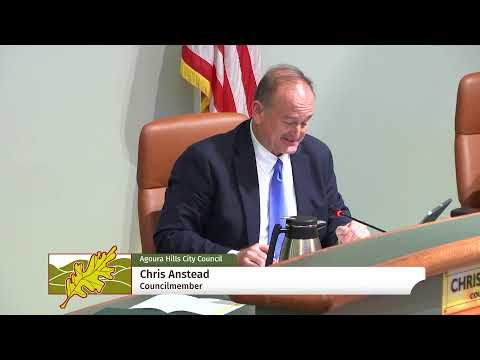
Council member Anderson moved to adopt Resolution No. 25-2101; Council member Chris Anstead seconded. The roll call vote was Anderson—Aye; Anstead—Aye; Klein Lopez—Aye; Mayor Pro Tem Jeremy Wolf—Aye; Mayor Sylvester—Aye. The motion passed 5-0.
Staff and the consultants said the Nexus Study will be used to collect updated fees on future development and to identify projects eligible for TIF funds. City staff noted a portion of the capital program costs (about $17.1 million of the total $40.8 million) will require other funding sources beyond TIF. The council did not set a priority order for the CIP; project selection and programming will come back to the council as individual project proposals and funding requests.
Ending: The council’s adoption establishes the analytical basis for higher TIF charges and a new CIP menu focused on multimodal improvements; implementation will depend on future project approvals, available matching funds, and council decisions on project priorities.