
House counteroffer trims higher-education grants; advocates urge preserving spinal cord injury research funding
Get AI-powered insights, summaries, and transcripts
Subscribe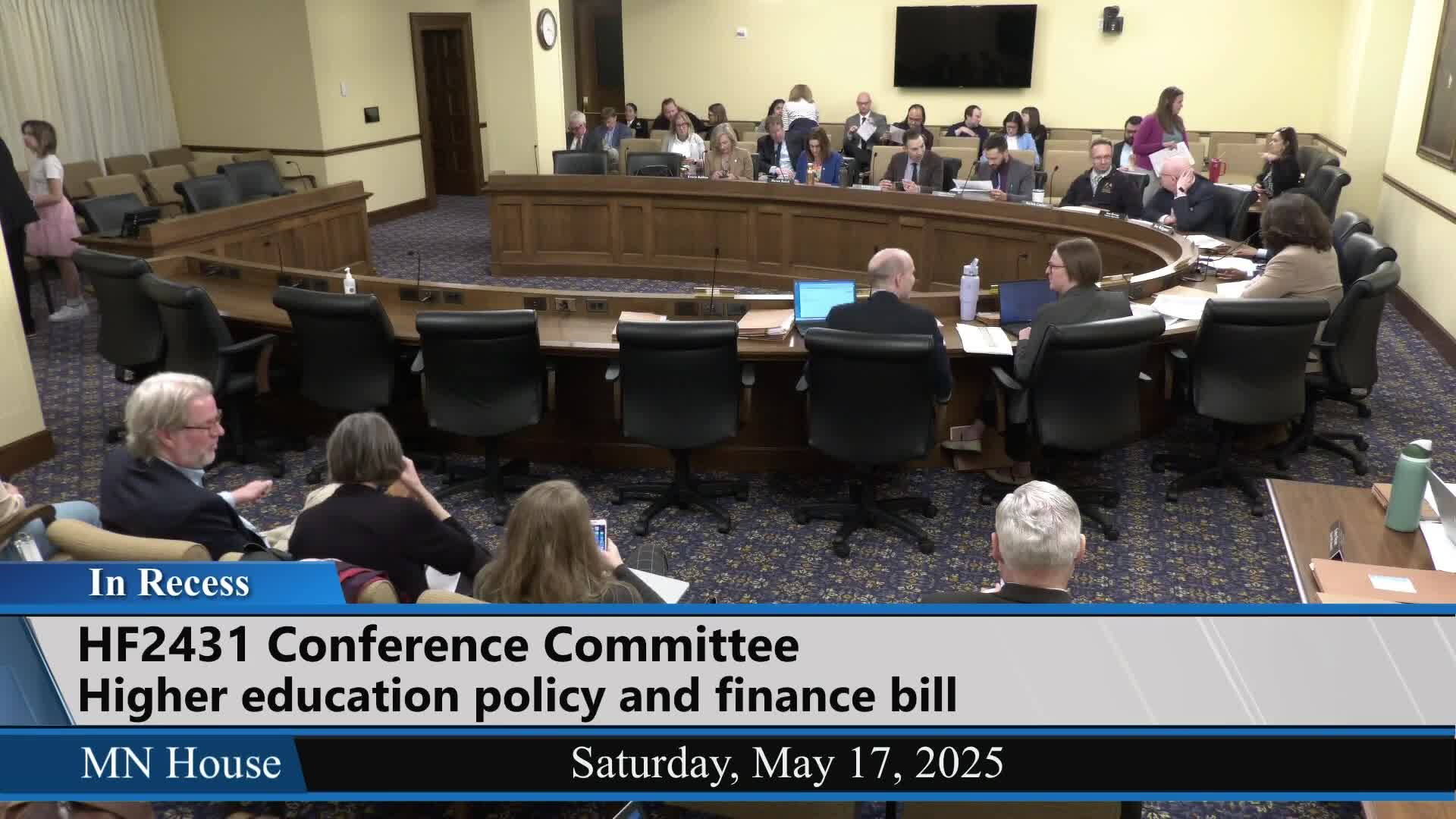
Summary
On May 17, 2025 the House fiscal committee released a counteroffer to ongoing budget negotiations with the Senate that reduces several higher-education grant line items and proposes savings to the spinal cord injury and traumatic brain injury research grant program.
On May 17, 2025 the House fiscal committee released a counteroffer to ongoing budget negotiations with the Senate that reduces several higher-education grant line items and proposes savings to the spinal cord injury and traumatic brain injury (SCI/TBI) research grant program. Advocates told the panel the program has helped catalyze clinical trials and private investment and urged lawmakers to preserve current funding and the program’s placement in the Office of Higher Education.
House fiscal staff member Ken Savory walked members through a spreadsheet of the counteroffer, highlighting multiple line-item changes. The House’s offer reduces the state grant allocation to $50,968,000 in fiscal 2026–27 and to $34,302,000 in the tails, and moves childcare grants to $1,000,000 in each of fiscal 2026–29. The House aligned with the Senate on student teacher and shortage-area grants at $500,000 in fiscal 2026–29, and proposed a $4,000,000 savings for the student parent support initiative in fiscal 2026–29.
Savory said the House proposes $4,000,000 in savings to SCI/TBI research grants in fiscal 2026–27 and $5,000,000 in fiscal 2028–29. The offer left Minnesota State funding unchanged and mirrors the Senate on a $2,000,000 savings for cannabis research at the University of Minnesota in fiscal 2026–27 and fiscal 2028–29. The House also indicated some policy rows in the circulated document are agreed (grayed out) while others remain open (white). The transcript shows a line for an UMN–Mayo Clinic partnership remaining at a full cut in the House offer and that the House agreed with the Senate on a campus misconduct policy item.
Two witnesses from the public urged the committee to keep SCI/TBI research funding at current levels and to retain the program within the Office of Higher Education. Joey Carlson, who identified himself as a person with a cervical spinal cord injury and a former Medtronic employee, said the state-funded program helped bring researchers and companies together and that continued funding could produce both clinical advances and jobs. "I'm advocating that we keep this funding going, at its current level so, we can keep this good progress going," Carlson said.
Matthew Broderick, director at United Way Paralysis and a parent advocate, described state-funded programs in other states that he said seeded clinical trials and eventual federal approvals for commercial devices. He said the Minnesota program has produced a similar ecosystem and warned that moving the program to the Department of Health would undermine its focus. "The mandate is so different to improve care and so overwhelming that the idea of looking at a novel device or a novel treatment that's on the cutting edge ... that's where OHE has this sort of dispassionate oversight," Broderick said. He told members the program has produced a substantial return on investment, saying, "We have told you between 5 and 8 to 1." Broderick added, "This is not the time to slow that momentum down."
Rep. Robbins asked witnesses to explain why the Office of Higher Education, rather than the Department of Health or a university research unit, is the best home for the program. Broderick responded that, in his experience on the program’s advisory council, OHE’s structure supports the grant program’s focus on academic research and early-stage commercialization, while placing it in a health department could reorient the work toward care delivery and away from research translation.
Committee staff noted several items remain open for negotiation with the Senate. The chair said the House will take the counteroffer back for review and return after recess. No formal vote or final action on the counteroffer was recorded during the meeting.
The committee’s documents and the spreadsheet discussed were distributed at the meeting. Several numbers and line-item year notations in the transcript were difficult to parse; where transcript wording was unclear, this article flags those specific entries as transcribed ambiguities rather than asserting a corrected reading.