
Assembly committee hears SB 507 on funding for office that oversees state boards; late amendment on taxi/TNC fees draws opposition
Get AI-powered insights, summaries, and transcripts
Subscribe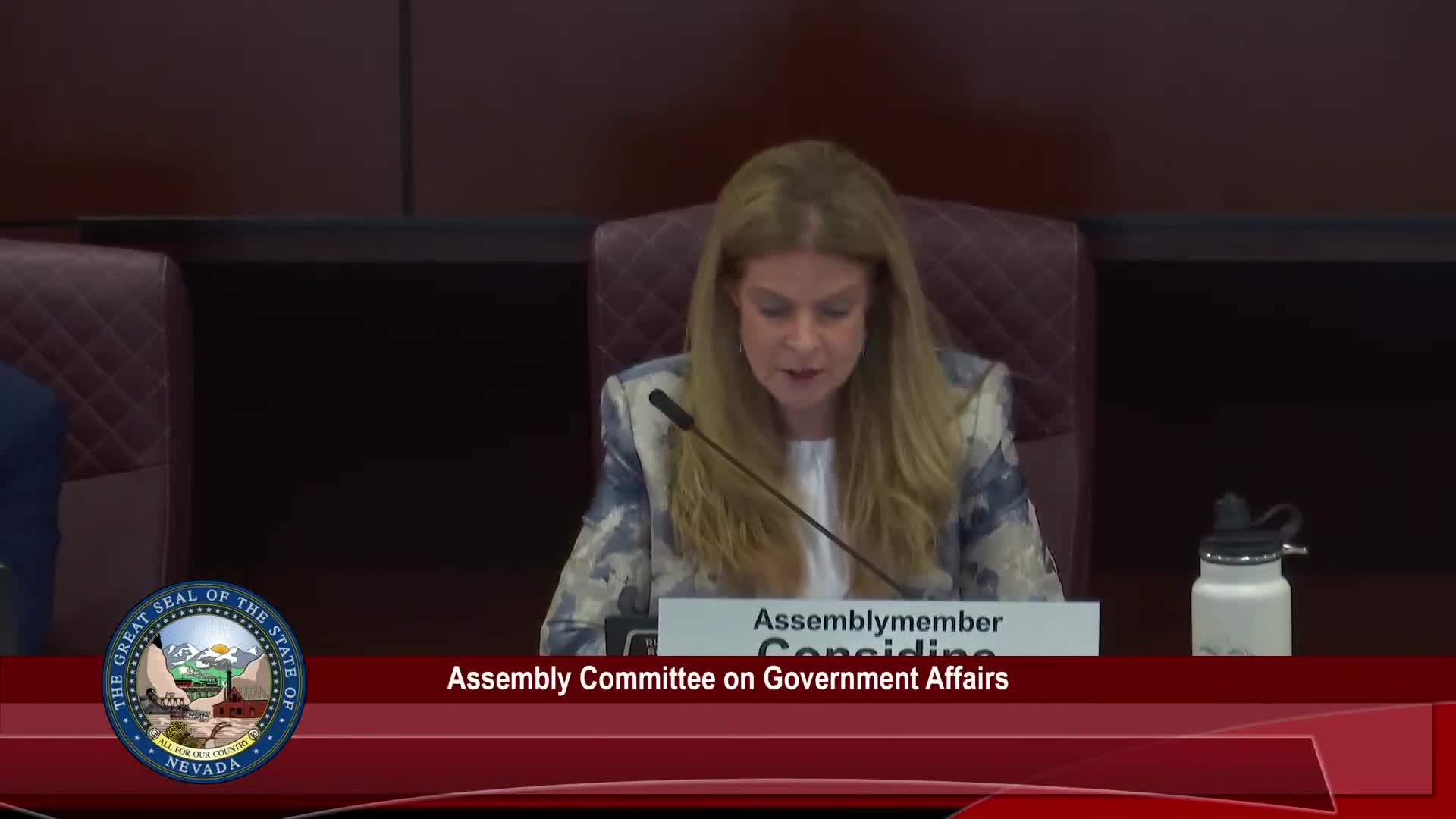
Summary
The Assembly Committee on Government Affairs opened a hearing Jan. 19 on Senate Bill 507, a budget implementation bill that would fund an Office of Nevada Boards, Commissions and Council Standards by charging licensing boards fees to cover the office’s costs.
The Assembly Committee on Government Affairs opened a hearing Jan. 19 on Senate Bill 507, a budget implementation bill that would implement a long‑term funding plan for the Office of Nevada Boards, Commissions and Council Standards within the Department of Business and Industry (DBI). The bill would allow the office, by regulation, to prescribe fees to recover costs and set up an account to administer those fees; DBI officials said they plan to bill boards quarterly and ‘‘true up’’ and refund any unexpended money at the end of each year.
Madison Ryan, program analyst with the Legislative Counsel Bureau Fiscal Analysis Division, told the committee SB 507 would implement the office’s long‑term funding plan following enactment of SB 431 in the 2023 session and noted the Senate adopted amendments that add provisions relating to transportation network companies (TNCs) and taxicabs. "The bill as amended now also revises provisions relating to transportation network companies and taxicabs," Ryan said. She told the committee the money committees previously approved funding for 11 positions to be paid from cost‑allocation reimbursements over the 2025–27 biennium and two additional positions with general‑fund support in fiscal 2026, contingent on enabling legislation that allows cost allocation.
Why it matters: The proposal centralizes some administrative support for 34 licensing boards under DBI and replaces multiple separate approaches to reporting, procurement and administrative services with a single office funded by fees charged to the boards. Supporters say it will create consistent standards and a small team of experts that individual boards can draw on; opponents say the change shifts costs to licensees and risks subsidizing weaker boards with money from efficient, self‑funded agencies.
DBI testimony and cost model DBI Director Chris Sanchez and administrative services officer Emily Surby (listed in the record as the department presenter) walked committee members through how the cost allocation would work. Surby said the department estimated total board revenue at about $54,787,000 for fiscal 2025 and that the office would bill boards quarterly for a legislatively approved budgeted amount (DBI gave examples of approximately $706,000 in year 1 and $1.4 million in year 2). At year end the office will perform a true‑up and refund unspent funds to boards pro rata based on the same allocation percentages.
Surby said the allocation is based strictly on licensee count across the 34 boards (licensees as a share of the total determine each board’s percentage). She gave two examples used in DBI’s model: the Landscape Architecture Board would pay roughly 0.14% of the office budget (about $973 in year 1) and the State Contractors Board would pay about 6.9% (about $48,000 in year 1); DBI said the contractors board’s estimated annual revenue is more than $8 million, so the cost allocation would be small relative to that board’s budget.
DBI said the office staff would not replace existing board staff; rather, an 11‑person office would provide shared services such as accounting, an administrative law judge and other expertise. Sanchez told the committee the department intends to post regular reports on a boards portal and to provide interim updates to the legislature, with an expected cadence set in regulation (the director said quarterly reporting was likely).
Transportation amendments and stakeholder concerns The Senate adopted late amendments that added two sections (reprinted in the hearing as sections 8.3 and 8.7) addressing which regulatory authority may collect a particular fee and how a ride referred from a TNC to a taxicab would be classified. David Goldwater of Pinion Public Affairs, representing a transportation‑technology vendor identified in the record as Captain, asked the committee to remove section 8.7 from the reprint and keep only section 8.3. Goldwater said stakeholders concluded section 8.7 — language attempting to classify a ride handed off from a TNC to a taxicab as a taxi ride for regulatory purposes — raised operational and legal questions that should be worked out in the interim rather than adopted in the heat of session.
Yoniq Wilburn, administrative attorney for the Nevada Transportation Authority (NTA), told the committee Nevada law creates separate statutory schemes for taxicabs and transportation network companies (citing NRS 706 and NRS 706A). Wilburn said the schemes differ on metering, surge pricing and existing fee/tax structures, in part because Clark County also has a separate Taxicab Authority; she said those differences explain why stakeholders want to resolve cross‑jurisdictional questions by further discussion rather than finalizing section 8.7 now.
Stakeholder testimony Several witnesses testified in opposition. Richard Perkins, representing Yellow Checker Star Transportation in Southern Nevada, said the amendment reached the Senate without adequate stakeholder input and expressed particular concern about section 8.3 (which delineates which authority may collect the fee) and the removed section 8.7. Perkins also said he understood the current taxicab “tech” charge to be $0.20, and he opposed what he said would be an effort to expand technology fees absent broader stakeholder review.
Alexis Moderex of the Nevada chapter of the Associated General Contractors said she opposed SB 507’s impact on the State Contractors Board. Moderex said contractors pay license fees that fund their board and that moving some costs into a shared allocation — even if small in dollar terms — would be an additional charge to contractors and could reduce services licensees currently receive.
Patty Mamola, a former chair of Nevada’s Board of Engineers and Land Surveyors, testified in opposition and said the allocation model charges smaller boards the least even though they may need the most support. She said the bill could add costs to licensees without corresponding benefits to public protection.
Questions and clarifications from the committee Committee members asked several questions about (1) whether boards would see a cap or limits on travel or other discretionary expenditures (DBI said that topic had not been discussed and that travel caps were not included in SB 507), (2) how the allocation percentage is calculated (Surby: licensee count), (3) whether cash balances would be refunded (Surby: yes, by percentage at true‑up), (4) whether struggling boards would be forced into the allocation (Sanchez: DBI identified three boards struggling financially and said the department is working with LCB and Fiscal to address those boards; he said those boards would not be part of the cost allocation until resolved), and (5) whether fee regulations would go through the Legislative Commission and whether budget changes would go through the Interim Finance Committee (Ryan, LCB fiscal: regulatory fees go through the Legislative Commission; office budget changes requiring additional positions or revenue through IFC).
Outcome and next steps The committee closed the SB 507 hearing with no vote taken. Members and presenters asked to continue working with stakeholders in the interim on the transportation‑fee language (in particular section 8.7) and for DBI to provide the committee the detailed allocation percentages and the board‑by‑board estimates used in its model. DBI said it would post board reports on its web portal, aim for quarterly reporting, and return to interim committees with updates.
Ending: The committee recessed and later closed the hearing. No committee action or recorded vote on SB 507 occurred during the Jan. 19 session.