
Minnesota House adopts education-policy substitute; narrow votes on start-date and discipline amendments
Get AI-powered insights, summaries, and transcripts
Subscribe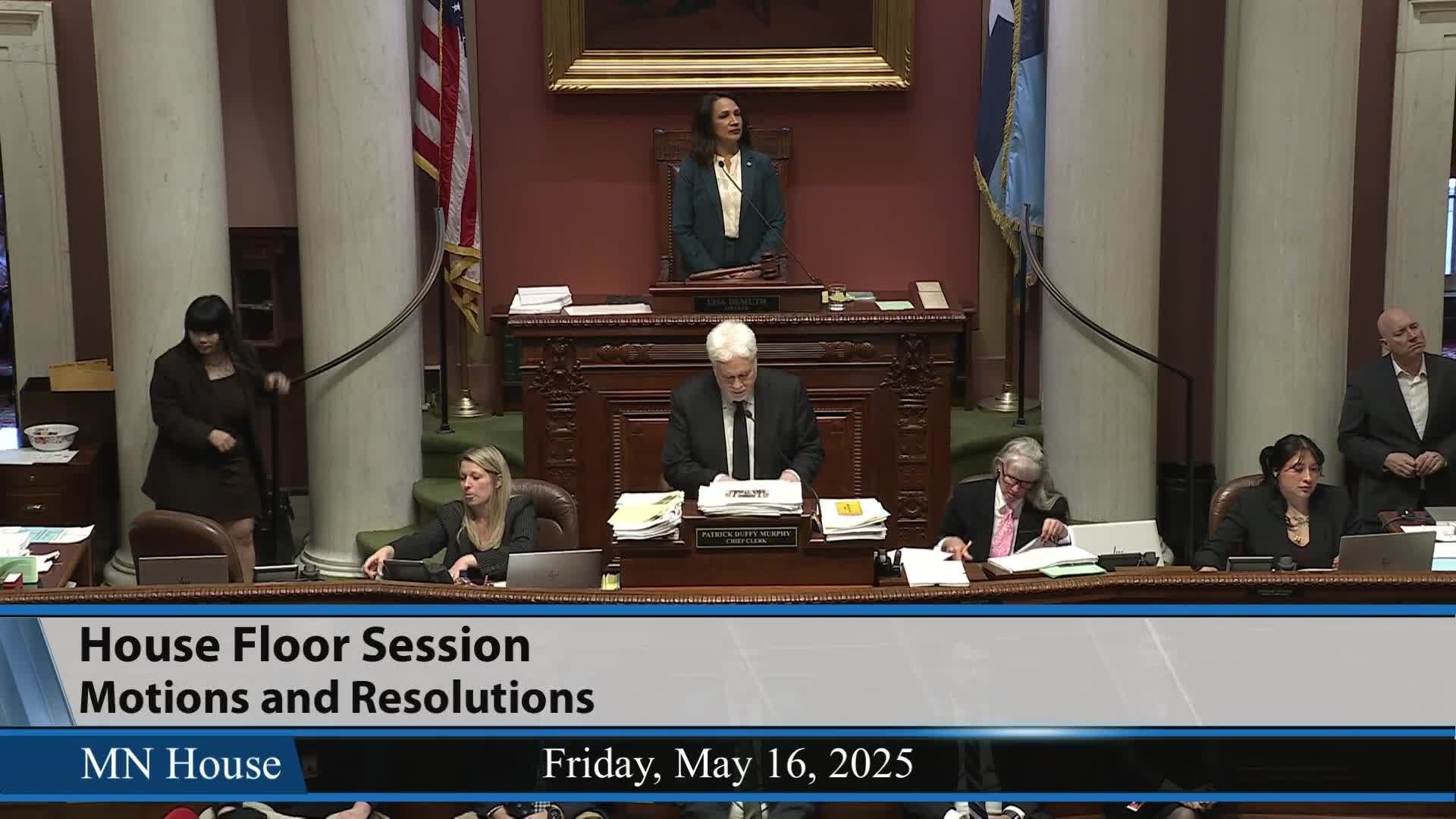
Summary
The House passed Senate File 1740, a substitute education policy bill incorporating House language and several adopted amendments that give districts two-year start-date flexibility; contentious amendments to restore suspensions and broaden disciplinary options failed or were narrowly rejected during floor debate.
The Minnesota House on May 16 passed Senate File 1740 (substituted with House language), an education-policy package that includes temporary calendar flexibility for school districts and a series of technical and programmatic provisions. The final passage was 131 yays to 3 nays.
Members debated several high-profile amendments during third reading. A floor amendment that would allow districts temporary flexibility to start school before the day after Labor Day for the 2026–27 and 2027–28 school years, provided they do not begin before Sept. 1, was adopted 84–46. Two separate amendments that would have restored broader suspension authority for young students and clarified exclusions of nonexclusionary discipline failed on tied votes of 67–67.
The bill as passed keeps multiple committee-level changes and technical fixes. Provisions in the adopted substitute and amendments include a short-term exception to the Labor Day start-date restriction for two school years (not earlier than Sept. 1), expanded language on charter and innovation programs, changes to substitute-teacher rules and pilot authority, and technical updates on special education dispute processes and allowances for stock epinephrine in schools.
Supporters said the temporary calendar flexibility responds to unusual Labor Day dates in two upcoming years and gives districts local control to avoid losing instructional days or pushing school end dates later into June. Representative Joachim, who explained a start-date amendment based on house file 1124 language, described the proposal as “a thoughtful compromise” that preserves the Sept. 1 floor while giving districts options for school years with late Labor Day dates.
Opponents — many representing Greater Minnesota and resort areas — argued the change would harm local economies and family traditions that cluster around the Labor Day weekend, and urged members to protect the long-standing late start. Representative Bliss and others warned the move would take weeks out of short resort seasons and reduce revenue for small businesses.
On school-discipline changes, backers of restoring limited suspension authority for early grades urged that administrators and staff face unsafe classrooms and need a concise tool to remove a student for a short time while teams plan supports. Opponents cited state data on disproportionate suspensions among students of color and students with disabilities and urged continued use of nonexclusionary practices and focused supports. Representative Frasier and others pointed to Department of Human Rights and Department of Education analyses showing large disparities in past suspension patterns and recommended caution before reversing the nonexclusionary approach.
After votes on multiple amendments, the House adopted the substitute and passed the bill. Sponsors said they will continue work in conference committee with the Senate on outstanding fiscal and policy issues.
Votes at a glance: amendment adopting house language (substitute) — adopted; start-date amendment (a1) — adopted 84 ayes, 46 nays; disciplinary amendment a3 (restore K–3 suspension authority) — failed (tie) 67 yeas, 67 nays; amendment a4 (alternate discipline compromise) — failed 67 yeas, 67 nays; final passage — 131 yeas, 3 nays.
The bill’s supporters noted that other education and funding bills remain to be resolved in conference, and they framed SF 1740 as a policy package aimed at local control, innovation authority and technical fixes rather than a large new spending plan.