
Chief Justice Natalie Hudson warns judicial funding in conference agreement risks access to justice
Get AI-powered insights, summaries, and transcripts
Subscribe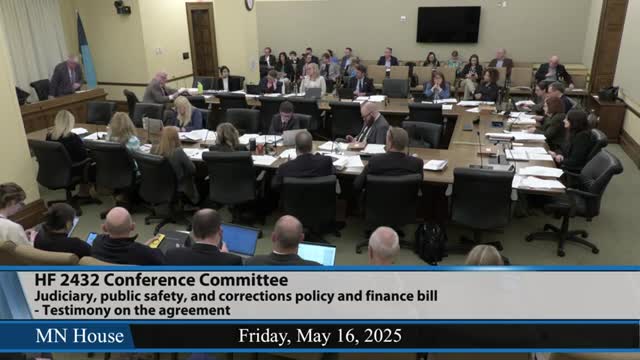
Summary
At a May 16 Public Safety and Judiciary Conference Committee hearing, Chief Justice Natalie Hudson testified that the conference agreement’s funding leaves judicial salaries frozen, undercuts recruitment and retention, and risks timely access to justice despite modest investments included in the package.
Chief Justice Natalie Hudson told the Public Safety and Judiciary Conference Committee on May 16 that the conference agreement includes modest funding but does not address what she called the judiciary’s most urgent need: staffing and pay to maintain timely access to justice.
"Without a stable, well supported workforce, our ability to provide timely access to justice will be at serious risk," Chief Justice Natalie Hudson said, speaking on behalf of "the 322 judges and approximately 2,800 staff who serve in the Minnesota judicial branch." She said the agreement provides some one-time dollars and limited pay increases but leaves judicial salaries frozen for two years.
Hudson said the judiciary was not consulted when the branch’s budget target was set and urged fuller consultation going forward. "As a coequal branch of government, we must be meaningfully included in decisions of this magnitude," she said.
Why this matters: Hudson framed courts as a constitutional institution that enforces rights, resolves disputes and is essential to democracy. She told committee members the judiciary already lags the public sector on compensation, that applicant pools for judgeships—especially in Greater Minnesota—have declined, and that the judicial branch is seeing employees leave for higher-paying local and state jobs.
The conference agreement does fund several judicial priorities Hudson listed: increases to cover insurance and compensation costs; a pay rate increase for forensic psychological examiners; and one-time funding to develop a Justice Partner Access system to improve information sharing. But Hudson said much of the funding is one-time and will not stop a longer-term decline in competitiveness for employees and applicants to judgeships.
State Court Administrator Jeff Shorban appeared with the chief justice and took no substantive issue with her characterization of the court system’s needs during the hearing, instead offering to answer technical questions from committee members.
Committee members voiced support for Hudson’s concerns on the record. Chair Latz told Hudson he shared her disappointment that legislative leaders had set the judicial target without apparent consultation. Chair Scott said there was no reason for the executive branch to pre-clear legislative work before the conference committee took it up.
What the committee did: The hearing included adoption of separate policy and technical provisions that affect the judiciary (for example, a provision to protect judges’ real property records and a Justice Partner Access provision). Committee votes on those items occurred later in the session; the conference committee adopted an overall spreadsheet that the chairs directed nonpartisan staff to convert into a formal report. The committee did not adopt any additional permanent salary increases for judges in the conference agreement presented that evening.
Context and next steps: Hudson noted the Commission on Judicial Selection has reported a nearly 50% drop in applicants for open judgeships over the past decade in some areas, and said the chief justice’s office expects continued difficulty recruiting qualified candidates if salaries remain stagnant. Committee chairs said they would continue to work with the judiciary and requested more consultation going forward.
Ending: Hudson closed by underscoring courts’ constitutional role and saying, "Failing to invest in the courts is not just a budget decision. It is a decision about the kind of justice system that Minnesotans will have." Committee chairs thanked her and said they would seek ways to address the branch’s concerns in future work.