
Conference committee adopts decommissioning study and phased closure language for Stillwater Correctional Facility
Summary
The conference committee adopted an amendment (A39) directing a decommissioning study and requiring a written closure plan for the Stillwater Correctional Facility; union representatives and corrections staff warned the committee that a rapid phase closure without a detailed plan could endanger staff and inmates.
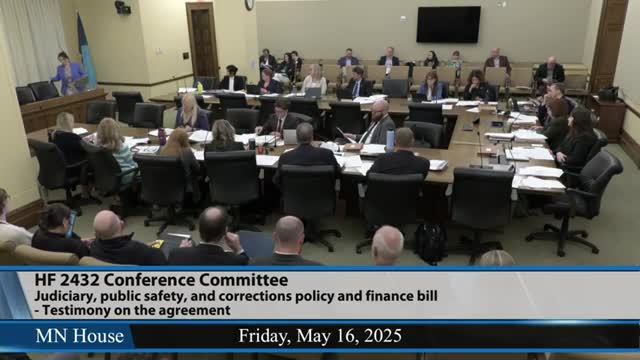
The Public Safety and Judiciary Conference Committee on May 16 adopted an amendment (A39) that requires a decommissioning study and a written plan for a phased closure of the Stillwater Correctional Facility.
Representative (Chair) Muller moved adoption of the A39 amendment with an oral change moving a study deadline from December 31 to September 30; the motion passed on voice vote. The amendment includes an appropriation for a decommissioning study and requires the Department of Corrections commissioner to develop a written plan addressing staffing, transfers, program continuity, property cleanup and potential future uses for the site.
Union and corrections staff representatives urged the committee to reject or delay closure until a full plan exists. Devin Bruce, director of legislative affairs for MAPE, said the statutory process requiring legislative approval before closing a facility was being undermined and that the administration had begun transfers before the decommissioning study was completed. "The process that we're witnessing today for the closure of Stillwater Correctional Facility is just utterly disappointing and completely adverse to the original intent of the underlying statute," Bruce said.
Ethan Vogel, legislative director with AFSCME Council 5, testified the committee should not approve closure without a concrete plan and oversight, warning of safety risks from moving Stillwater's population—"roughly 1,200 people"—into other facilities. Vogel quoted offense breakdowns for Stillwater inmates presented to the committee: "Of those 579 sentences for homicide. 470 plus sentences for assault or domestic assault... there are 248 misconduct sentences." He said shifting that population into facilities without single-cell capacity and adequate staff risks violence and harm to correctional workers.
Commissioner Paul Schnell described the studies as two-fold: an operational "management study" addressing staffing, collective bargaining and services, and a decommissioning study addressing property status, cleanup and bond issues. He told the committee that labor-management discussions required by collective bargaining agreements must occur to determine staff impacts and transfers.
What the amendment does: The A39 amendment (as adopted): - Appropriates funds for a decommissioning study (committee discussion noted $1,000,000; the department indicated those funds are being sourced by a cancellation elsewhere and labeled the item budget-neutral for the biennium). - Moves the study timeline forward (oral amendment changed the deadline from Dec. 31 to Sept. 30). - Requires the commissioner to prepare a written closure plan that addresses workforce protections, program continuity, transfers of incarcerated people, property and bonding issues, and clarifies that closure will not shorten or otherwise alter individual sentences as a mechanism for release.
Concerns and next steps: Union witnesses and some committee members said the timetable and leadership agreement that brought closure language to the conference committee allowed too little public vetting and stakeholder engagement. Several chairs urged continued legislative oversight; Chair Latz proposed a joint update in September to receive progress reports on the decommissioning work. Commissioner Schnell said the timing of some actions reflected operational realities and that required bargaining and management conversations will drive the specifics of staff protections and transfers.
Ending: The committee approved A39 with the incorporated date change. Committee members said they expect ongoing updates and stakeholder engagement as the department carries out the decommissioning study and implements any phased closure plan.