
Board supports bill to preserve LVN suctioning in schools as Respiratory Care Board advances rulemaking
Get AI-powered insights, summaries, and transcripts
Subscribe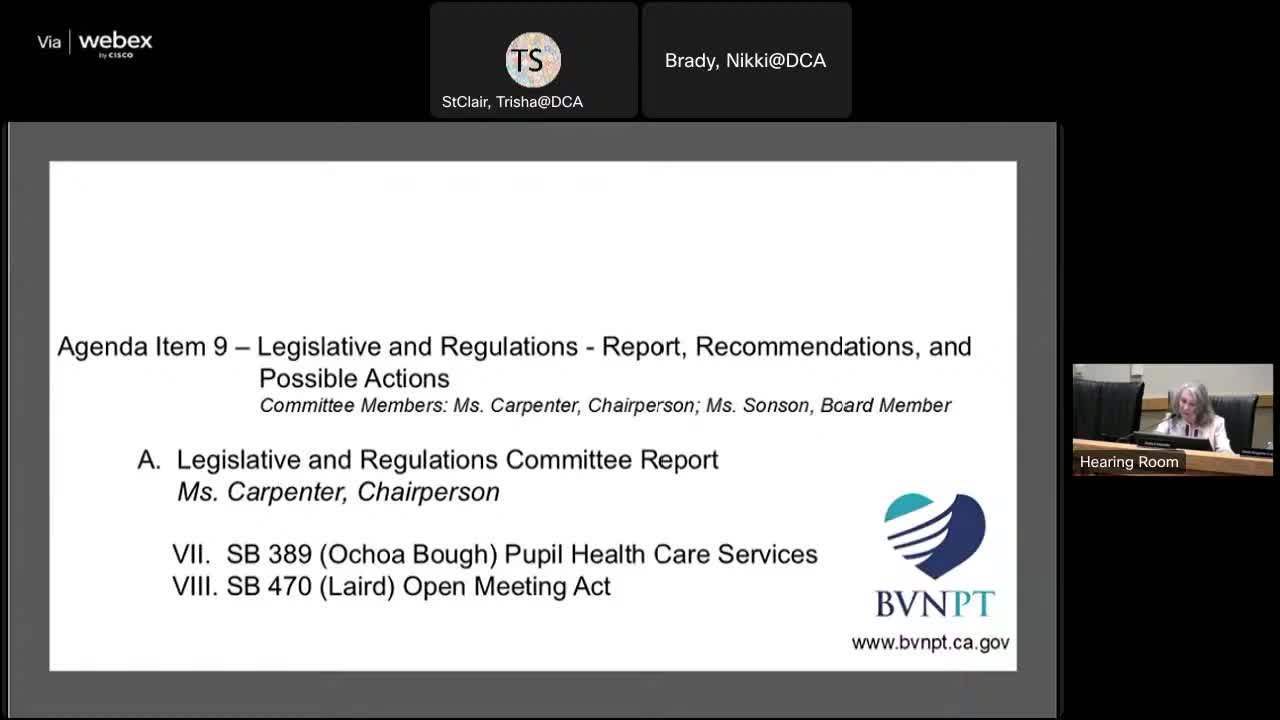
Summary
The Board of Vocational Nursing and Psychiatric Technicians voted to support SB 389, a measure aimed at protecting school-based licensed vocational nurses' ability to provide basic respiratory services, while staff warned the Respiratory Care Board's separate rulemaking could narrow LVN practice in other settings.
The Board of Vocational Nursing and Psychiatric Technicians voted to support Senate Bill 389, which the board says is intended to preserve licensed vocational nurses' ability to deliver basic respiratory care in school settings.
Executive Officer Elaine Yamaguchi told the board the Respiratory Care Board (RCB) has advanced a rulemaking package that could narrow the circumstances in which vocational nurses perform suctioning and other respiratory tasks outside of regulations the RCB is now developing. "The Respiratory Care Board would recommend that vocational nurses not be allowed to do suctioning," Yamaguchi said, describing RCB discussion of carve-outs for home health and congregate-care settings and noting pushback from school-nurse advocates.
Nicholas Gonzales, the board's education analyst, briefed members on the amended language of SB 389 and the policy context. Gonzales said the bill would add a statutory cross-reference allowing an LVN working under a credentialed school nurse to perform basic respiratory services as defined under Business and Professions Code section 3765, while recognizing that a defined regulatory definition of "basic respiratory services" remains unresolved. "We do not have a defined basic respiratory tasks and services in regulation," Gonzales said, adding that the lack of regulatory detail is a gap the respiratory care rulemaking needs to fill.
Public commenters urged the board to protect LVN practice. Shirley Jones, representing an LVN organization, said LVNs have long performed suctioning and warned of risks if that care is restricted. Christina Curry, an LVN instructor, asked how LVNs can protect that scope and sought reassurance that school-based services would be preserved.
The board said it will monitor RCB rulemaking and continue engagement with stakeholders. Members voted to support SB 389 at the meeting; staff said they will notify and coordinate with affected parties as further rule language emerges.
Why it matters: Suctioning can be a critical, time-sensitive intervention for patients with tracheostomies and other respiratory needs. Changes in the RCB's regulations or statutory cross-references could affect how schools, home health agencies and residential-care providers staff and supervise patients who require respiratory care.
What comes next: The RCB's rulemaking will proceed through internal review at the Department of Consumer Affairs and the Office of Administrative Law; the board said it will bring developments back to the board for discussion and possible action as regulatory text becomes available.