
House passes education finance bill including indexing, READ Act funds and UI sunset; vote 93-41
Get AI-powered insights, summaries, and transcripts
Subscribe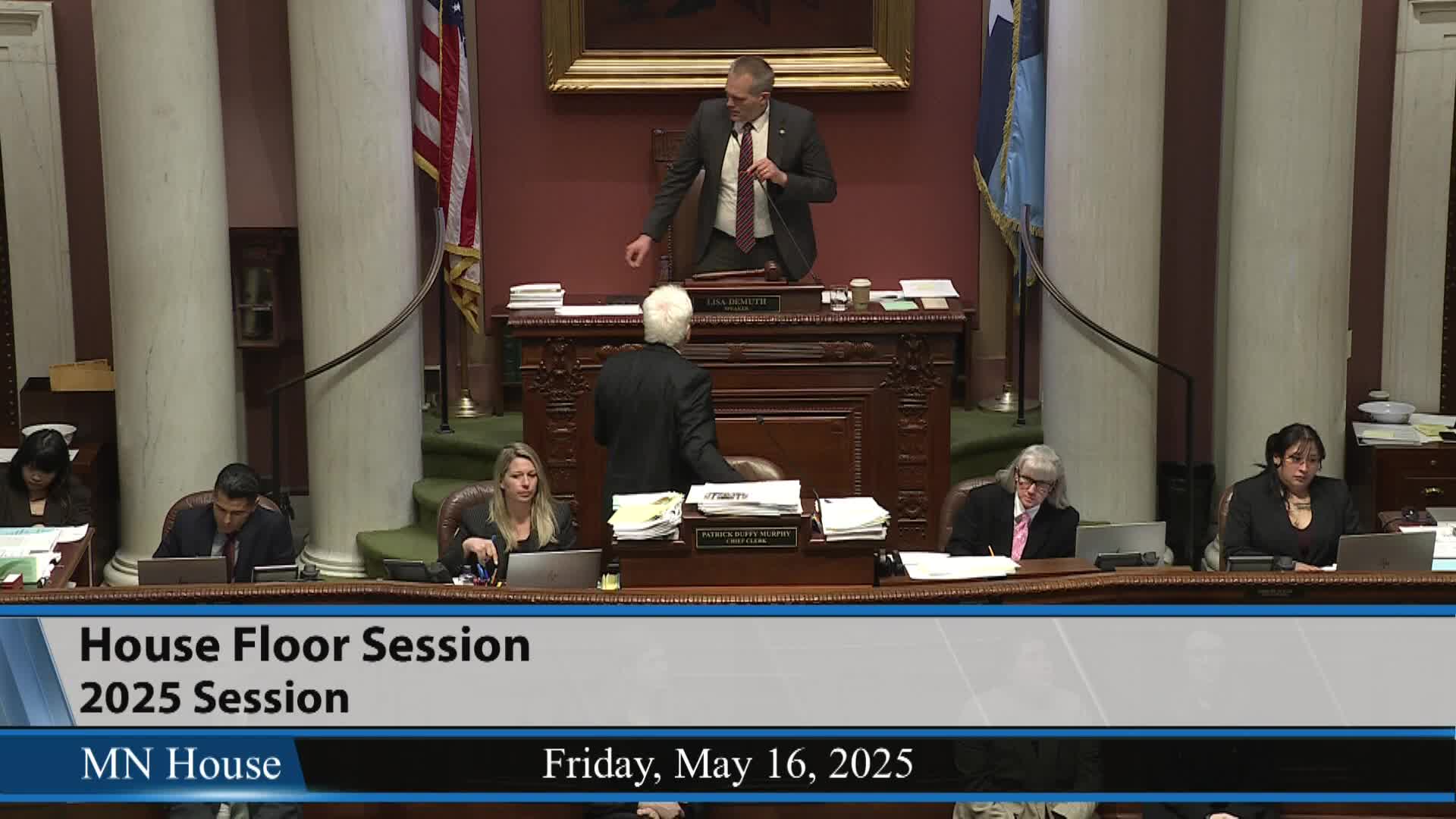
Summary
The Minnesota House voted 93 to 41 to pass House File 2433, the education finance bill, following floor debate that covered formula indexing, READ Act funding, compensatory aid concerns and a contested provision that sunsets unemployment insurance eligibility for hourly school workers after the summer of 2028.
The Minnesota House voted 93 to 41 to pass House File 2433, the education finance bill, following floor debate that covered formula indexing, READ Act funding, compensatory aid concerns and a contested provision that sunsets unemployment insurance eligibility for hourly school workers after the summer of 2028.
The bill’s supporters said it provides stability and flexibility for districts; opponents warned the unemployment provision and other cuts would hurt hourly school employees, staff retention and some smaller districts. The bill moves to conference committee with outstanding issues, including compensatory aid and negotiations with the Senate and governor.
Representative Joaquin, identified in debate as the bill author, said indexing the general education formula to inflation gives school districts “stability and predictability” and is necessary because prior underinvestment left districts with gaps the state still must close. Joaquin also noted the bill preserves many program baselines and adds the $40,000,000 READ Act allocation for the first biennium.
Representative Joakim (co-chairing negotiations in remarks presented earlier in debate) described House File 2433 as a compromise that preserves major prior-session provisions while adding flexibility districts requested, including a new basic supplemental aid (BSA) account that districts may use more flexibly than prior targeted pots of money. Joakim said the bill’s target included $40,000,000 in the first biennium for the READ Act and that policy changes were kept “to a minimum.”
Representative Kreisha (Education Finance chair) summarized policy provisions and said the bill includes a task force to reexamine the compensatory revenue formula, and that one of the more contentious policy changes—the repeal date for unemployment insurance eligibility for hourly school workers—remains subject to debate. Kreisha said the changes are intended to give districts flexibility to “solve these problems locally.”
Several members described district-level impacts if compensatory aid is not addressed. Representative Hansen said South Saint Paul faces a $1,500,000 loss under current calculations—about $517 per student—and urged further work in conference to avoid what she called a “compensatory cliff.” Representative Feist, who represents Columbia Heights, said Columbia Heights would lose about $1,080 per student under the current formula and praised the bill’s task force for beginning a review of how compensatory dollars are targeted.
A recurring theme in debate was support for the READ Act (reading/literacy funding and implementation). Representative Mueller, who spoke at length on Article 11 (the READ Act provisions moved into this bill), described provisions that set a “science of reading” rubric for curriculum, expand options for teacher professional development in reading instruction, and redirect some prior contractor funding back to districts. Mueller cited Monroe Elementary School’s reported gains after adopting science-of-reading approaches as evidence the provisions can produce results.
On the unemployment-insurance (UI) issue, several members voiced strong opposition to the bill as written. Representative Greenman, Representative Hill, Representative Green and others said removing UI eligibility for paraprofessionals, bus drivers, food service workers and other hourly school employees would remove a recent safety net those workers had gained and would undermine workforce stability. Those speakers gave personal and constituent examples of hourly workers who relied on the benefit. Supporters including Representative Joakim and Representative Kreisha argued the UI provision was a mechanism decision driven by budget constraints, expressed a desire to find other employment solutions for summer months, and said the bill provided other protections and flexibility.
The bill also reallocates or reduces growth in several funding streams: it slows growth in per-pupil aid, creates a basic supplemental aid account by reallocating several smaller pots (including library funds), reduces the special education transportation reimbursement rate (from 100% to 95% as described on the floor), funds long-term facilities maintenance, consolidation transition aid, and captures approximately $2,000,000 of MDE funds that would otherwise have returned to the general fund for use in the bill.
Floor action began with Representative Nisga’s motion to take House File 2433 from the table; that procedural motion was agreed to by voice vote and the chief clerk gave the bill its third reading. After debate the roll was called remotely; the chief clerk announced there were 93 yays and 41 nays and "the bill is passed and its title agreed to." Two recorded remote votes read on the roll were Katiza Wautoon (aye) and Kraft (aye). The bill will proceed to conference committee for negotiations with the Senate and the governor’s office.
Discussion-only items, directions to staff and formal action are separated in the record: the House took formal procedural action to remove the bill from the table and then voted to pass the bill on final passage; the compensatory aid task force and conference negotiations were described as ongoing directions rather than final actions.
Votes at a glance House File 2433 (education finance) — Final passage — Yea: 93; Nay: 41 — Outcome: passed.
(For details recorded on the floor: the chief clerk read select remote yes votes during the roll; the clerk announced the final tally and passage.)
Representative quotations are taken from the House floor debate as recorded in the legislative transcript.