
White County committee backs pay-scale increase approach; longevity and health insurance remain unresolved
Get AI-powered insights, summaries, and transcripts
Subscribe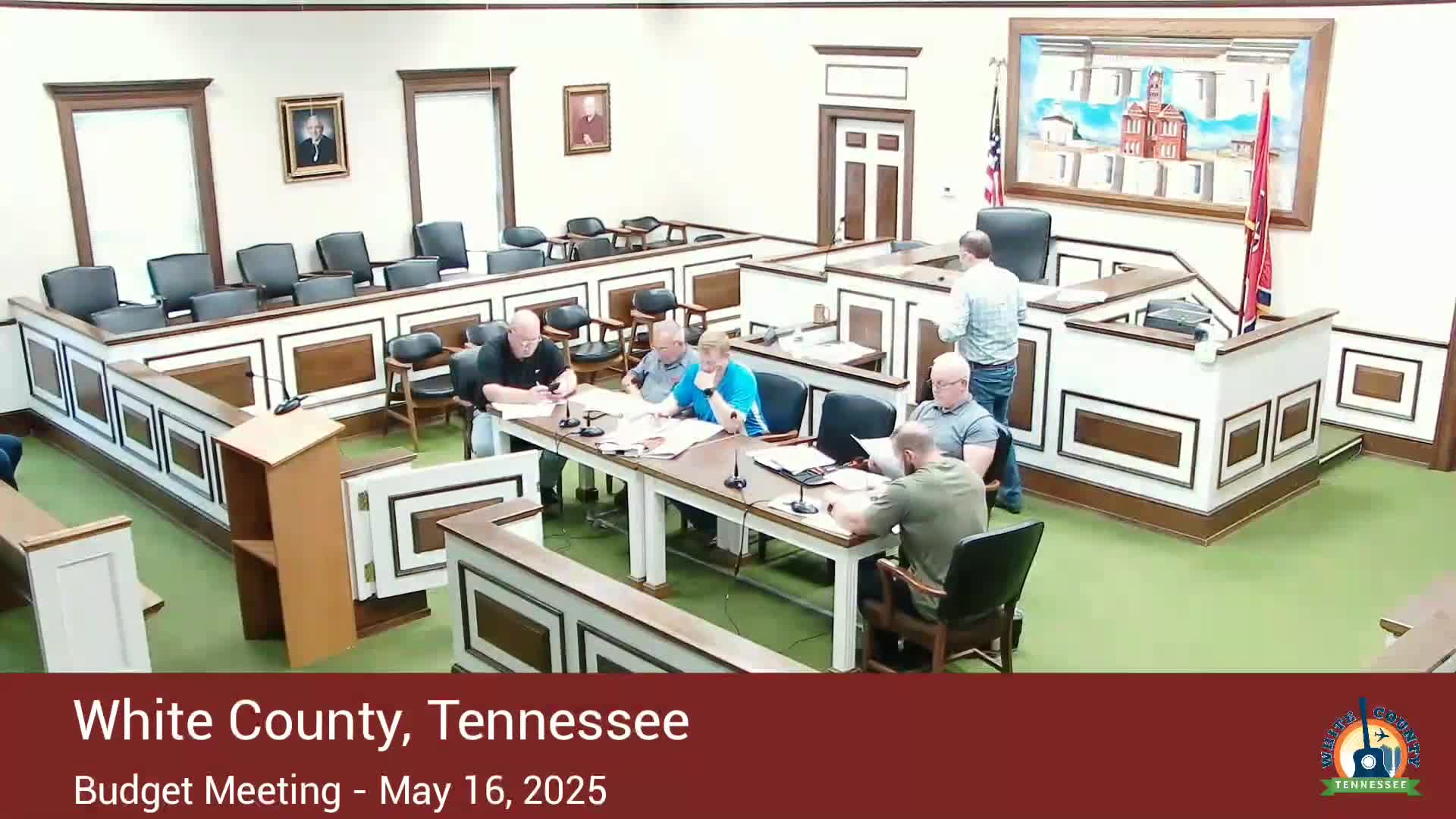
Summary
The budget meeting discussed a county-wide pay-scale change averaging ~15% plus an additional $1/hour in many grades, longevity bonuses, detective/sergeant pay alignment and the county health-insurance match. Committee members discussed options to reallocate tax pennies to cover insurance, but no final decision was made.
The White County Budget Committee spent substantial time on employee compensation and benefits during its special-call meeting, reviewing a pay-scale proposal staff labeled the “original” pay schedule and several alternatives that trade pay increases for head-count reductions.
Staff said the pay proposal in the packet averages about a 15% increase across positions and includes an additional $1/hour increase layered on top of that scale in the staff’s “original” scenario. That package — combined with other budget lines — is the basis for the levy adjustments under discussion.
Positions and pay-grade alignment: staff described roughly ten requested positions that could be deferred under some scenarios (five EMS positions, four for the sheriff’s department and one for county buildings). Committee members also discussed internal grade alignment: patrol detectives were moved by staff into the same grade as patrol sergeants in the current scale and several members asked staff to raise detective pay to a higher subgrade so detectives would be paid above sergeants.
Longevity pay and IRS treatment: staff explained longevity as a one-time supplemental payment added to a payroll check and subject to standard IRS withholding; it would be paid on a regular payroll check (staff offered December as an example) unless the board instructed a different method.
Health insurance: staff reported the county currently pays 92% of employee-only coverage on the plan tier the county uses as its baseline and pays about 65% on dependent tiers (employee + child, spouse or family). Meeting figures showed roughly 67% of eligible county employees currently use the county plan; staff provided counts during the meeting (for example, 106 employees on employee-only coverage and additional employees on dependent tiers, as stated during the session). The staff estimate for employee-only coverage at the county contribution level is roughly $50.16 per month.
Trade-offs discussed: some commissioners proposed using one penny from the capital or school allocation to partially fund a higher county insurance contribution. Other members cautioned that redirecting a penny would reduce money available for capital projects or school allocations and that roughly one-third of eligible employees — as reported in the meeting — do not take county coverage; commissioners warned that shifting the cost could incent additional enrollments and change the fiscal math.
Outcome and next steps: the committee did not adopt a final benefits package. Members asked staff to include longevity, the pay-scale changes, and insurance-cost options in the resolution that will go to the full commission so the full body can weigh the trade-offs and adopt final funding.