
Washoe County, Nevada Humane Society adopt shared protocol to keep dangerous dogs out of the community
Get AI-powered insights, summaries, and transcripts
Subscribe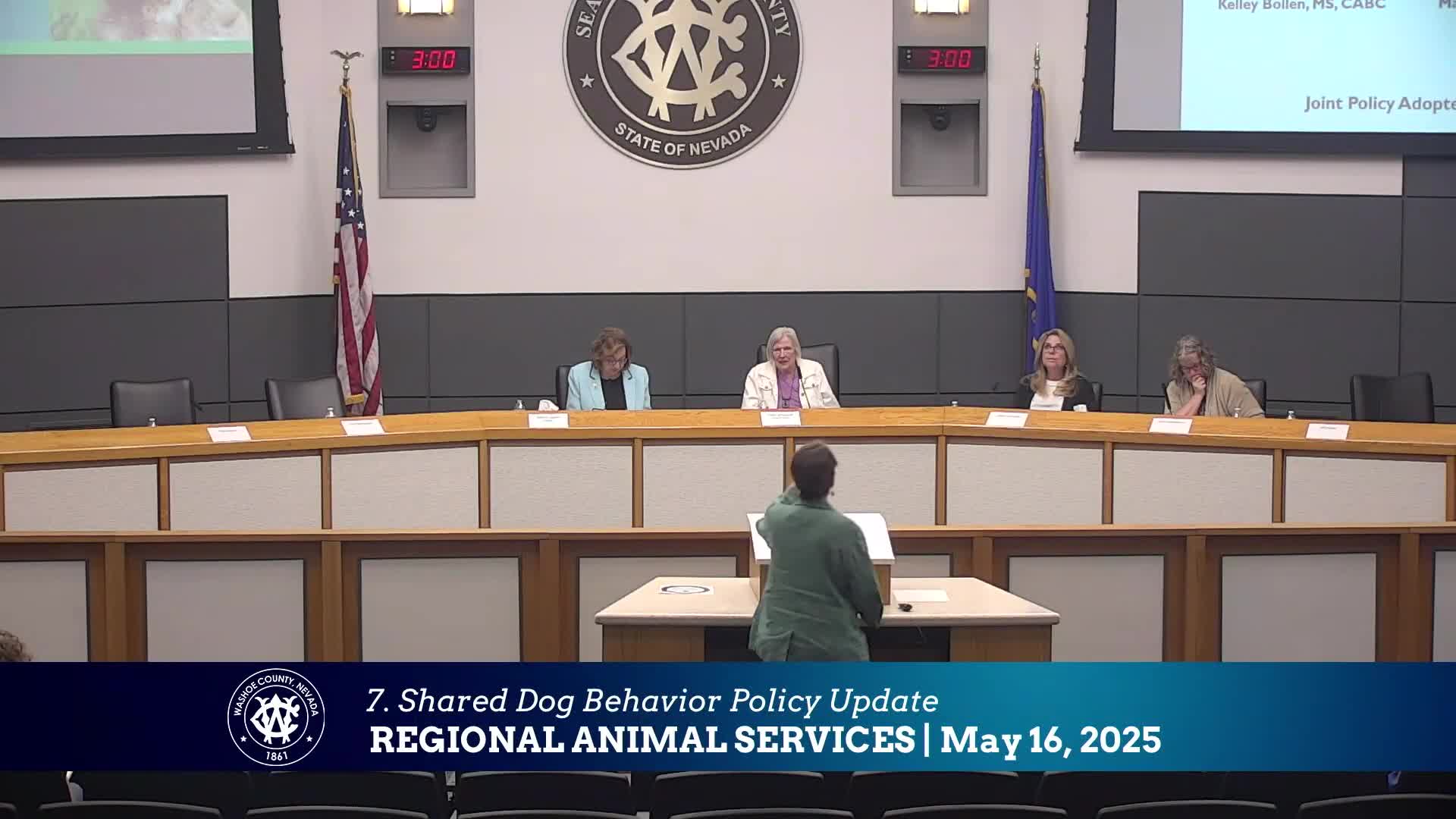
Summary
Behavior consultants for Washoe County and Nevada Humane Society presented a joint protocol that sets assessment steps and euthanasia criteria for dogs that show dangerous levels of aggression, using the Dunbar bite scale to define risk thresholds.
Behavior consultants for Washoe County and the Nevada Humane Society presented a joint dog-behavior protocol on May 16 that outlines how both organizations will identify dogs with dangerous levels of aggressive behavior and set euthanasia as the humane outcome when public safety and animal welfare require it.
Kelly Bolen, the county-contracted behavior consultant, said the document is intended to create shared, objective standards for assessing risk and to avoid returning dogs to the community when they pose a danger. "Dangerous dogs should not be returned to the community," Bolen told the advisory board. "This shelter recognizes that dogs that exhibit dangerous levels of aggressive behavior to humans and other animals must not be made available for adoption or rescue, but must be humanely euthanized." The protocol is the product of joint work between WCRAS and NHS behavior staff.
The policy defines criteria and assessment steps: review of any behavioral history, medical exam findings, standardized in-shelter behavior documentation, formal behavior evaluation (when safe), and documented behavior observed in foster or adoptive homes. Bolen told the board that the Dunbar bite scale will be used to classify bites: level 1 (air snap) through level 6 (fatality).
The agreed euthanasia threshold in the protocol is explicit: any dog with a history of a level 4 through 6 bite that broke skin with severe damage, or a dog with multiple level 3 bites across incidents, will not be returned to the community. Bolen said the scale and thresholds are intended to create objective, shelter-wide criteria for dangerous bites and repeated biting.
The policy also lists other situations where euthanasia may be the safest or most ethical outcome, including dogs that kill another dog or large livestock, those that show dangerous behavior in custody or in a foster/adoptive setting, and animals whose welfare is irretrievably compromised. The protocol recognizes the welfare risks to animals and to staff from retaining dangerous dogs in shelter care.
Dr. Shelley Volsche, who leads behavior and transfer assessment at Nevada Humane Society, described cross-department checks and forensic review of bite evidence. "In times when there's uncertainty about the scoring of a bite, we will actually...show a photo and have staff score it blind," Volsche said, describing an internal practice the organization uses to ensure scoring consistency.
Board members asked about training, follow-up and consistent application. Bolen and Volsche said they will train staff on body-language observation, safe handling, documentation and formal behavior evaluations; Bolen also said she consults on difficult cases. Bolen agreed to the board chair’s suggestion to pursue periodic cross-organization review and additional job aids (visuals showing bite-depth for scoring) to keep interpretations aligned.
Ending — Implementation notes: The shared protocol is in effect as a statement of practice between WCRAS and NHS; staff training and development of supporting job aids were discussed as immediate next steps. The policy establishes a clear threshold for when both organizations will not make dogs available for adoption or transfer because of public-safety risk.