
Committee adopts Fish and Game rule 25‑48 amid dispute over wildlife data and new fur‑bearing registration requirement
Get AI-powered insights, summaries, and transcripts
Subscribe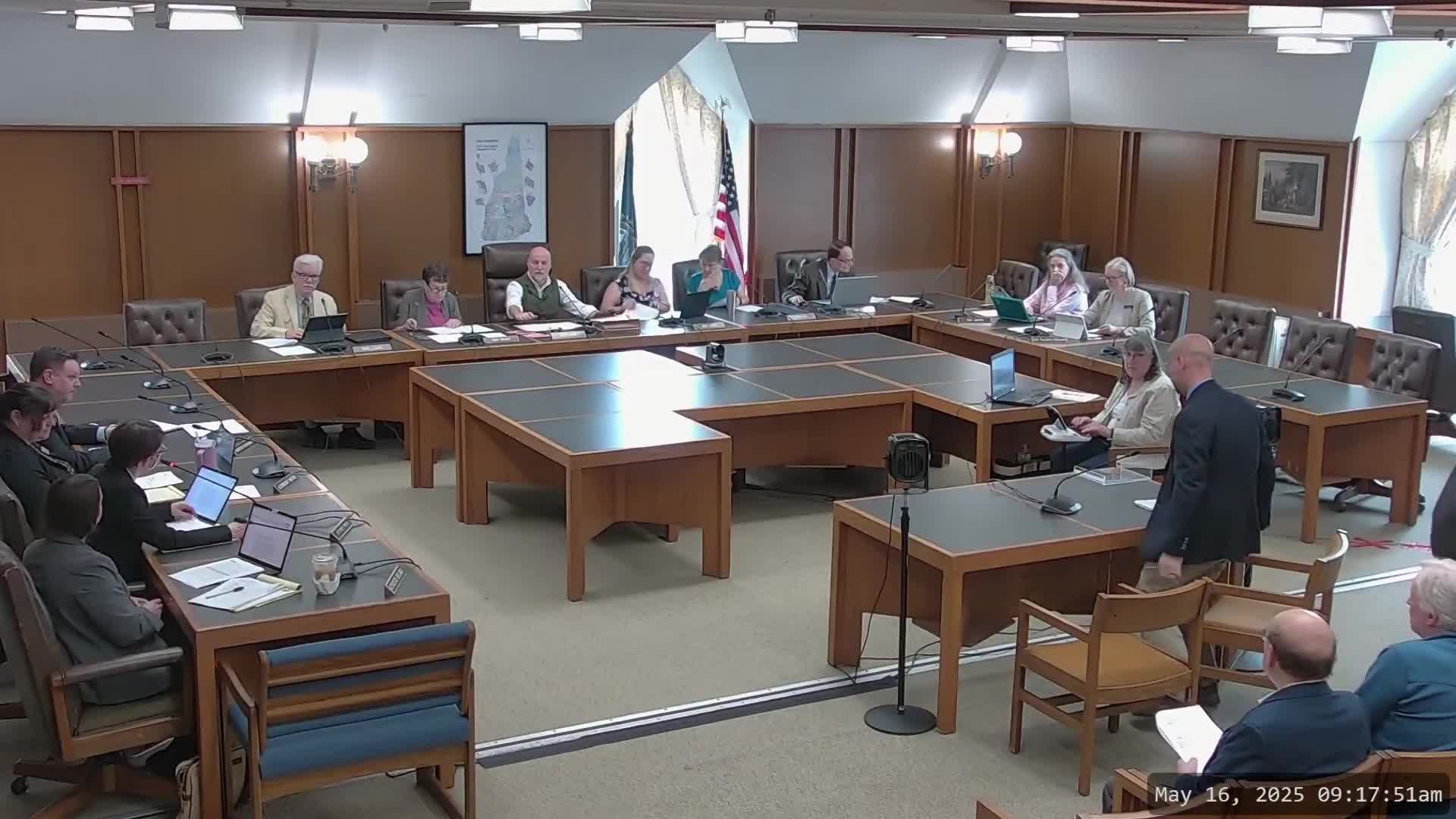
Summary
The Joint Administrative Rules Committee approved Fish and Game rule 25‑48, which updates hunting and trapping licensing and requires registration of taken fur‑bearing animals, after debate over the adequacy and sources of wildlife population data.
The Joint Administrative Rules Committee approved New Hampshire Fish and Game rule 25‑48, which revises licensing and permit requirements for deer, bear, moose, turkey and fur‑bearing animals and adds a new requirement to register taken fur‑bearing animals. The vote followed public testimony and a substantive exchange over which data sources the department should use to set seasons and limits.
Office of Legislative Services noted the agency filed a conditional approval and highlighted that public comments — including a submission from the New Hampshire Wildlife Coalition and 65 pages of written testimony — disagree with the agency about which data series should drive decisions. OLS said statutes require the executive director to investigate wildlife supply and commission scientific studies as necessary, language that gives the agency discretion but does not prescribe a single data source.
Dan Bergeron, chief of the wildlife division at Fish and Game, described the department’s data approach: historical catch‑per‑unit‑effort (CPUE) data from trappers has shown long‑term trends but is now based on a much smaller sample because trapping participation has declined; the agency has therefore begun hunter observation surveys and a camera‑trap survey with the University of New Hampshire (UNH) to develop independent indices. Bergeron said the department has also started a cause‑specific mortality study on fisher and leveraged nearly $2,000,000 in federal Pittman‑Robertson funding plus UNH match for research projects.
Game program supervisor Andy Timmons told the committee that CPUE data is now derived from a very small pool: over the last two years, 32 trappers targeted fishers — about 6% of total trapping license holders — and the most recent year saw seven fisher removed by trapping statewide. The department said hunter surveys produce roughly 600 returns from each of the 10,000 surveys sent to two hunter groups, yielding a larger sample for observation indices than current trapper CPUE data.
Weldon Bosworth, a Guilford ecologist testifying for the New Hampshire Wildlife Coalition, told the committee he reviewed the public comments and the department’s responses and concluded the responses were too general and depended on future work. Bosworth noted that CPUE and harvest data exist for decades (harvest data dating to 1922; CPUE for roughly 35 years) and warned against relying on short‑term surveys because of shifting‑baseline effects. He said multiple fur‑bearing species show substantial long‑term declines and noted widespread rodenticide exposure in fishers as a possible contributing factor.
Committee members discussed options: postpone to collect more data, approve with the understanding the agency will reenter rulemaking if new data warrants changes, or object. Chair and members said the department acknowledged limited data but explained ongoing research efforts; Representative Carol moved to accept the rule with the understanding that the agency will reenter rulemaking if the new data requires changes; Representative Leon seconded the motion and the committee approved it on a voice vote.
The rule includes a new registration requirement for all taken fur‑bearing animals; Fish and Game told the committee that the additional data will inform future management decisions and that the camera‑survey and mortality‑study results are expected soon (UNH camera results due in June, per the department). The department said it can open rulemaking at any time if emerging data indicate a need to change seasons or limits.