
Conference committee debates cutting negative SAI, warns of outsized losses for lowest-income students
Get AI-powered insights, summaries, and transcripts
Subscribe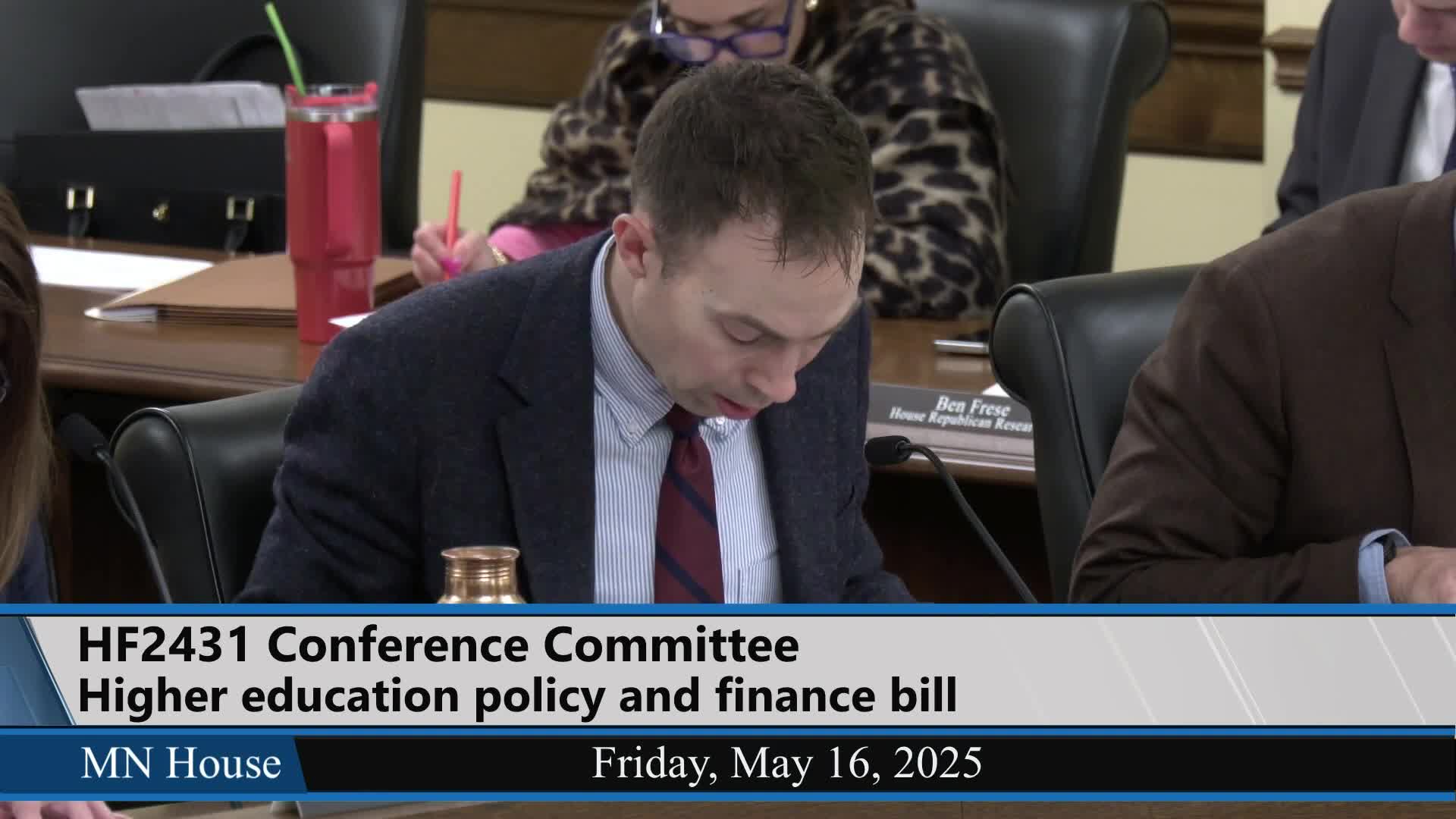
Summary
At a Minnesota Legislature conference committee meeting, members reviewed the House's second offer on higher education finance, focusing on changes to the state grant program including a proposal to recode the negative Student Aid Index (SAI) to zero.
At a Minnesota Legislature conference committee meeting, members reviewed the House's second offer on higher education finance, focusing on changes to the state grant program including a proposal to recode the negative Student Aid Index (SAI) to zero.
The discussion centered on how the change would redistribute about $87.7 million in savings and who would bear that reduction. University and college financial aid staff and system leaders warned the proposal would concentrate cuts on the lowest-income students, while members discussed trade-offs among tuition caps, program consolidations and one-time appropriations.
Why it matters: The committee is negotiating how to close a projected shortfall in the state grant program. Testimony from higher-education officials said one parameter change under consideration would shift a large share of the required savings onto students with the lowest family incomes, potentially reducing awards used for books, supplies and other non-tuition costs.
Savory, Hopkins summarize House offer
Committee staff walked members through the House's "offer 2" spreadsheet. Staff member Savory said the House adds $51,958,000 above base for the state grant program in fiscal 2026-27 and made several one-time and program-specific adjustments, including a $500,000 one-time appropriation for fast remediation at Lake Superior College and a $500,000 one-time carve-out for workforce development scholarships for law enforcement.
Staff member Hopkins reviewed unresolved policy differences between the House and Senate offers. Hopkins noted the House accepted some Senate organizational language but did not agree to roll certain menstrual-product appropriations into a rider consolidation and was moving cannabis research funding to a Center for Cannabis Research in the School of Public Health.
Warnings from financial-aid staff
Meredith Fergus, financial aid analyst, Office of Undergraduate Education, University of Minnesota Twin Cities, testified on the distributional effects of recoding the negative SAI to zero. "The worry we have about the negative SAI recoding is its disparate impact by income," Fergus said. She told the committee that the proposed change would "essentially [be] concentrating that $87,000,000 reduction on the students whose income is less than $28,000 a year." Fergus added that the lowest-income group (under $20,000 in family income) would see about an $800 reduction on average and that full-time students in that group would likely see the full $1,500 reduction.
Fergus explained the family-income metric used by the Office of Higher Education (OHE): for dependent students the calculation uses parental income; for independent students it uses student and spouse income. She said the state grant maximum is structured as a "Pell-plus" model and that state grant plus Pell typically covers tuition and fees for many low-income students, while the additional $1,100 to $2,000 historically helped pay books, supplies and other costs.
Senator Duckworth and other members pressed on how those averages translate to real household impacts. "For a student who is full time, they would see a full 1,500 reduction," Fergus said, adding that for a student with $15,000 to $20,000 annual income that reduction can equal roughly 10% of annual income.
System and campus leaders urge broader spread of reductions
Bernie Ullman of Minnesota State (Minnesota State Colleges and Universities) told the committee that his system serves many part-time and adult learners who would be disproportionately affected if changes tightened eligibility or reduced Pell access. Ullman warned that federal proposals under consideration in Congress (including potential limits on Pell for some part-time students and risk-sharing proposals) could further complicate state policy decisions and urged that any state choices spread reductions as equitably as possible across students.
OHE and North Star Promise Plus
Dennis Olsen, commissioner of the Minnesota Office of Higher Education, told members that the North Star Promise Plus pilot award had been funded at 15 percent of a student's Pell award but that OHE recommended zero funding for the Plus program in the next biennium "simply because we have to, make a commitment to fund the base awards first." Olsen said the agencies projected Promise Plus spending would come close to available resources and that the recommendation was to prioritize base commitments.
MAPE and grant-administration testimony
Devin Bruce, director of legislative and political affairs for the Minnesota Association of Professional Employees (MAPE), urged the committee to adopt a 10 percent administrative withhold for competitively awarded grants rather than the 5 percent level that the Senate would default to. Bruce said competitive grants can incur higher administrative and IT costs and that the 10 percent standard was consistent with some existing statutory guidance in the current biennium.
Unresolved issues and next steps
Committee members discussed disagreements over how to treat menstrual-product appropriations, cannabis research funding location, tuition cap language and application-deadline timing. Staff noted one spreadsheet change that would move the application deadline to the 30th day of the academic term, estimated to save about $4.1 million. No final agreement was reached: the committee recessed to allow conferees time to review the House offer and proposed changes.
The committee took no formal votes during the session. Members indicated they would continue negotiations and reconvene after additional review of the House proposal.
Ending: The conference committee recessed without adopting the House offer; conferees agreed to reconvene after additional review.