Maryland proposes CTE redesign: 14 career clusters, 48 program guides, 'core-plus-flex' model; public comment open
Get AI-powered insights, summaries, and transcripts
Subscribe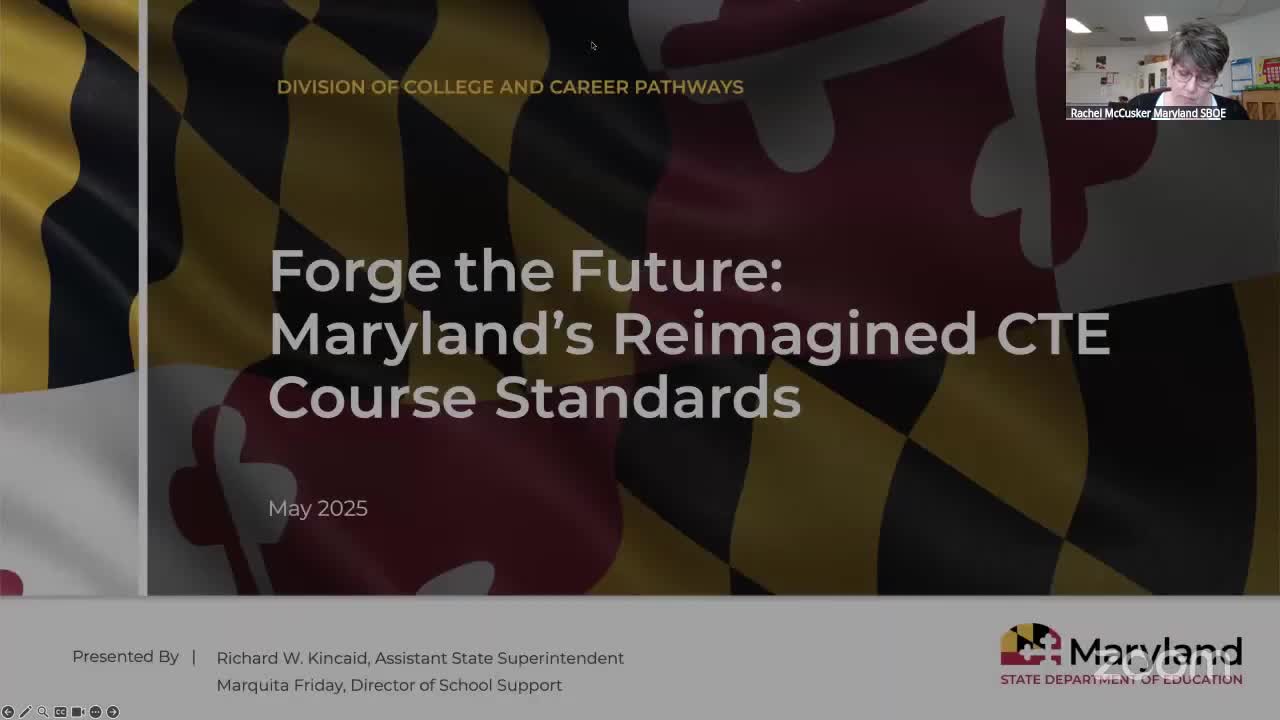
Summary
Maryland's State Department of Education presented a statewide redesign of career and technical education (CTE) that condenses programs of study, introduces a two-course core plus flexible options model, aligns courses to industry credentials and postsecondary credit, and opens the materials for public comment ahead of a planned full-board vote.
Richard Kinkade, assistant superintendent for college and career readiness at the Maryland State Department of Education (MSDE), and Markita Bridal, director of school support, presented a proposal to redesign Maryland's career and technical education system, consolidate program guides, and publish course-level standards for public comment.
Kinkade said the proposal restructures the statewide CTE framework into 14 career clusters, reduces the number of statewide programs of study to 48 (from figures the presenters referenced in different places during the presentation), and compresses more than 200 existing course offerings down to 52 state-level courses. He described a new "core-plus-flex" sequencing model: two required core courses that carry the primary content and industry-aligned credentials, plus flexible third- and fourth-level options for work-based learning, apprenticeships, dual enrollment or other postsecondary pathways.
"All of our CTE programs should lead to careers that are high-skill, high-wage, or in-demand jobs," Kinkade said, citing reliance on labor-market information to justify program continuance. He said the team backward-mapped industry-recognized credentials and postsecondary credit to course outcomes so a student can earn credentials at the end of course 1 and course 2 if they choose.
Markita Bridal described the standards-development process: an initial program inventory, labor-market analysis (the presentation cited work from a contractor identified as LICAS), alignment to Perkins V (referred to in the presentation as "Perkins 5" or Perkins criteria for high skill/high wage/in-demand), credential back-mapping, employer validation, educator review, equity review, and a three-year rolling review cycle so roughly a third of standards are reexamined each year. Bridal said cosmetology and other programs that require state licensure were checked against Maryland Department of Labor licensing requirements to ensure alignment.
The presenters said the materials (48 program guides with labor-market data, credential mapping, course-level standards and other sourcing) are posted on MSDE's public landing page for review. The public-comment period is open; staff intend to return to the board in June with a synopsis of public feedback and staff recommendations, publish the final guides July 1, 2025, and offer local education agencies a two-year on-ramp with expected implementation in fall 2027.
Board members asked substantive questions about program reductions, local needs, student protections during phase-outs, and the compressed timeline for educator and employer review. Dr. Lewis expressed concern that the June board meeting (about a month after the committee presentation) may leave limited time for thorough district and public feedback. "This is a tight timeline," Kinkade acknowledged and said the department is asking local CTE directors to propose practical timelines and aggregate feedback to the department. Kinkade also warned that the transition will be "hard" and "messy," but described the standards as a baseline: "These standards are the floor. They're not the ceiling," he said.
Several board members and the presenters emphasized equity and access: staff said programs are standards-focused rather than curriculum-specific so local systems may choose curriculum that meets the standards, and that the Perkins federal statute requires attention to special populations and equitable access. Presenters also noted logistical barriers (professional learning, equipment) and asked LEAs to flag capacity issues as part of the feedback process.
Ending details: No committee motion or formal vote occurred on the CTE standards at the meeting; the item remains in the public-comment and educator-review phase and will return to the full board with recommended action and a summary of input.