
Grafton special education staff outline preschool placement rules, tuition comparisons and inclusion priorities
Get AI-powered insights, summaries, and transcripts
Subscribe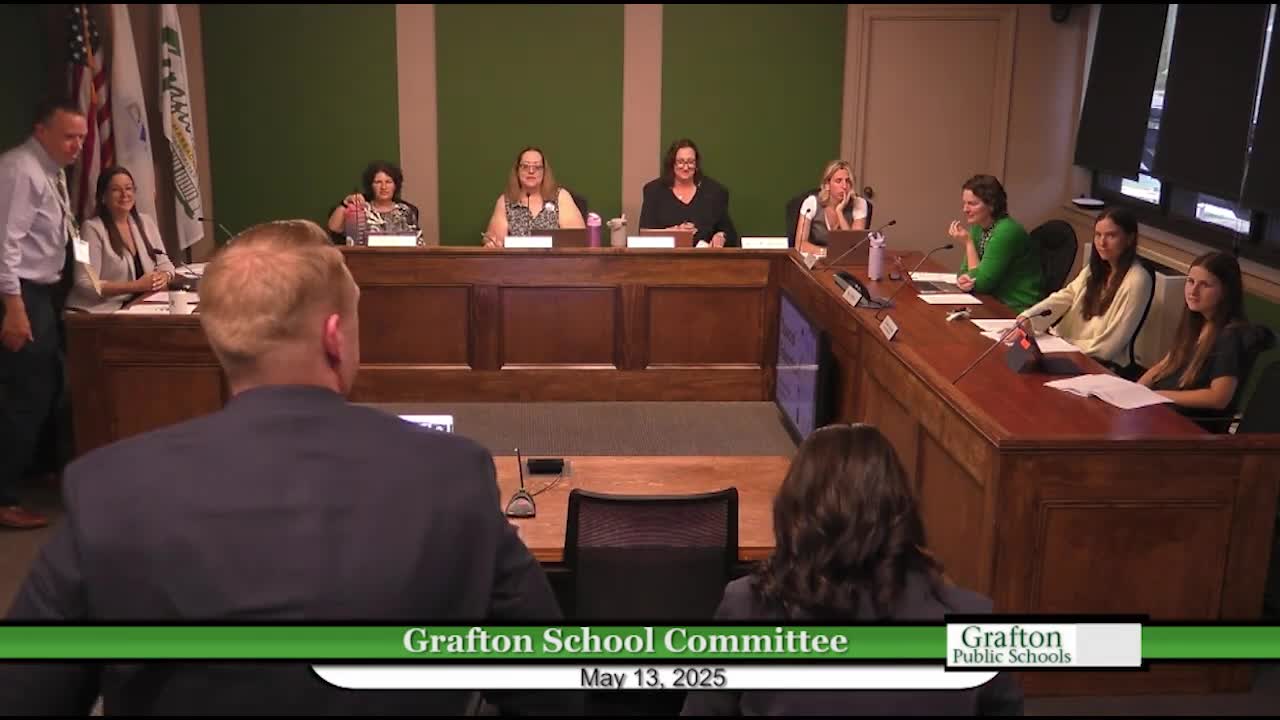
Summary
District special education leaders described how integrated preschool placement is determined, explained differences between DESE-regulated integrated preschool and EEC-regulated child care, and presented tuition and enrollment figures the committee will consider in the next budget cycle.
Special education leaders told the Grafton School Committee on May 13 that the district’s integrated preschool program is regulated by the Massachusetts Department of Elementary and Secondary Education and relies on having a majority of community peers in each classroom for true inclusion.
Nicole McDonald, speaking as a district special education leader, described the integrated preschool model as a DESE special education program for 3‑ to 5‑year‑olds that pairs students with disabilities and typical peers in the same classroom and requires specific ratios and staff qualifications. McDonald said the district typically staffs classrooms so that community peers outnumber students receiving special education services and that the program’s viability depends on sustained community‑peer enrollment.
McDonald and the committee discussed how the district projects preschool classroom need using early intervention referral numbers, historical eligibility trends and expected kindergarten transitions. McDonald said the district uses multiple-year data and early‑intervention referrals to estimate incoming special education preschool students but cannot obtain detailed referral information until parents provide permission to share it.
The presentation included tuition comparisons: McDonald reported the district’s current half‑day preschool tuition is $4,000 and full‑day tuition is $6,500; she also showed a midrange of comparable districts where some half‑day averages are higher and full‑day averages vary. She told the committee that changing tuition too rapidly could reduce community‑peer participation, which is essential to maintaining an integrated model. McDonald said the district has seven half‑day sections (eight students per section) and two full‑day classrooms (eight students per classroom), which equates to roughly 56 half‑day slots and about 16 full‑day slots.
Committee members raised questions about how revenue from tuition is used and the impact of proposed state-level moves to expand universal preschool. McDonald said the boosters, district staff and finance director have historically worked to incrementally raise tuition while preserving access; she also noted a sliding fee scale exists to assist families who need financial help.
Chris Kitchell, who leads related co‑teaching and inclusion professional development, described district professional development designed to strengthen co‑teaching practices, align specially designed instruction with the district’s new ELA and math curriculum, and build an in‑house library of co‑teaching examples for staff. He described recent unified sports expansions at the middle school and said staff would continue follow‑up sessions with co‑teaching pairs next year.
Committee members thanked staff for the data and said fee decisions will come to the committee as part of the budget process. The committee did not vote on fees at the meeting; staff said they plan to return with more details in the budget cycle.