
Grafton committee hears detailed update on integrated preschool and fee policy; no vote taken
Get AI-powered insights, summaries, and transcripts
Subscribe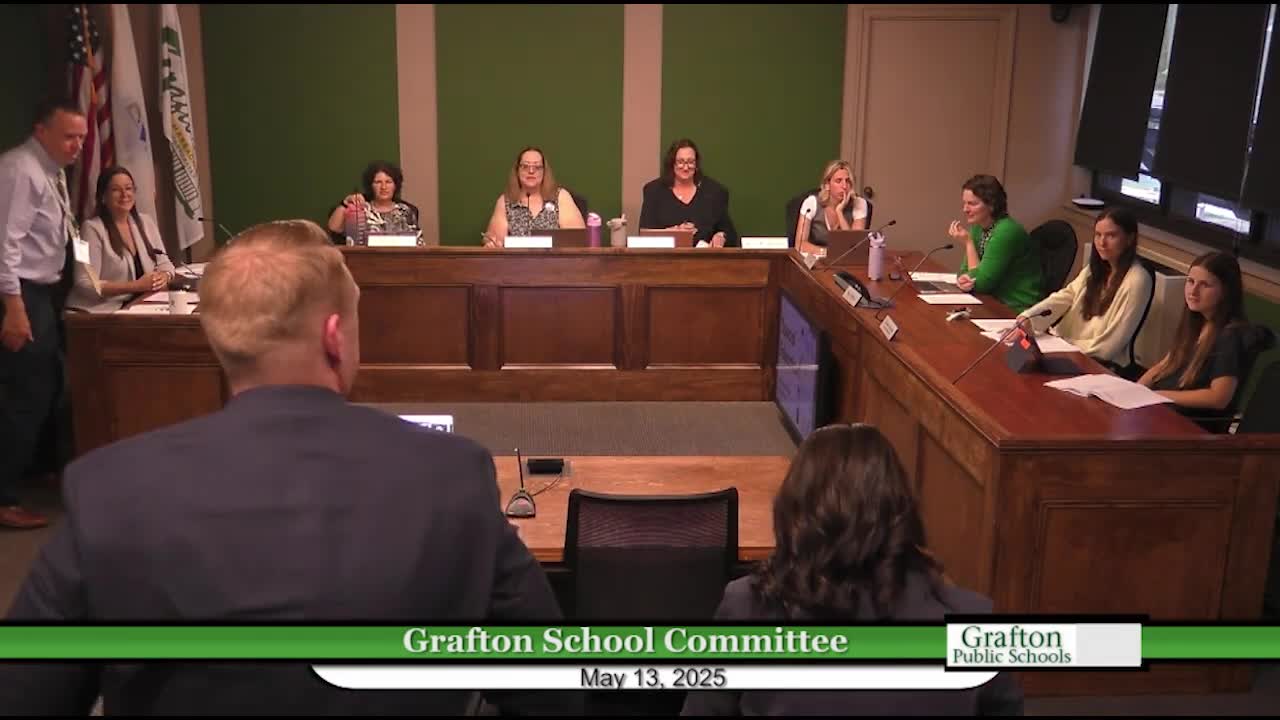
Summary
District special education staff described how integrated preschool is regulated, how classroom counts are determined, and how tuition compares with peer districts; committee deferred any fee decisions to a later budget process.
Special education staff gave the School Committee an extended briefing on Grafton’s integrated preschool program, how classroom assignments are determined, and the district’s tuition and fee approach; committee members did not vote on any fee changes at the meeting.
Nicole McDonald and Chris Kitchell presented the report, explaining that an integrated preschool in Grafton is governed by the Massachusetts Department of Elementary and Secondary Education special education regulations and is designed to provide students with disabilities (ages 3–5) the opportunity to learn alongside typically developing peers in the same classroom. “The integrated preschool program is really regulated by the Department of Elementary and Secondary Education under the special education regulations,” McDonald said, noting differences between DESE‑regulated integrated preschool and EEC‑licensed child care programs.
McDonald described the staffing and ratio rules: integrated preschool classrooms are structured so community peers are roughly 8 and special education students roughly 7 (an example ratio given was 8 community peers to 7 special education students) so community peers make up less than 50% of a class and preserve an integrated environment. She also explained that districts project special education classroom needs using early intervention referral data, historical eligibility trends and anticipated kindergarten transitions.
On tuition, presenters compared Grafton’s fees with similarly structured DESE integrated preschools. McDonald said Grafton’s half‑day tuition is $4,000 and full‑day tuition is $6,500. Using the district’s enrollment figures discussed in the presentation, committee members and staff counted roughly 16 full‑day students (two full‑day classrooms of eight each) and 56 half‑day students (seven half‑day sections), which the presenters used to estimate differences between Grafton’s current revenues and local averages. One committee member calculated that, compared with the local averages McDonald provided, Grafton’s current rates produce approximately $50,000 less revenue annually than the averages shown in the presentation, though McDonald and others cautioned that the peer sample includes outliers and that structural differences (program days, licensing, district size) complicate direct comparisons.
McDonald emphasized that decisions about tuition are made carefully because raising fees can reduce demand for community peers — and community peers are required to keep integrated classrooms compliant with DESE regulations. “If we don't have kind of that balance, it's no longer an integrated an inclusion opportunity,” she said.
Committee members asked for additional details and clarity about counts and the district’s sliding‑scale financial assistance. The presenters confirmed that the district offers a sliding fee scale for families needing financial assistance and that the district will bring any future fee proposals to the committee for approval. The committee heard that there is demand for preschool slots and that families sometimes hold out for a spot at the neighborhood elementary school (North vs. South), which affects enrollment dynamics.
The presentation also covered spring programming and inclusion initiatives: McDonald and Kitchell summarized special events such as Best Buddies prom, Everyday Heroes, Special Olympics participation, and expanded unified sports programs at the middle school. Kitchell described professional development to strengthen co‑teaching practices and alignment with curriculum coaches so special education modifications are practical with the district’s adopted curricula.
No fee change motion was presented or voted on; McDonald told the committee the briefing was informational and that specific decisions on fees would be brought to the committee in the budget process.
The committee asked the special education team to return with any clarified enrollment counts, clearer peer comparisons and the existing sliding‑scale formula for families prior to any vote on tuition.