
House repasses Senate File 1959 to fund veterans homes, homelessness and suicide-prevention programs
Get AI-powered insights, summaries, and transcripts
Subscribe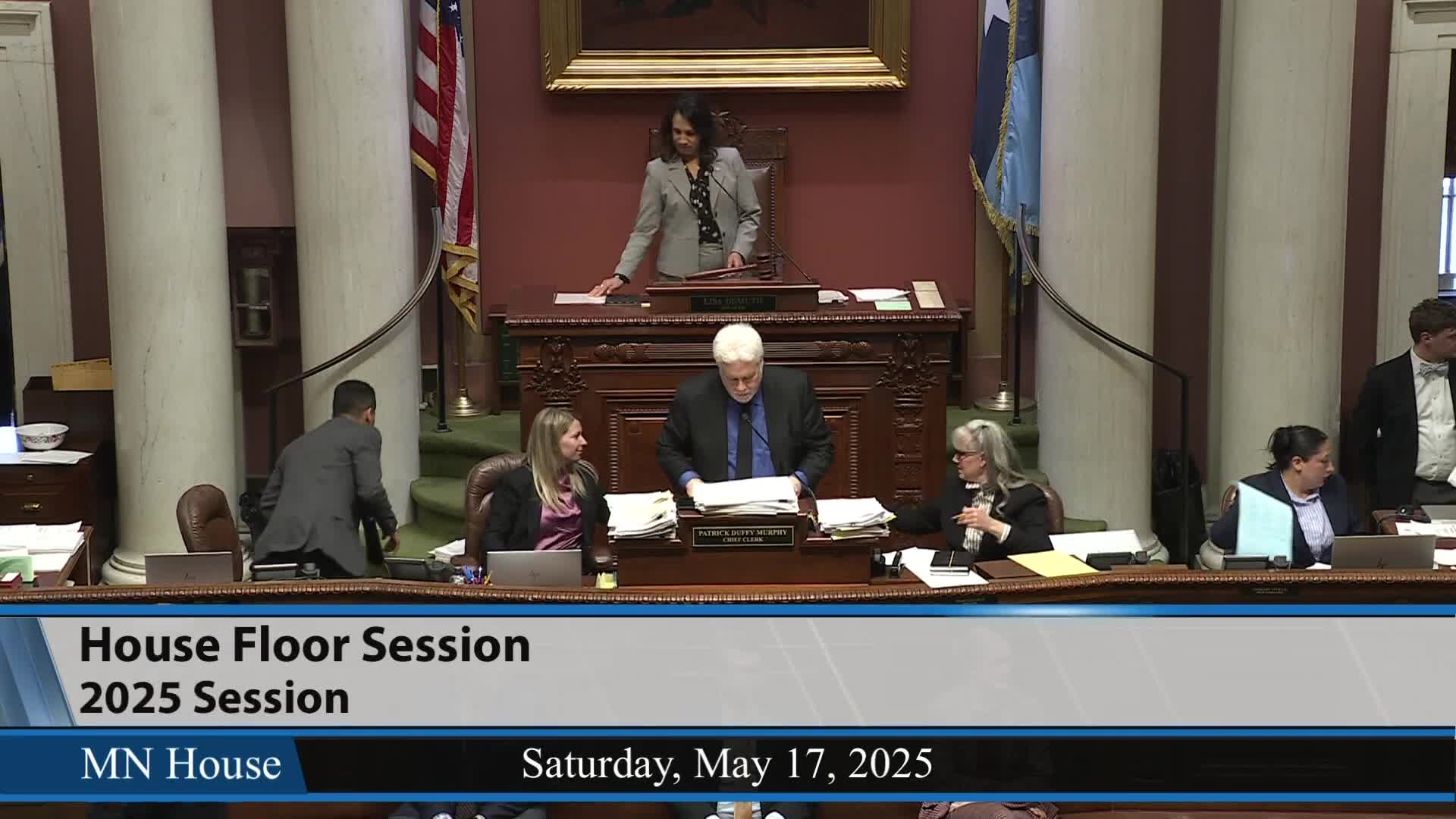
Summary
The Minnesota House adopted the conference committee report on Senate File 1959 and repassed the bill as amended, increasing funding for state veterans homes, homelessness services, suicide-prevention efforts and related veteran supports, and recognizing Special Guerrilla Unit veterans.
The Minnesota House adopted the conference committee report on Senate File 1959 and repassed the bill as amended, restoring and increasing state funding for veterans homes, homelessness initiatives and suicide-prevention programs and including a state recognition for Special Guerrilla Unit (SGU) veterans.
The conference committee report, announced at the start of the floor sequence, was moved for adoption by Representative Bliss and ultimately approved by voice vote and a roll call that resulted in 130 yeas and 0 nays. The clerk recorded that the bill was "repassed as amended by conference" and the title agreed to.
Why it matters: The package increases state appropriations for Minnesota Department of Veterans Affairs priorities including operating support for recently established veterans homes, homelessness prevention and wraparound services, suicide-prevention funding, and targeted technical assistance for county veteran service officers. Sponsors said the state funding is intended to help the homes reach staffing levels that preserve federal per diem reimbursement and avoid potential federal clawbacks.
Representative Bliss, the author and cochair on the conference committee, said, "Well, folks, we did it. We got a lot more funding. Fortunately, we were able to fully fund our veterans homes. We restored the homelessness initiatives." Bliss later added the appropriation for the homes was a prior commitment that "chewed up a lot of our money" and that the state must fund the homes so they can "receive the per diem back from the federal government."
Committee members and other lawmakers described key components included or removed in the conference report. Representative Hemmingson Yeager, a conferee, said the conference negotiations produced a large increase in a line item — "going from $5,000,000 to $50,000,000" — and emphasized staffing as a critical implementation concern: "if these homes don't get to 90% staffing, you can see how the ripple effect impacts everything." Yeager also noted the homes employ state workers represented by AFSCME and MAPE.
Several members highlighted nonbudget provisions and targeted appropriations. Representative Hill and others praised inclusion of funding for organizations such as Hometown Hero Outdoors, which the member said connects veterans and first responders to outdoor therapeutic activities. Representative Feist noted funding for a technical assistance coordinator and support for county veterans service officers (CVSOs) to focus on women veterans, suicide prevention, and system-involved veterans.
Members of the Hmong community and their advocates secured a formal recognition in the bill for Special Guerrilla Unit veterans. Representative Cha, who spoke about the SGU recognition, said "Every time this SGU bill comes into a hearing, it's almost traumatizing for them to be here to remind them that they have not been recognized," and described the measure as meaningful across Minnesota's Hmong communities.
Not all provisions were retained. Representative Freyberg told the floor that the bill "eliminates funding for the Veterans Resilience Project," a program that, according to lawmakers' floor remarks, provided trauma-informed care and had testimony supporting its effectiveness. Multiple members also expressed disappointment that a separate provision aimed at curbing so-called "claim sharks" (third-party actors who charge veterans for benefit assistance) did not survive conference negotiations; Representative Bonner called the omission "unconscionable" and said addressing that issue should be a top priority in the next session.
Members stressed implementation issues the department must address. Bliss said he expects the Minnesota Department of Veterans Affairs (MDVA) to return with a "comprehensive plan" on suicide prevention and with steps to staff veterans homes to secure federal per diem. Several lawmakers urged continued attention to outreach, food-security programs (including Meals on Wheels and Lutheran Social Services), and programs that help veterans access outdoor therapeutic activities.
Formal action: The motion to adopt the conference committee report and repass Senate File 1959 as amended carried. The clerk recorded 130 ayes and 0 nays; the bill was repassed as amended by conference and the title agreed to.
The House debate spanned multiple members and included personal testimony from lawmakers with military service and from representatives of communities affected by the bill. Members called for continued work on the items that were not included in the final package and for follow-up from MDVA on staffing, suicide-prevention planning and program implementation.