
Senate finance committee approves bill shifting NLX funds to school unemployment aid
Get AI-powered insights, summaries, and transcripts
Subscribe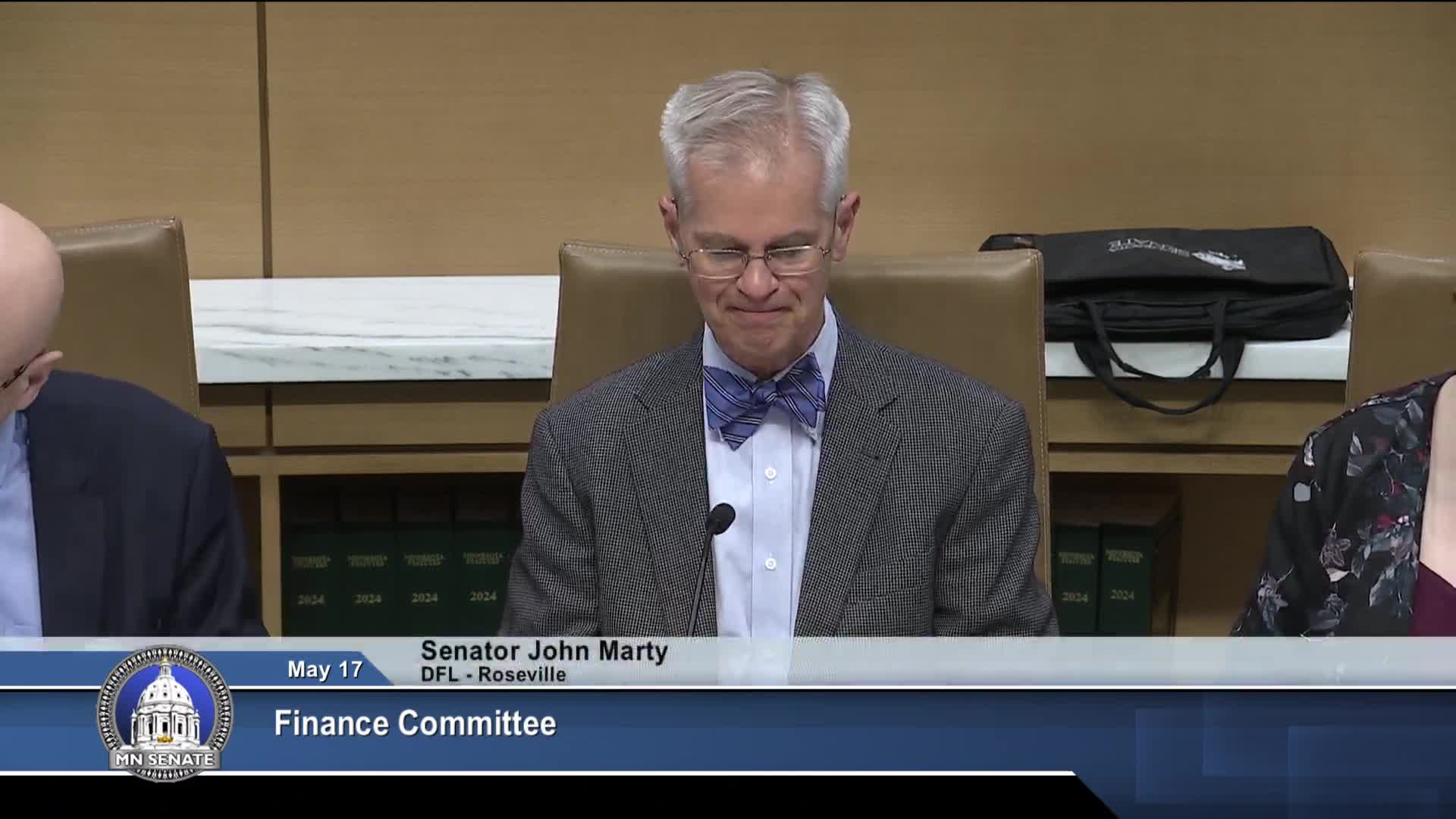
Summary
The Minnesota Senate Finance Committee on May 17 approved House File 1143, a bill that cancels $77,232,000 from the Northern Lights Express appropriation and directs a $100 million transfer into a school unemployment aid account to cover unemployment costs for hourly K‑12 workers.
The Minnesota Senate Finance Committee on May 17 approved House File 1143, a bill that cancels $77,232,000 from an existing Northern Lights Express (NLX) appropriation and directs a $100 million general‑fund transfer into a school unemployment aid account to cover unemployment costs for hourly K‑12 workers.
The measure, presented by Senator McEwen, passed by voice vote after roughly an hour of discussion and a failed recorded amendment that would have increased the NLX cancellation to $100 million and removed a provision reducing special education aid forecasts.
The bill responds to a 2023 change in state law that made hourly K‑12 workers — positions such as bus drivers, nutrition staff, clerical staff and education support aides — eligible for unemployment insurance. “This workforce, made up primarily of women and women of color, have been consistently undervalued, overlooked, and underpaid,” Senator McEwen said during the committee hearing, arguing the change “righted a decades long wrong.”
Nonpartisan fiscal analyst Jenna Hofer told the committee that the bill cancels $77,232,000 of the NLX appropriation in fiscal year 2026 and transfers $100 million to the school unemployment aid account in fiscal year 2026, with that special revenue transfer available through June 30, 2028. Hofer said the bill also changes how some costs are tracked in the state forecast, producing corresponding reductions in forecasted special education aid because certain unemployment costs that otherwise would be billed to special education will instead be paid from the school unemployment account.
Hofer summarized the fiscal flows: “Section 2 of the bill would cancel $77,232,000 in fiscal year 2026 from the project,” and “Line 6 shows the additional appropriation for school unemployment aid under section 4 of the bill. So it'd be a hundred million dollars in fiscal year 2026.” She told senators the Department of Education’s current forecast estimates approximately $63,000,000 in eligible summer hourly‑worker expenses in fiscal 2026 and about $70,000,000 in fiscal 2027.
Hofer also explained the special education impact: under current forecasts, once the school unemployment aid appropriation runs out districts would bill eligible unemployment costs for hourly workers to special education aid. By providing the additional school unemployment aid in fiscal 2026 and 2027, the bill reduces the amount forecasted to be billed to special education aid, producing estimated reductions of $683,000 in fiscal 2026 and $22,085,000 in fiscal 2027 (a biennial total of $22,768,000) and a further reduction of $47,392,000 in the 2028‑29 biennium, according to the spreadsheet Hofer presented.
Senators pressed staff about mechanics and fiscal tracking. A staff member explained the proposal “is to cancel 77.232 of that appropriation, leaving a hundred and $17,100,000 of the original NLX appropriation,” and that the item is tracked in the global budget agreement as part of other tail items. Hofer clarified that the school unemployment appropriation would be transferred to a special revenue account and paid on the normal K‑12 aid payment schedule, which pushes a portion of payments into the following fiscal year.
Senator Howe offered an amendment to replace the $77,232,000 cancellation with $100,000,000 and to delete the bill’s section reducing special education forecasted spending. The amendment was read into the record as: “House file 11 43 on page 1, line 10, delete 77,232,000 and insert 100,000,000. And on page 1, delete section 3.” The amendment failed on a recorded roll call, with five senators voting aye and six voting nay (ayes: Senators Pratt, Dames, Draheim, Howe, Jasinski; nays: Senators Marty, Friends, Champion, Murphy, Pappas, Wicklund).
Debate included concerns that repurposing NLX funds reduces money available for transportation and that the forecasting mechanics make the transaction look like a shift rather than a direct appropriation. “We are now doing shifts in gimmicks, taking this money from the transportation side,” Senator Jasinski said. Senator McEwen responded that while the decision was difficult, ensuring unemployment coverage for low‑paid hourly school workers was a priority: “I can't say that the money for that train is more important than the lives of all of those thousands of Minnesotans.”
After the failed amendment, Senator Friends moved House File 1143; the motion prevailed by voice vote and the committee recessed pending the pensions commission meeting. Committee members noted the NLX appropriation language expires June 30, 2028, and that the change will alter forecasted special education spending in upcoming finance forecasts.
Votes at a glance: - Amendment (Howe): “Delete 77,232,000; insert 100,000,000; delete section 3” — mover: Senator Howe — recorded vote: 5 ayes, 6 nays — outcome: failed. - House File 1143 (move to pass/engross): mover: Senator Friends — outcome: approved by voice vote.
What changed - NLX appropriation cancelled: $77,232,000 (section 2 of the bill). - School unemployment aid appropriation: $100,000,000 transferred from the general fund to the school unemployment special revenue account in fiscal 2026; funds available through 06/30/2028 (section 4 of the bill). - Special education forecast reductions (reflecting shifted billings): estimated reductions shown on committee spreadsheet — $683,000 (FY26), $22,085,000 (FY27), biennial total $22,768,000, and $47,392,000 reduction in 2028‑29 biennium (section 3 of the bill).
The committee recessed after the vote and said it would reconvene after the Pensions Commission meets later in the day or on the following day if the pensions meeting did not occur.