
Bend MPO board discusses local fatality review process and data gaps; staff to research models
Get AI-powered insights, summaries, and transcripts
Subscribe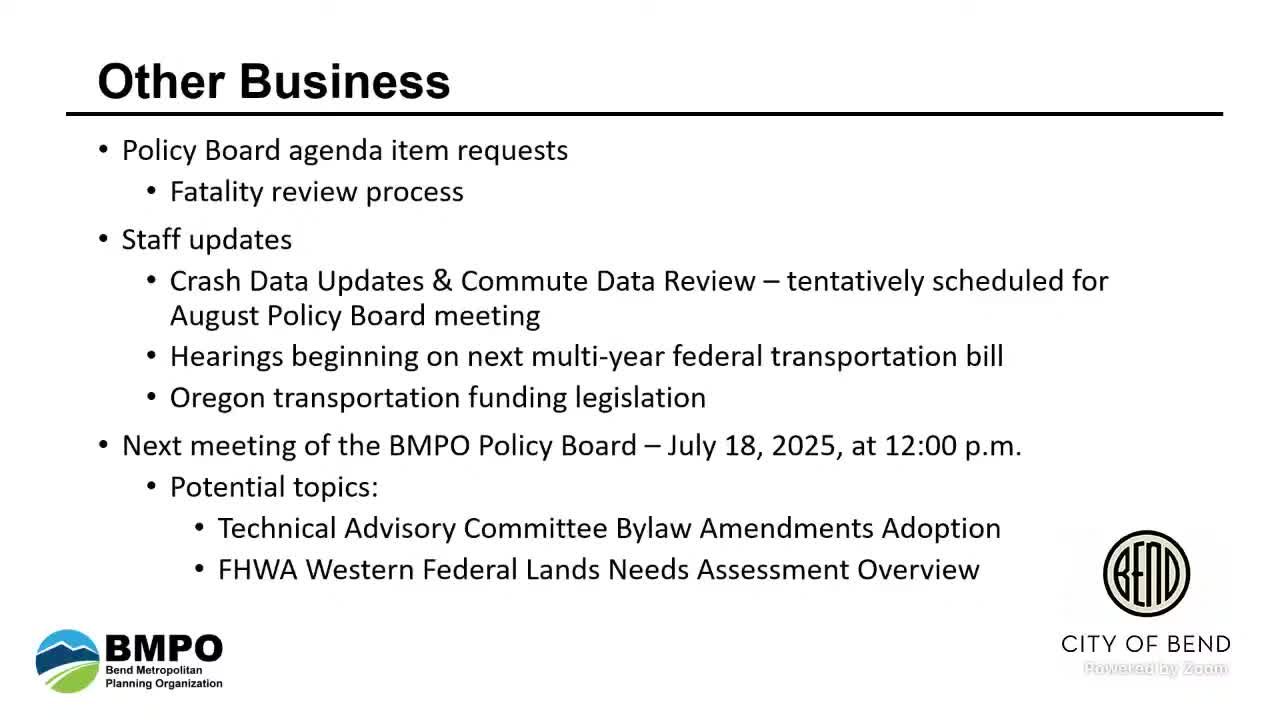
Summary
The Bend MPO policy board on June 20 debated whether to create or adopt a local crash-fatality review process after members said some serious incidents on private property are not captured in state highway statistics.
Policy board members discussed whether the Bend MPO should develop a local fatality or serious-injury review process to capture lessons from crashes that do not appear in state highway-only statistics, such as incidents in private parking lots.
Councilor Mike Riley raised the issue after a local parking-lot fatality and said the incident highlighted gaps in available data and the need to consider policy implications (parking-lot design, speeds, and other local measures). Riley asked whether a local review mechanism would make sense for policy learning.
Kent Schimpweiler, interim planning manager in ODOT Region 4, described existing state processes: ODOT conducts a biennial review under its All Roads Transportation Safety program that highlights hot spots and systemic issues, and the agency now operates a quicker "vulnerable crash response" to review pedestrian and bicycle fatalities soon after they occur. Schimpweiler noted that investigations and court processes can delay facts in any single incident and that some state reviews operate on longer timelines as a consequence.
Tyler Deakey, Bend MPO manager, said staff will research models used by other jurisdictions and consider whether the MPO's upcoming Safety Action Plan update (kicked off in August) could incorporate a local review or an improved local dashboard. Deakey noted that incorporating existing models rather than building a system from scratch would be the initial approach.
The board did not take formal action; members asked staff to explore practices used elsewhere, what data are collected, who participates in reviews, and how findings are used to inform local policy and low-cost countermeasures.