
Board approves three-year secondary reading-intervention contract after extended debate
Get AI-powered insights, summaries, and transcripts
Subscribe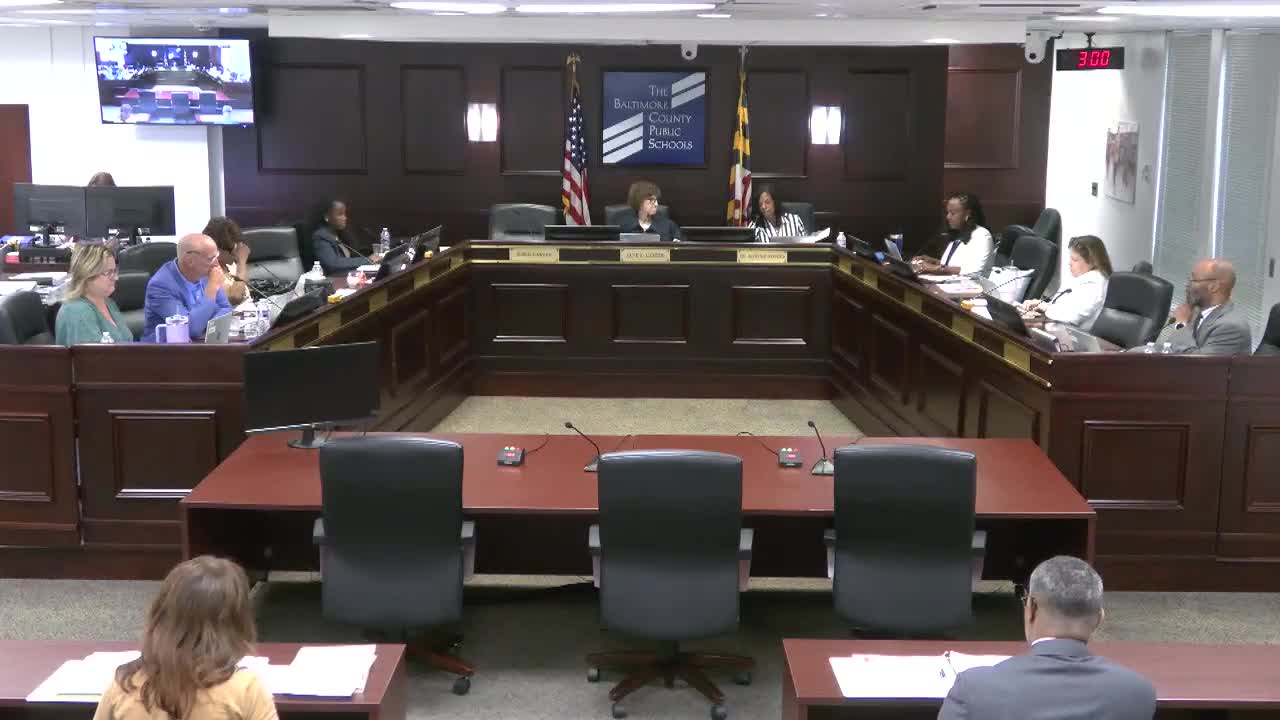
Summary
The Baltimore County Board of Education approved a three-year contract for secondary reading-intervention programs (Read 180 and ILET) after extended discussion about implementation, professional development and student outcomes.
The Baltimore County Board of Education on July 8 approved a three-year contract to provide tier‑2 reading-intervention programs for middle and high school students, one of two vendors the district will use to support students who do not reach grade-level reading benchmarks.
The contract — shortened from an earlier six‑year proposal to a three‑year, $1.6 million agreement presented at the meeting — was framed by district staff as a targeted, time‑bound purchase aimed at improving fidelity of implementation and allowing the district to reassess results more frequently.
District leaders described the contract as covering two comprehension-focused models used in secondary schools: Read 180 (used in about 15 schools that have demonstrated training and implementation fidelity) and ILET (proposed for schools where Read 180 had not shown the same results). Dr. Rogers (superintendent) told the board the contract targets about 5,000 licenses out of roughly 56,123 secondary students—about 9%—and that adding decoding licenses would bring the intervention coverage to roughly 12% of students, which aligns with typical national tier‑2 rates.
In committee and in the full board discussion, staff emphasized implementation supports: an initial full day of vendor training, follow‑up coaching, in‑classroom modeling and school visits by district specialists, plus vendor dashboards to monitor fidelity. The revised contract reduced an earlier proposed $300,000 window for school‑level expenditures to $50,000 and committed to more frequent progress reporting to the board.
Mister Connolly (staff) presented data showing percentile gains for students who participated in the district’s tier‑2 programs. He reported an average increase in percentile rank among participating students, and highlighted a roughly 11‑point increase tied to the ILET implementation over the 2023–24 to 2024–25 window. Connolly said Read 180 students increased from the 18th to the 22nd percentile overall; clusters of schools implementing Read 180 with fidelity showed larger gains (approximately 16th to 24th percentile).
Board members pressed staff on whether observed shortfalls had been implementation problems rather than product problems. Staff said they intend to hold schools to minimum fidelity thresholds, run twice‑monthly vendor reports on implementation, provide ongoing coaching and, where necessary, switch a school from one vendor to the other if a student is not making expected progress. Staff also said that Read 180 and ILET are compatible with “A/B” bell schedules and that vendor professional development will include both summer paid sessions and in‑school coaching time.
Several board members sought clarity about training quantity and delivery. Staff said teachers receive a full initial training day before the school year, additional sessions in August, and follow‑up coaching (some in‑class modeling) during the year. The difference in allotted coaching days between Read 180 and ILET in the contract was explained as a function of the different numbers of schools that will implement each program under the proposed plan.
After discussion, the board voted by roll call to approve contract item M3. The roll call recorded yes votes from Young, Henn, Booker Dwyer, Harvey, Agumbe/Ogunbe, Savoy, McMillian, Pumphrey and Lichter and a no from Chamonowski. The motion passed.
Board members said they will expect regular, data‑driven updates on progress and fidelity and reiterated that purchasing a program must be paired with sustained professional learning and monitoring.
The board’s decision shortens the vendor commitment and prioritizes implementation checks before the district makes any longer‑term commitments.
Ending: District staff said they will return to the board with ongoing implementation reports; the contract term and expanded monitoring were presented as steps to enable earlier district review and course corrections if results do not meet expectations.