
State board set to weigh new ACAP reading cut scores; staff and advisers recommend conservative adjustment
Get AI-powered insights, summaries, and transcripts
Subscribe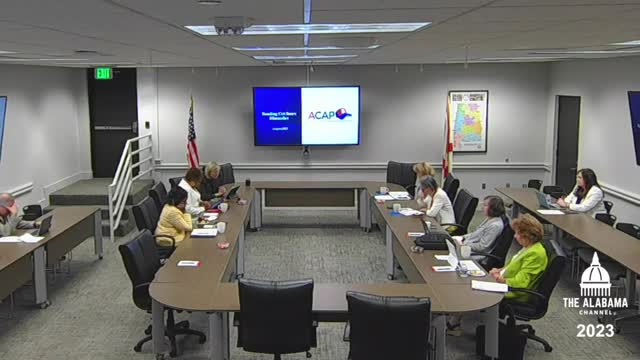
Summary
The Alabama State Board of Education heard a presentation and committee recommendations to set new cut scores for the revised ACAP reading assessment; technical advisers and testing vendors recommended lowering the cut scores by two standard errors of measurement to reduce false retention decisions.
The Alabama State Board of Education on Thursday discussed proposed cut scores for the revised ACAP (Alabama Comprehensive Assessment Program) reading test that will be used in decisions about promotion and retention in early grades.
Board members and staff framed the issue as the board’s duty under the Literacy Act to set a score that will trigger retention consideration for third-grade students. State Department of Education staff and outside psychometricians said the new, skills-focused ACAP differs from the previous test and that applying old cut scores would misclassify many students.
Department assessment staff presented three options derived from standard-setting work with classroom teachers and technical advisory committees. For third grade the old cut score was 452; if the department made no statistical adjustment the benchmark would be 473 (about 32.1% of current students below that score using this year’s data). Adjusting downward by one standard error of measurement would yield a cut score of about 454 (roughly 24.4% below). The more conservative technical recommendation — used in previous transitions and favored by the Department’s DRC vendor and the Technical Advisory Committee (TAC) — was to lower the content-derived cut score by two standard errors of measurement (minus‑2 SEM). Under that approach the third-grade adjusted cut score would be about 435 (about 17.4% of students below).
For second grade staff offered parallel figures: the existing cut score of 448 would translate to a content‑based standard‑setting recommendation near 487 (39.8% of students below by current data); minus‑1 SEM would place the cut at about 471 (32.4% below); minus‑2 SEM would place it near 455 (25.1% below).
Department leaders and the vendor statisticians told the board the minus‑2 SEM adjustment is intended to reduce the likelihood of retaining students who are on the statistical “bubble” — in effect, to increase confidence that students flagged for retention truly have reading skills below expectations. Several board members said they understood the statistical rationale but voiced concern about moving students who still need support into later grades without continued services. Department staff said state law limits some state-funded supports (for example, ARI funding is restricted to K–3 by current law) but that the department is using other funds to extend supports for students who promote but score near the cut.
No formal vote to adopt cut scores occurred during the work session. Department staff told the board the Literacy Act requires the board to set the score formally; staff recommended the minus‑2 SEM-adjusted cut scores to be included on a future meeting agenda for a vote. Board members were given 30 days to submit follow-up questions to the superintendent and the department indicated it will report back with additional materials, including committee membership details and further impact data.
Board discussion also covered implementation monitoring: staff said the department will review performance of students who are promoted under these rules (tracking outcomes in fourth grade) and revisit cut scores annually as needed.