
Council recognizes Autry Museum's Black Cowboys exhibition and honors Wat Thai teachers' summer program
Get AI-powered insights, summaries, and transcripts
Subscribe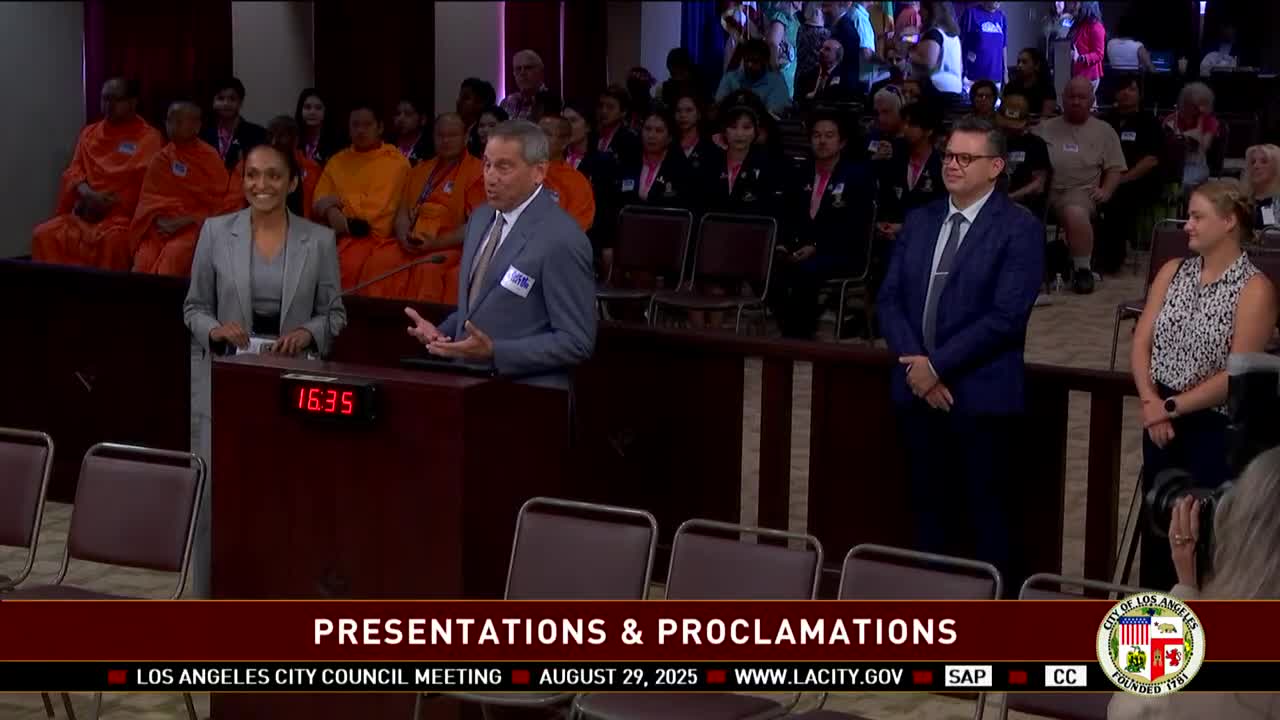
Summary
Council members and presenters highlighted the Autry Museum of the American West's exhibition on Black cowboys and recognized Wat Thai of Los Angeles for its volunteer teachers and cultural programming; the museum invited the public to a free community day and the council presented a certificate.
Council members and presenters used a ceremonial portion of the meeting to highlight cultural programs in Los Angeles: the Autry Museum of the American West's exhibition on Black cowboys and a recognition of Wat Thai of Los Angeles for its volunteer teachers and summer master-teacher program.
A museum representative described the exhibition, saying it emphasizes both history and present-day connections in Los Angeles. The representative noted that many Black cowboys were written out of mainstream histories and said the Autry's exhibition brings that history to light. In the transcript the representative said, "Probablemente ustedes no sabedan que los blancos los borraron de la imagen." The museum invited the public to a community day on Sept. 27 from 10 a.m. to 5 p.m.; the representative said the museum would make admission free for military, children under 12 and emergency personnel that day.
The council presented a certificate signed by the council to an individual named Aaron (identified in the transcript as "sef1or Aaron") in recognition of the exhibition and community partnerships. A councilmember praised the museum as "a museum of Los Angeles" and said he would pay admission for attendees from the chamber that day.
In a separate recognition, the council acknowledged Wat Thai (identified in the transcript as "Watay"), a Thai temple and community center in the San Fernando Valley area that provides language, music and dance instruction and seasonal teacher exchanges. Surana, speaking on behalf of the temple, described the organization's education programs for children and called the experience of hosting visiting teachers from Thailand "un gran placer poder servir en esta en esta capacidad." A councilmember noted that the temple "se establecif3 hace me1s de 50 af1os" and thanked teachers who volunteer each summer.
Both items were framed as community-building efforts that connect Los Angeles to broader cultural histories and diasporic communities. The transcript records invitations to public events and the council's ceremonial certificate presentation; no formal council action or funding appropriation is recorded in these excerpts.