
Residents discuss smart-growth ideas and concerns at Hopkinton town hall
Get AI-powered insights, summaries, and transcripts
Subscribe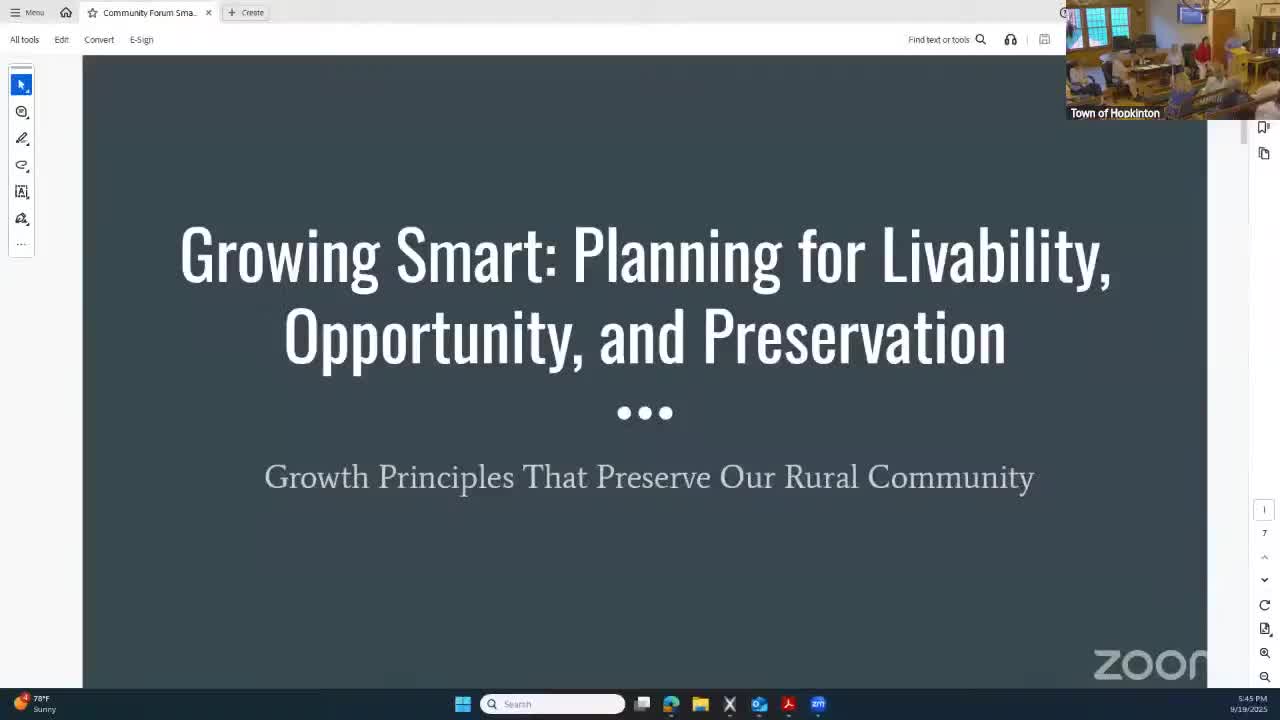
Summary
Michelle McCray presented smart-growth principles and village-focused revitalization; attendees raised affordability, public-transportation and Main Street safety as priorities.
Michelle McCray, an Economic Development Commission member and long-time Hopkinton resident, gave a layperson—s overview of smart-growth planning at a town-hall meeting and invited residents to weigh in on village revitalization.
"Smart growth is an approach to community design that connects housing, transportation, and land use to create healthy, prosperous, and resilient neighborhoods," McCray said, describing principles such as preserving community history, supporting existing businesses, creating pedestrian-friendly "complete streets," encouraging mixed uses and compact development, and preserving rural landscapes.
McCray used regional examples and local assets to illustrate the approach, citing Hopkinton—s farms, artist community, and trail network. She said Hopkinton—s "existing assets" and preserved landscapes make the town a candidate for targeted, village-scale projects rather than large-scale commercial development.
Residents responded with a mix of support and concerns. Marjorie Allen, a lifelong resident, said affordability should be a priority: "People can't afford to live in the town now," Allen said, urging planners to think about both seniors and young families when considering mixed-use housing. Betsy Dalton and other residents asked whether the town could better catalog and promote vacant main-street properties in Ashaway and Hope Valley to attract appropriate businesses.
Several speakers emphasized infrastructure limits. Jean Arthur and others called for wider sidewalks and safer crosswalks on Main Street. Sherry Desjardins, the town zoning officer, cautioned that some buildings lack the parking or septic capacity to support certain uses: in one instance she said a property could not support a "35-seat cafe" because "there's only 8 parking spots. We can't make any more parking spots there." Residents suggested starting with small, highly visible projects to build momentum and attending Grow Smart Rhode Island events; McCray noted a Main Street conference scheduled for Oct. 25.
Sam Wilcox, president of the Richmond Town Council and attendee at the Hopkinton session, recommended promoting ecotourism tied to the Wood River and regional parks to draw visitors while supporting local businesses. Wilcox also mentioned state-level tax discussions that affect municipal budgets: he said a proposed bill to abolish the meal-and-beverage tax would reduce Richmond's budget by about $200,000, illustrating how state policy can shape local development options.
Speakers repeatedly urged the commission to focus on small, achievable projects that preserve village character while adding needed services and housing options. McCray closed by asking residents what they would like Hopkinton to become and inviting them to submit ideas to the commission.