
Carmel-by-the-Sea group proposes AMS‑compatible street‑numbering to improve emergency response and data compatibility
Get AI-powered insights, summaries, and transcripts
Subscribe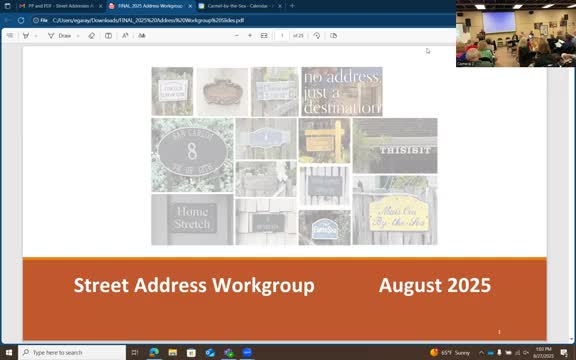
Summary
At a community workshop on Wednesday, an ad hoc group of residents and city staff outlined a plan to give every building in Carmel‑by‑the‑Sea a standardized, Address Management System (AMS)‑compatible street number and described a multi‑step process to gain county and U.S. Postal Service acceptance.
At a community workshop on Wednesday, an ad hoc group of residents and city staff outlined a plan to give every building in Carmel‑by‑the‑Sea a standardized, Address Management System (AMS)‑compatible street number and described a multi‑step process to gain county and U.S. Postal Service acceptance.
The group said the change would not force home mail delivery or require the post office to close but would make buildings “findable” in national databases used by utilities, mapping platforms and emergency dispatch. “The United States Postal Service … is the primary authority for standard street addressing,” said Emily Goree, the city’s administrative analyst, summarizing the group’s work with USPS staff.
Why it matters: staff and residents told the workshop that incompatibility with AMS contributes to delayed or failed deliveries, difficulty with online transactions and occasional complications completing government and insurance forms. The group also said dispatch and response are affected: Carmel’s local dispatch historically translates local, nonstandard addresses into county dispatch information, a step the presenters said can add “30 seconds to 3 minutes” before county assets are notified.
The ad hoc group and its scope: Mayor Pro Tem Bob Delves formed the volunteer group after an extended council discussion earlier this year. Delves described the team as a fact‑finding body created "to enable the city council to make a well informed decision" on whether to implement standardized addresses. Participants named at the workshop included Nancy Toomey (frequent city volunteer and Carmel Residents Association representative), Kevin Roos (prototype lead on numbering schemes), Paula (former long‑serving city council member), Hans Bueter (city councilor who earlier coined the prototype term “MVP”), Rob Culver (public works contact), and city staff including Goree. Monterey County, the Monterey Fire Department and representatives from utilities such as PG&E and Cal Am Water also participated in meetings with the group.
Key technical findings and prototype: the group developed and tested four numbering approaches — quadrant‑based, continuous within the city, continuous within the county and a “logical positional” model the group favored. The logical positional model preserves local cues that help residents visualize a location (for example, giving each north–south block a 100‑number band so the first digit corresponds to the avenue north of the lot), while keeping most numbers to four digits or fewer. Kevin Roos said the prototype was shared with USPS AMS staff and with the county for preliminary review and received tentative support.
USPS, delivery and the post office: presenters emphasized that implementing AMS‑compatible numbers does not automatically change mail delivery patterns. “PO box delivery will continue as it has been,” Goree said; she added that centralized PO‑box delivery is preferred and cost‑effective for USPS and that the city has communicated that it does not intend to compel at‑home delivery or to close the town’s post office.
Legal and code obligations: the group cited building, residential and fire code requirements that address markings be legible, visible from the street and meet size standards; Goree and Delves cited code language calling for characters “4 inches high with a minimum stroke of half an inch.” Delves also said the group concluded the city’s traditional address scheme is not compatible with AMS and that permitting the city to remain noncompliant with applicable state and fire‑safety requirements would raise legal problems; he cautioned that a binding election that sought to preserve noncompliance would not resolve the legal requirement.
Public safety and dispatch: presenters and the acting police dispatch lead described Carmel’s unique dispatch arrangement. Because current local address formats are not AMS‑compatible, Carmel maintains its own local dispatch to translate local descriptions into county dispatch calls. Delves said that translation/triage step — and the fact that out‑of‑area responding units may be less familiar with local landmarks — can add measurable time when incidents are handled by outside assets. The Monterey Fire Department currently serves Carmel under contract; presenters said both fire and police leadership have told the group they would prefer standardized addresses for safety reasons but wish to remain nonpolitical on the topic.
Utilities and service providers: utility representatives attended meetings, the group reported, and expressed willingness to participate in a coordinated data update. Delves said many utilities run enterprise billing and GIS systems capable of mass updates, and the companies that attended had technical staff ready to discuss batch updates of customer records to minimize the change‑management burden on residents.
Accessory dwelling units (ADUs) and multi‑unit buildings: the group recommended that ADUs be eligible for their own AMS address but not require automatic assignment on day one. Nancy Toomey said the proposal would allow an ADU owner to request a separate address at the planning counter after go‑live. For multi‑unit buildings the presenters noted the AMS convention that a structure typically receives one primary address with individual units numbered internally; building owners may need to supply internal unit maps for mail carriers and emergency responders.
Signage and marking: the presenters noted code requirements for address signage (numerals 4 inches tall, half‑inch stroke) and said individual property owners generally would choose and post the number style that fits their property; the city would maintain enforcement and verification roles if council directs implementation.
Public comment and concerns: the workshop drew broad public comment. Supporters cited delayed deliveries, trouble with contractors or service calls, and safety concerns when callers cannot describe a location quickly. Opponents urged preserving village character and warned about visual change; some urged a highly visible, phased change‑management and communications program. The group logged roughly 95 emails from residents during its work and said community feedback heavily informed its recommendations.
Next steps and timing: the ad hoc team said it will present its findings to the full City Council at the council’s October meeting. The group also scheduled another community session in early September to continue outreach. Delves and staff said a successful county and USPS approval process and coordinated updates with utilities could allow a technical “go‑live” rollout in months rather than years, but staff cautioned the timetable depends on county and utility commitments. If council authorizes implementation, staff will lead the formal county coordination, detailed numbering scheme finalization, distribution to AMS and a mass‑distribution plan to utilities and other data consumers.
The workshop concluded with an invitation for more feedback as the group and city staff finalize materials for the City Council; the council will decide whether to direct staff to proceed with county and USPS approvals or to take a different path.