
Indian River County leaders begin rewriting plan-development rules, prioritize definining “public benefit” and affordable housing
Get AI-powered insights, summaries, and transcripts
Subscribe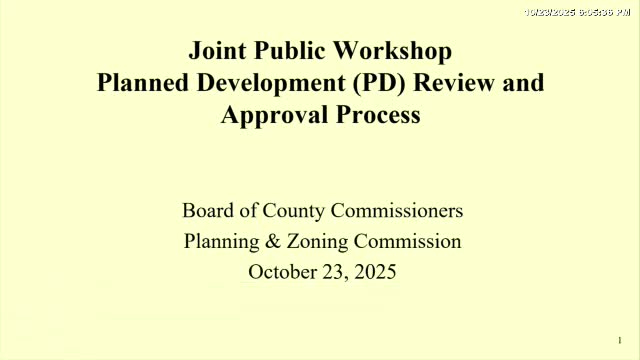
Summary
Indian River County commissioners and Planning & Zoning held a joint workshop Nov. 18 to seek consensus on rewriting parts of the county's plan-development (PD) rules, prioritizing a formal definition of "public benefit" and steps that would steer waivers, affordable-housing incentives and procedural notice.
Indian River County commissioners and members of the county Planning & Zoning Commission met in a joint workshop on Nov. 18 to seek shared policy direction on rewriting parts of the county's plan-development (PD) rules, concentrating first on how the county defines a "public benefit" and how that definition should affect waivers and incentives for developers.
Staff framed the discussion as an effort to update a PD ordinance adopted around 1990 and used to approve more than 50 PD projects over the past three decades. "The preeminent topic of discussion for plan developments, at least in recent years, is what is a public benefit," said Ryan, county planning staff, who led the presentation. He told the two boards that staff intends to return with a drafted definition if the boards give direction.
Why it matters: PDs are the negotiated path that allows developers to request deviations from conventional zoning (lot size, setbacks, lot width and similar standards) in exchange for improvements the county considers to benefit the public. Changes to that definition would affect which projects qualify for those concessions and which kinds of improvements the county prioritizes when it trades regulatory flexibility for community gain.
What staff proposed and what leaders discussed
- Defining "public benefit": Staff recommended adding an explicit definition to the local development regulations (LDRs) to reduce ambiguity. Current LDR language (referenced by staff as section 90.204) notes that a public benefit should be "proportionate to the degree of exception or variation requested," but it does not define the term. The consultants and staff presented a non-exhaustive list of items historically accepted as public benefits (dedications of right-of-way beyond what is required, off-site stormwater treated at developer expense, off-site traffic improvements exceeding code requirements, conservation set-asides, land dedication for public purposes, upsizing utilities, transit stops with shelters and limited public access for events).
- Items commonly rejected as public benefits: Staff and commissioners agreed that private amenities available only to residents (clubhouses, private amenity packages not open to the public), enhanced entry signage and purely aesthetic features generally do not qualify.
- Relationship to impact-fee credits: County Administrator John Tukanich and staff explained that Florida law requires dollar-for-dollar credits for off-site work that would otherwise be eligible for impact-fee credits, and that credits are applied by category (traffic improvements credit traffic impact fees, water/sewer credits apply to those buckets). That limits how staff can treat some infrastructure as a nonmonetary public benefit.
- Guardrails for waivers and deviations: Staff asked whether the boards want policy direction or code language limiting the degree of waivers (for example, caps expressed as a percentage reduction of minimum lot width or fixed-foot minimums). Multiple commissioners expressed support for setting guardrails rather than leaving unconstrained discretion. Commissioners and P&Z members also voiced that building height should be made explicitly non-waivable through the PD process.
- Affordable and workforce housing: Both boards signaled that affordable housing should be the top public-benefit priority. Staff asked whether meeting a specified affordable-housing threshold should satisfy the public-benefit requirement (and thereby reduce other public-benefit demands); commissioners and several speakers supported that approach in concept and asked staff to craft workable thresholds and timing safeguards so off-site affordable units (if allowed) are delivered in a reasonable timetable.
- Minimum PD project size: Staff reported national practice often centers on a 40-acre minimum for single-family residential PDs and proposed 38 acres as a local starting point (staff noted many original parcels measure slightly under 40 acres). The boards generally supported a minimum in that neighborhood while allowing exceptions to the minimum for projects that deliver set affordable-housing components.
- Compatibility, buffers and setbacks: Commissioners and P&Z members discussed ties between interior lot reductions and additional perimeter buffering, and asked staff to consider either percentage-based or fixed-foot crosswalks (for example, increasing a required buffer when lot widths are reduced). Several members said 5-foot side setbacks (seen in some recent projects) are too narrow and raised 7.5 feet as a more acceptable floor in many contexts; members emphasized the need to evaluate compatibility on a site-by-site basis and to give staff authority to require larger buffers where surrounding lot patterns warrant them.
- Procedural items and notice: The boards generally supported requiring developer-hosted neighborhood meetings after technical review (TRC) and strengthening signage and mailed-notice radii; commissioners asked that staff calculate reasonable applicant fees for larger signs or broader mail notice so the county does not carry all incremental costs. County staff and several board members preferred a county-hosted project page or a county-managed project posting rather than asking each applicant to maintain a stand-alone project website.
Public comment and stakeholder input
Developers, builders and residents were active during the public-comment portion and at times during the policy discussion. Deb Robinson, vice president of Laurel Homes and Laurel Builders, urged caution about expanding requirements because "every rule you add, every single foot you add to the buffer restricts how many units you can build, which means they've got to cost more." She said lengthy regulatory processes and added standards raise prices and make workforce housing more difficult to deliver.
Nick Schroth, a commercial broker, and other private-sector speakers urged staff and the boards to reduce timing and uncertainty in the entitlement process, saying long lead times and unpredictable requirements drive land prices higher and make development costs—and ultimately home prices—rise.
Other commenters urged stronger protections for existing farmland and conservation set-asides, and said Indian River County should not emulate larger, high-growth neighboring counties.
Consensus and next steps
- Staff was asked to draft a formal definition of "public benefit" and return with proposed code language or policy options for the commission and P&Z to review.
- Commissioners and P&Z agreed staff should return to the joint group with stakeholder outreach; staff proposed a follow-up, public stakeholders meeting for detailed discussion of the six topics and to show draft language. A tentative date discussed in the workshop was a follow-up joint meeting in late January (staff will confirm timing after accommodating holiday schedules and stakeholder availability).
- No formal votes or code amendments were adopted at the workshop. The meeting was explicitly a consensus-seeking workshop; any ordinance changes would come back through the formal public hearing processes at P&Z and the Board of County Commissioners.
What staff will bring back: a draft definition of "public benefit," options for waiver guardrails (percent or fixed-foot limits), recommendations on minimum PD project size with affordable-housing exceptions, suggested buffer/compatibility guidelines, and proposed procedural changes for neighborhood meetings and notice. Staff also will study how to operationalize an affordable-housing priority so that timing, delivery and enforcement protections are built into any incentive.
Ending
County officials described the workshop as the first of several planned joint meetings to align policy and provide clearer expectations for applicants, neighbors and staff. "We need to be able to communicate and understand the parameters," Commissioner Joe Ehrman said during the meeting, urging clearer rules and faster, predictable processes for both the public and applicants. Staff will return with drafted language and a stakeholder forum for the boards to consider before any formal ordinance amendments are introduced.