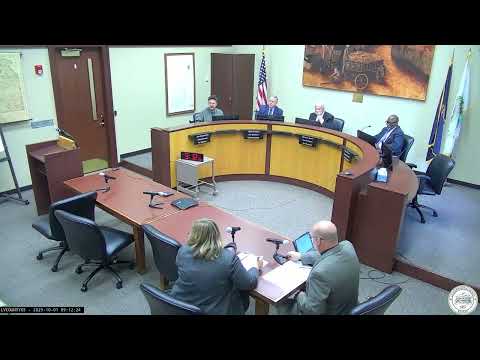
Commission holds work session on zoning regulation changes; commissioners ask for more time and specific edits
Loading...
Summary
County planning staff presented a package of zoning-text amendments covering multiple topics, including R-1 density near cities, special-use-permit transfer rules, garage-sale definitions and subdivision housekeeping; commissioners asked for more review time and targeted edits.
Leavenworth County planning staff presented a broad set of proposed zoning-code amendments during a work session that would revise or clarify multiple sections of the county’s zoning and subdivision regulations. Commissioners and staff discussed roughly 15 discrete changes; no ordinance or final action was taken and staff was directed to return with revisions and additional information.
Staff said the package includes: a definition of “garage sale” to prevent flea-market‑style activity where not intended; insertion of plan and zoning-district language adopted in 2019 that never made it into the regulations (a housekeeping item); new parameters limiting where the R-1 residential district may be recommended when reliant on septic systems (staff proposed a 1,500‑foot buffer from city limit lines to concentrate higher densities near cities where sewer utilities are expected); clarifications on whether small ponds and embankments should require building permits; measurement of lot frontage on cul‑de‑sacs and curved streets (allowing minimum road frontage to be measured at the building setback line for pie-shaped lots); and subdivision-regulation housekeeping (repeal of obsolete lot-depth language and easement clarifications).
Staff also discussed special-use permits (SUPs). After earlier Board direction, text now clarifies that SUPs do not automatically transfer to new owners. Commissioners debated options: some said the SUP should transfer automatically to a buyer if the use remains substantially the same, while others preferred retaining the board’s 2024 decision that SUP rights do not transfer on conveyance. Staff proposed an administrative notice-of-transfer process and the board asked staff to return with language making a transfer-of-rights an administrative process when the proposed use remains the same; substantial changes would require reapplication and a hearing.
The draft also includes language allowing the commission to require licensed professional security staff for certain events or SUPs when law enforcement presence would otherwise be required. County counselor Misty Brown said adding the language to the regulations gives notice to applicants that security may be required and leaves room for a later policy to define specifics.
Other items discussed included a proposal to remove the family homestead exemption procedure because staff finds it difficult to track and enforce; and a proposed “lot‑tie” agreement process to allow owners to legally tie two adjacent platted lots together (filed with the register of deeds) so an accessory building may be placed on one lot while the primary structure remains on the other, avoiding a formal replat in many cases.
Several commissioners asked for more time to review the redlines and recommended adjusting front-setback language that now measures setbacks in some places as 105 feet from the centerline of the road. Commissioners asked staff to explore setting setbacks by road classification and measuring from the back of right-of-way rather than a fixed centerline distance. At least one commissioner said he preferred the board have more time to study the package; staff agreed to bring edited language back to the commission before any formal adoption or a public hearing.