Enterprise staff pushes permitting for utility work; water-main projects to continue into next year
Get AI-powered insights, summaries, and transcripts
Sign Up Free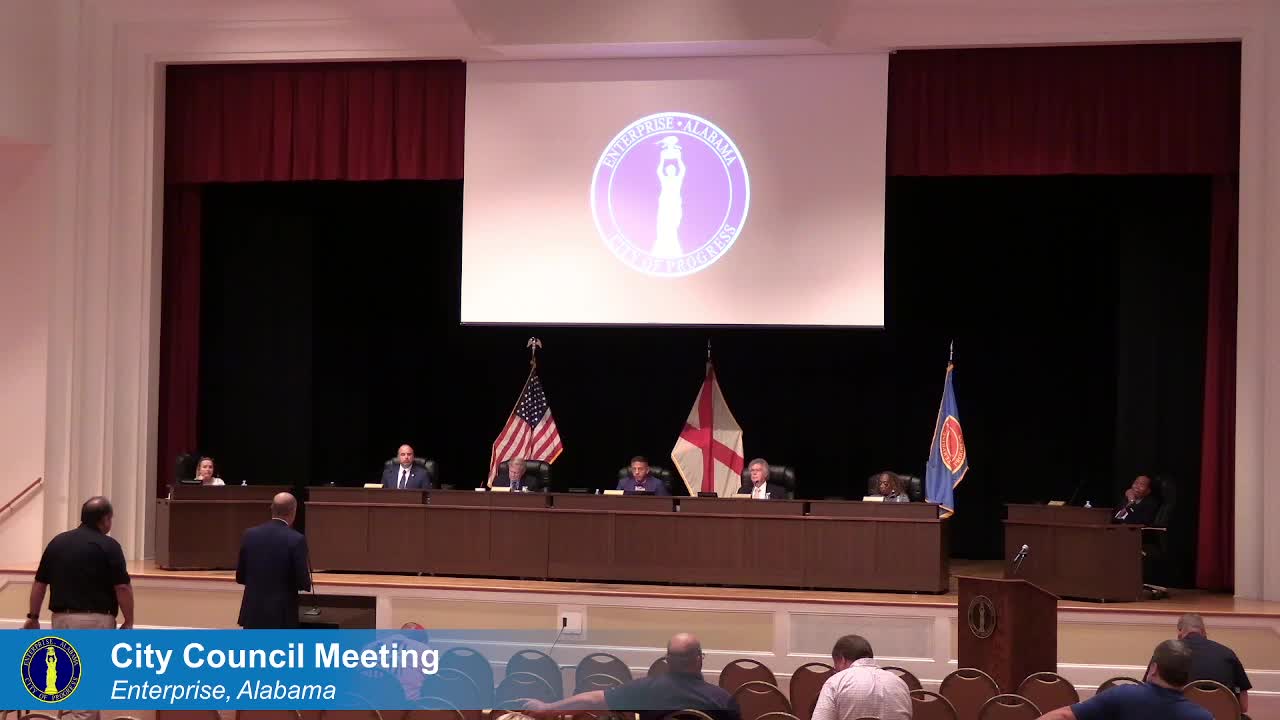
Summary
City staff told the council Oct. 7 that water main replacements on Alberta, Daleville and Weeda streets will continue into next year and proposed a permitting process for utilities working in city right-of-way to improve communication and quality control.
Enterprise city staff reported progress and problems on a multi-year water-main replacement program and recommended a new permitting process for private utilities working in city right-of-way to improve communication and project closeouts.
Barry Mott, city engineer and public works director, told the council crews have patched Alberta Street and expect to finish dress-up and patching on adjacent segments within days; Daleville and Weeda patches were scheduled for the following week. Mott said the work often requires keeping the existing main in service while crews install and test the new main, then perform service line conversions and "cut and kill" the old lines; that sequence lengthens the time before final road patching.
Mott and other staff described two types of situations: full main replacements, which are disruptive and require temporary service arrangements and final pavement repairs, and isolated service-line replacements, which are less disruptive because many service runs can be bored under pavement without open cuts. They also described warranty and punch-list processes: contractors must establish vegetation and address punch-list items, and standard warranty periods commonly last one year for completed projects.
During discussion the council and staff raised community complaints about limited advance notice when private utilities, including fiber-optic contractors, enter neighborhoods and cut lawns or trench through yards. Mott proposed creating a municipal permit process for utility work in the city's right-of-way that would require affected companies to provide a scope, schedule, erosion control plans and contact information; the permitting process would be patterned on ALDOT's utility permit practices and would exempt emergency repairs. "If you're going to dig up half the street and you're going to replace water, are you going to pave the street back?" Mott asked. "At least we could have those conversations and you would know."
Council members responded that a permitting process would improve communications and reduce the number of resident calls staff must chase reactively. The council asked staff to bring the permitting concept to a future work session and to consider adding that to the fourth-quarter goals list so that staff can develop a proposed ordinance or administrative process.
Why it matters: The water-main program is a multi-million-dollar, multi-year investment (staff noted borrowing roughly $20 million for water-line replacements). A permit process for non-city utilities aims to reduce homeowner complaints, protect pavement and yards, and ensure work is closed out and warranted.
What's next: Staff will prepare a permitting proposal for review at a work session and add the item to Q4 planning if the council agrees. The engineering department will continue inspection and punch-list oversight on Alberta, Daleville and Weeda streets and coordinate with contractors on vegetation and warranty enforcement.