
State Radio seeks one‑time SIF funds for message switch, siren logger and NDIT O&M costs
Get AI-powered insights, summaries, and transcripts
Subscribe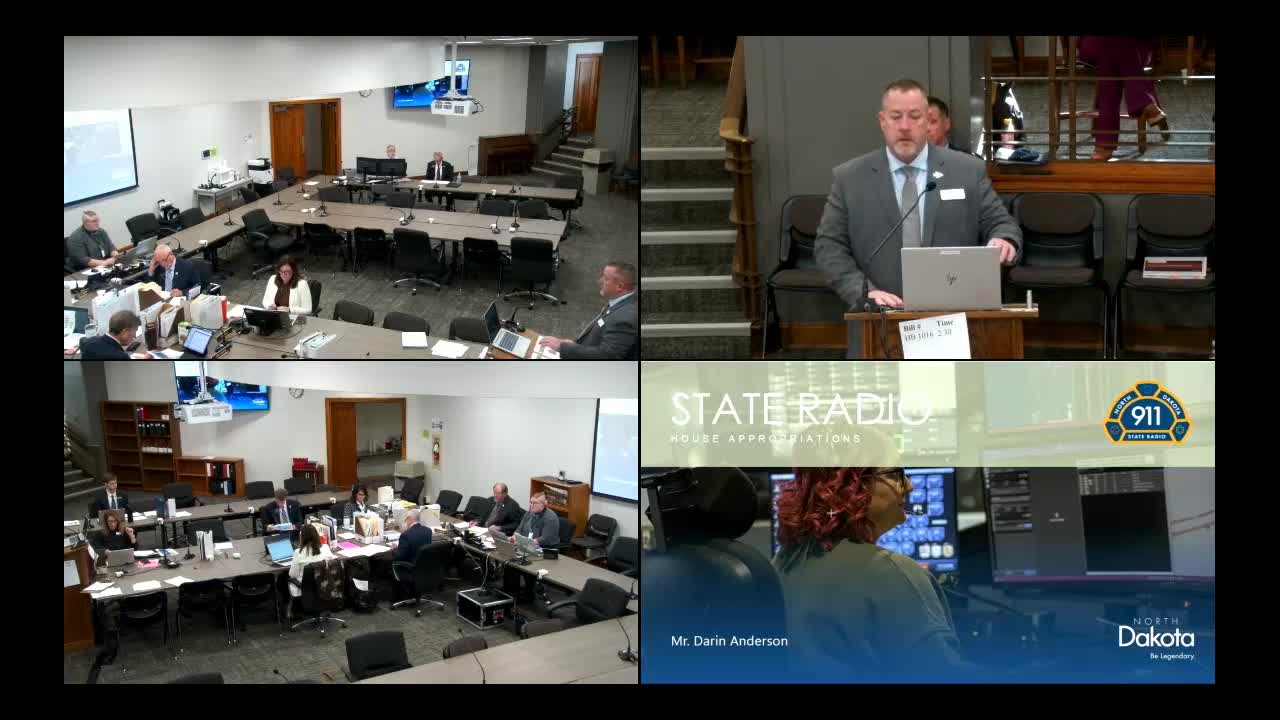
Summary
State Radio requested three budget initiatives in House Bill 1016: $525,000 for a redundant message‑switching system, $495,000 one‑time for logger/tower upgrades tied to the statewide radio transition, and $509,000 for NDIT operation and maintenance costs; committee members pressed on alternative funding sources and county impacts.
Darren Anderson, director of State Radio at the Department of Emergency Services, told the Government Operations section that State Radio operates 24/7 dispatch support for 26 counties and manages the statewide law‑enforcement message switch used for driver‑license and background queries.
Anderson emphasized the volume and risk: roughly 7 million queries per month run through the message‑switch system. He said the system currently contains single points of failure and described Idaho’s recent outage as an example, where a multi‑day outage prompted emergency spending. State Radio asked for $525,000 in one‑time State Infrastructure Funds (SIF) to replace or add redundancy to the message switch.
On a second initiative, Anderson requested $495,000 in one‑time SIF funds to upgrade a logging/recording system required by the new statewide radio system (siren/siren-compliant radio integration), acquire tower trailers and compatible handheld radios for evacuation and backup operations. He told the committee no federal grant option was available for that recording purchase.
A third ask sought roughly $509,000 to cover North Dakota Information Technology (NDIT) operation and maintenance costs identified after State Radio had already published rate schedules for counties; Anderson said NDIT costs amount to about 21% of State Radio’s budget and the additional $509,000 represented an unanticipated 5% increase.
Committee members pressed about alternative funding sources for the siren/radio work, including potential use of BEAD broadband funds; Anderson said BEAD was categorized as broadband and that the radio (RF) nature made BEAD eligibility uncertain but he and the department would continue to coordinate with NDIT. Representatives also asked how local jurisdictions fit into costs and whether NDIT would count ongoing maintenance funds twice; State Radio responded that local jurisdictions and NDIT budget processes would be addressed in follow‑up and that the department would return with clarifications.
No committee vote occurred; the department was asked to provide additional detail, including a line‑item spreadsheet and clarification of grant/carryover balances.