
Subcommittee advances bill clarifying confiscation of nicotine and hemp products from under‑21s; substitute to appropriations
Get AI-powered insights, summaries, and transcripts
Subscribe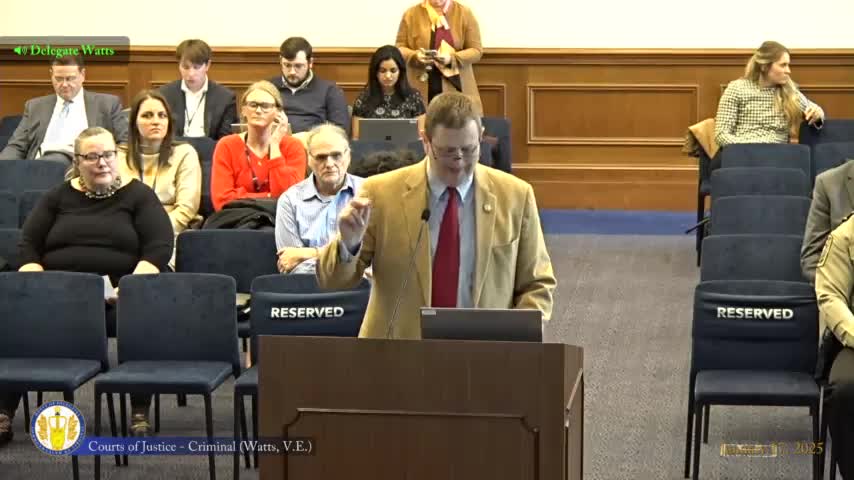
Summary
A substitute for HB 1946 (which incorporated HB 1558) clarifies that possession of retail tobacco and nicotine vaping products by persons under 21 can be confiscated and sets a streamlined seizure/destruction process; the subcommittee adopted technical line amendments and recommended reporting and referral to the Appropriations Committee.
Delegate Hope presented the substitute for HB 1946 (as amended to incorporate HB 1558) to the House Criminal Law Subcommittee on Jan. 17. The substitute narrows the proposal to focus on confiscation of nicotine vaping and retail tobacco products possessed by persons under 21 and clarifies cross‑references to the Code. The bill builds on last year’s licensing framework for retail and vape shops and aims to give law enforcement and schools authority to confiscate these products even though civil penalties for juveniles were removed in prior legislation.
Substitute language adds a cross reference to Code § 15.2‑912.4 and changes the seizure/destruction procedure to mirror the destruction code section used for controlled substances; that avoids a lengthy forfeiture‑style circuit‑court filing for the routine destruction of contraband. Counsel explained the substitute replaces a forfeiture‑style process with seizure upon lawful discovery and a later court order to destroy, and the substitute clarifies that seizure of the contraband is the sole penalty (preventing an unintended Class 1 misdemeanor under the general penalty provision).
Staff and counsel identified drafting fixes; the subcommittee agreed to strike references to purchase or attempt to purchase so the statutory language focuses solely on possession by persons under 21. Law‑enforcement testimony emphasized increased use of vapes in schools after civil penalties were removed: Lieutenant Deontay Diggs (Stafford County Sheriff’s Office, Juvenile Services) said schools saw increased vaping and that civil penalties’ removal reduced options for diversion and parent‑mandated education. Elizabeth Hobbs of the Virginia Sheriffs Association registered support. Public‑health groups (American Heart Association and American Cancer Society’s advocacy arm) registered concerns about criminalizing youth and urged exploring regulatory alternatives (flavor bans, enforcement at retail). Delegate Hope stressed the bill contains no new civil penalties for juveniles; it only permits confiscation and retains an existing $25 penalty that already exists under current law for possession on school property.
After adopting the substitute and the line amendments, the subcommittee voted to report the substitute as amended and to refer HB 1946 to the Appropriations Committee for further consideration.