
House panel weighs study of carbon pricing impacts; committee later votes ITL
Get AI-powered insights, summaries, and transcripts
Sign Up Free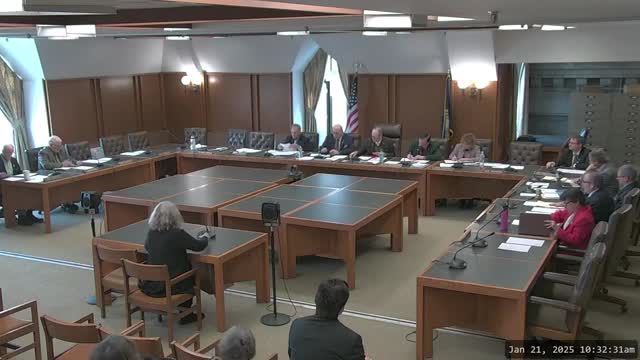
Summary
The Science, Technology and Energy Committee heard hours of testimony on House Bill 306, a proposal to create a commission to study how regional or national carbon pricing would affect New Hampshire. After public testimony and executive-session debate the committee ultimately voted 10–8 to recommend Inexpedient to Legislate (ITL).
Representative Wendy Thomas, the bill’s prime sponsor, introduced House Bill 306 and framed it as a preparatory study to examine how national or regional carbon pricing mechanisms might affect New Hampshire citizens, businesses and the environment.
"Carbon pricing is a market based strategy to reduce greenhouse gas emissions by assigning a monetary cost to emitting carbon dioxide and other greenhouse gases," Representative Wendy Thomas told the committee. She said the study would examine short- and long-term effects on energy costs, public health, and economic competitiveness, and would consider how any fees might be returned to residents, businesses and municipalities.
Supporters who testified highlighted examples of existing carbon-pricing programs and their potential benefits. Representative Kat McGee, speaking in support of the study, cited the World Bank’s tally of existing carbon-pricing instruments and said the Regional Greenhouse Gas Initiative (RGGI) returns money to New Hampshire ratepayers. "We have the regional greenhouse gas initiative as an example which is a large emitter cap and trade program here in New England that brings in an excess of $50,000,000 back to New Hampshire each year," McGee said.
Opponents warned of economic costs and political backlash from carbon-pricing policies. Michael Sununu, testifying for himself, said a hypothetical $40-per-ton carbon fee could raise hundreds of millions in New Hampshire and expressed skepticism about how legislatures would manage such funds. "The potential for raising taxes on pretty much every family and business in the state to the tune of at least a half a $1,000,000,000 a year at that level," Sununu said, describing his estimate from a prior presentation.
Other testimony ranged from academic and legal perspectives to municipal and business concerns. Citizens Climate Lobby volunteer John Gage and other witnesses emphasized that carbon pricing is spreading internationally and urged state planning to avoid stranded assets. The New Hampshire Electric Cooperative, the Public Utilities Commission staff, and the state’s consumer advocate also participated in related hearings on other bills the same day; several speakers urged careful attention to competitiveness and regulatory impacts.
In executive session, Representative Donald Nader moved that HB 306 be recommended Inexpedient to Legislate (ITL); Representative John Bernardi seconded. The clerk recorded the committee vote as 10 in favor, 8 opposed. The committee therefore adopted an ITL recommendation. The committee directed members to file majority and minority reports on the motion.
What happens next: An ITL recommendation from the committee does not immediately kill a bill but means the committee recommends against further legislative action. The House leadership and floor procedures determine whether the bill reaches later stages.