
Senate bill would join interstate social‑work licensure compact to ease mobility and expand behavioral‑health workforce
Get AI-powered insights, summaries, and transcripts
Subscribe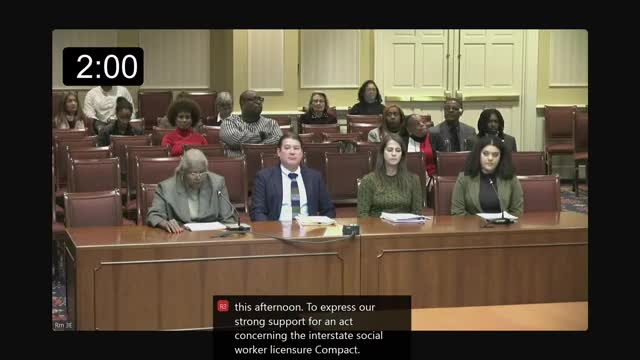
Summary
Senate Bill 174 would make Maryland the 23rd state to join the Interstate Social Work Licensure Compact, allowing eligible social workers to practice across member states under a single multistate license; advocates said the compact will help address a severe behavioral‑health workforce shortage.
Senate Bill 174 would enroll Maryland in the Interstate Social Work Licensure Compact, granting eligible social workers a multistate license that allows practice in member states without separate endorsement procedures.
Sponsor testimony emphasized mobility benefits for military families and continuity of care for clients who relocate. “The compact’s goals are to eliminate barriers to practice and client care, give social workers mobility and support relocating military spouses,” sponsor Sen. Cheryl Benson told the committee.
The National Association of Social Workers’ Maryland chapter, clinical associations and behavioral‑health providers urged passage. Carissa Proctor of NASW‑Maryland said the compact “breaks down barriers like high costs and long application processes” and helps retain and recruit practitioners. Mental Health Association of Maryland and a coalition of nonprofits noted a recent MHCC workforce study finding Maryland’s behavioral‑health workforce roughly half the size needed today and significant projected departures in coming years; advocates argued the compact is a fiscally prudent, immediate step to bolster capacity.
The compact preserves state regulatory authority: member states retain jurisdiction over practice standards and discipline, and compact applicants must hold an active, unencumbered home‑state license, meet compact education and exam requirements, undergo a background check and pay fees. The Council of State Governments’ compact office testified about model language and the national data system used to verify license status.
Ending: Advocates urged a favorable report; stakeholders said the compact complements broader workforce development efforts and would speed hiring and cross‑jurisdictional care delivery.